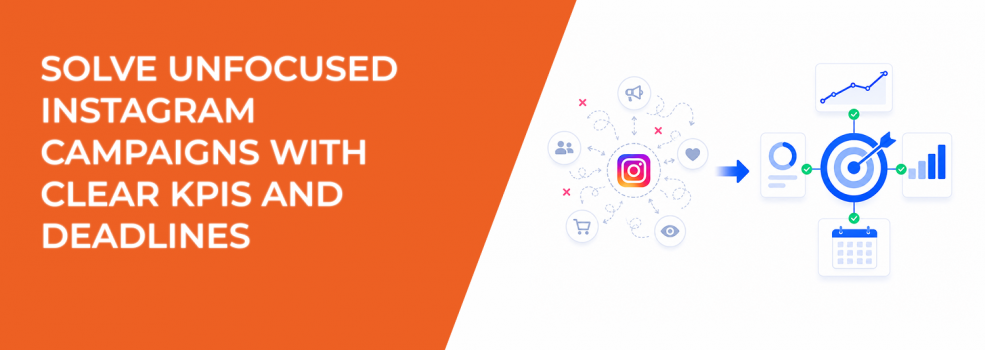
Many Instagram campaigns become chaotic because nobody defines success properly before launch.
The campaign starts spending budget, metrics begin fluctuating, and teams react emotionally to every change inside Ads Manager. CTR rises slightly, so budgets increase too quickly. CPA jumps for two days, so creatives get replaced prematurely. ROAS improves temporarily, so scaling begins before the campaign stabilizes.
This creates campaigns that constantly change direction without producing reliable optimization patterns.
Most of the time, the issue is not targeting or creative quality. The campaign simply launched without clear KPIs or evaluation deadlines.
Why Instagram Campaigns Lose Focus So Quickly
Instagram ads generate visible engagement signals very fast. That creates a dangerous optimization habit where advertisers start reacting to every available metric instead of focusing on the metrics tied to business outcomes.
Without KPI structure, campaigns often drift toward:
- vanity engagement,
- unstable scaling decisions,
- inconsistent testing,
- and wasted spend on low-intent traffic.
This becomes especially common in Reels and Story placements where engagement metrics appear quickly while meaningful conversion data arrives later. The campaign slowly optimizes around activity instead of profitable user behavior.
What Good Instagram Campaign KPIs Actually Look Like
Useful KPIs create operational clarity. They help advertisers decide whether campaigns are improving, whether scaling makes sense, and whether optimization changes are helping or hurting performance.
Weak KPIs are usually too broad:
- “increase awareness,”
- “improve engagement,”
- or “get more traffic.”
Strong KPIs define measurable business outcomes instead.
For example:
- maintain CPA below €45,
- achieve 3.0 ROAS within 14 days,
- generate qualified leads under a target CPL,
- or improve landing page conversion rate by 20%.
These benchmarks improve campaign management immediately because success becomes measurable instead of subjective.
Why Deadlines Prevent Endless Optimization Cycles
One of the biggest reasons Instagram campaigns lose efficiency is that advertisers never define when evaluation should happen.
Campaigns remain active indefinitely while teams continue making small adjustments based on incomplete data. That creates constant learning instability because Meta keeps reprocessing changing signals.
Deadlines solve this problem by creating fixed evaluation windows.
For example:
- evaluate CPA after seven days,
- review creative fatigue after frequency reaches a threshold,
- or assess scaling performance after 50 optimization events.
This creates cleaner optimization cycles and prevents advertisers from making premature decisions based on temporary volatility.
That is why evaluating campaign performance during the first 24 hours should look very different from evaluating a campaign after a full learning cycle.
KPI Structure Reduces Reactive Campaign Decisions
Campaigns without KPI structure often become emotionally managed.
Teams react to short-term fluctuations instead of trend patterns. CPM rises slightly, so budgets get reduced immediately. CTR falls temporarily, so creatives get paused too early. ROAS spikes for one day, so scaling begins aggressively without stable supporting data.
This reactive behavior damages optimization stability because campaigns never collect consistent learning signals.
Strong KPI frameworks reduce unnecessary changes because performance thresholds were already defined before launch. That makes it easier to separate temporary volatility from real performance deterioration.
Why KPI Discipline Improves Creative Testing
Creative testing becomes unreliable when campaigns lack stable benchmarks.
One creative may generate cheaper clicks while another produces better downstream conversion quality. Without KPI clarity, advertisers often scale the wrong ad because they focus on visible engagement metrics instead of business outcomes.
This is one reason many Instagram campaigns generate impressive interaction metrics while producing weak revenue performance.
Clear KPIs help advertisers evaluate creatives against the result that actually matters. That creates cleaner testing systems and more reliable scaling decisions over time.
Deadlines Also Protect Budget Efficiency
Campaigns without time constraints often continue spending long after performance problems become obvious.
This usually happens when advertisers keep “waiting for the algorithm” without measurable evaluation thresholds. Budgets continue running while CPA rises, conversion quality weakens, and frequency increases across the same audience segments.
Strong deadlines make optimization decisions more disciplined. They help determine:
- when campaigns deserve more spend,
- when ad sets should stabilize,
- and when performance has clearly failed.
That is why knowing when to pause or scale ad sets becomes much easier once KPI benchmarks and timelines are predefined.
Too Many Metrics Often Create Worse Decisions
Many advertisers track too much data simultaneously. That creates optimization paralysis where teams monitor dozens of disconnected metrics without identifying which numbers actually predict business outcomes.
This becomes especially dangerous during scaling because advertisers begin optimizing around isolated metrics instead of system-level performance.
That is why tracking campaign performance without metric overload creates more stable optimization environments. A small group of meaningful KPIs usually produces better decisions than oversized reporting dashboards filled with secondary metrics.
Focused Instagram Campaigns Need Operational Boundaries
Strong Instagram campaigns do not rely on constant intervention. They rely on structured evaluation systems that reduce guesswork during optimization.
Clear KPIs define what matters. Deadlines determine when decisions should happen. Together, they create more stable campaign learning conditions and reduce reactive optimization behavior.
Without those boundaries, campaigns usually drift between random edits, unstable scaling, and inconsistent reporting. The more clearly success gets defined before launch, the easier Instagram campaigns become to optimize later.