Spring often brings renewed sales targets, expanded campaigns, and larger acquisition budgets. With additional investment comes higher expectations: more leads, faster outreach, and measurable revenue growth. However, scaling prospecting and outbound operations without reinforcing performance infrastructure can quickly erode ROI.
The Reality of Spring Budget Expansion
Across B2B organizations, Q2 frequently marks a budget release cycle aligned with annual revenue acceleration plans. Industry benchmarks show that:
-
Companies increasing outbound spend by 20–40% in Q2 often expect pipeline growth of 30% or more.
-
Sales teams that scale campaigns without improving data quality experience up to 25% higher bounce rates.
-
Poor segmentation during expansion phases can reduce response rates by 15–28%.
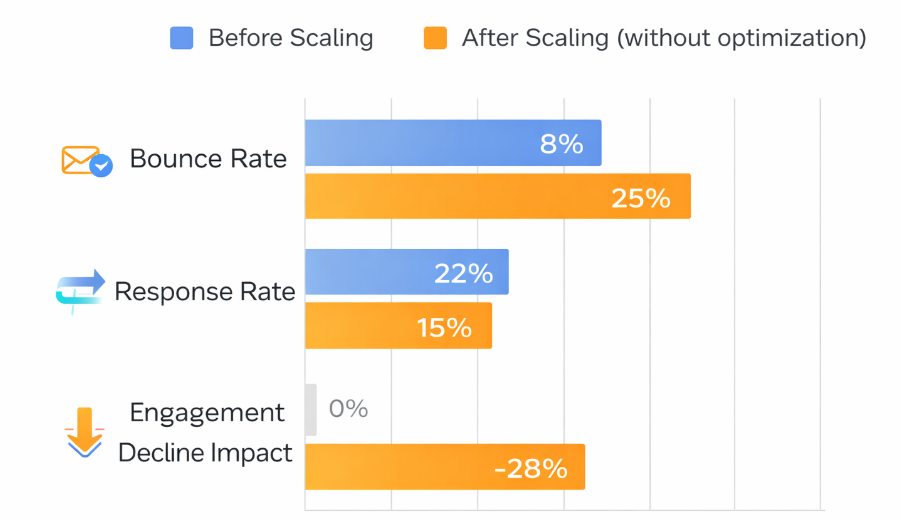
Comparing key outbound performance metrics before and after scaling without optimization reveals increased bounce rates and lower engagement
Budget growth alone does not guarantee performance gains. Scaling multiplies both strengths and weaknesses in your current system.
The Core Risks of Rapid Scaling
1. Data Degradation
When campaign volume increases, the demand for accurate contact and company data grows proportionally. If enrichment and validation processes are not reinforced, deliverability and engagement suffer.
2. Infrastructure Bottlenecks
Outbound automation platforms, CRM workflows, and enrichment pipelines may not be configured for higher throughput. Without load testing and process audits, performance slows or fails under pressure.
3. Audience Saturation
Expanding spend without expanding targeting sophistication often results in repeated exposure to the same limited segment, driving fatigue and declining engagement.
4. Misaligned ICP Expansion
Scaling sometimes pushes teams to widen targeting criteria too aggressively. This dilutes lead quality and inflates acquisition cost per opportunity.
Strategic Framework for Scaling Without Performance Loss
1. Strengthen Data Foundations First
Before launching larger campaigns:
-
Audit data accuracy and freshness.
-
Validate email deliverability at scale.
-
Standardize segmentation logic across teams.
-
Remove duplicate and stale records.
High-growth organizations treat data hygiene as infrastructure, not maintenance.
2. Scale Segmentation, Not Just Volume
Instead of sending more messages, increase segmentation granularity:
-
Segment by company size tiers.
-
Segment by growth signals and hiring patterns.
-
Segment by technology stack.
-
Segment by engagement behavior.
Advanced segmentation can increase response rates by 20–50% compared to broad outreach.
3. Automate Enrichment Workflows
Manual prospect research becomes unsustainable at higher volumes. Automated enrichment pipelines ensure:
-
Real-time company data updates.
-
Role-based contact validation.
-
Trigger-based campaign enrollment.
Automation reduces human error and preserves speed without sacrificing precision.
4. Expand ICP Methodically
If expanding targeting criteria, do so in controlled cohorts:
-
Test adjacent industries separately.
-
Pilot new geographic markets before full rollout.
-
Analyze conversion by micro-segment.
Scaling without structured experimentation often hides inefficiencies.
5. Protect Deliverability and Domain Health
Outbound scale increases email reputation risk. Protect performance by:
-
Gradually warming new domains.
-
Monitoring bounce and spam complaint rates.
-
Distributing volume across multiple inboxes.
-
Maintaining list hygiene thresholds below 3% hard bounce.
Deliverability failures can collapse performance within days.
Operational Metrics That Must Be Tracked During Expansion
During scaling phases, track leading indicators weekly:
-
Bounce rate
-
Reply rate
-
Meeting conversion rate
-
Cost per qualified lead
-
Sales cycle length
-
Pipeline-to-close ratio
A sudden spike in volume combined with declining reply rates typically signals segmentation or targeting drift.
Infrastructure Readiness Checklist
Before increasing spend, confirm:
-
CRM automation workflows are optimized.
-
Data enrichment is automated and monitored.
-
Campaign reporting dashboards reflect real-time performance.
-
Team capacity matches projected lead flow.
-
A/B testing processes are formalized.
Performance degradation usually occurs when demand grows faster than operational systems.
Scaling With Intelligence, Not Just Investment
Budget increases should amplify precision, not noise. The highest-performing teams approach scaling as a systems engineering challenge:
-
Reinforce data architecture.
-
Optimize segmentation depth.
-
Automate intelligently.
-
Monitor aggressively.
-
Expand experimentally.
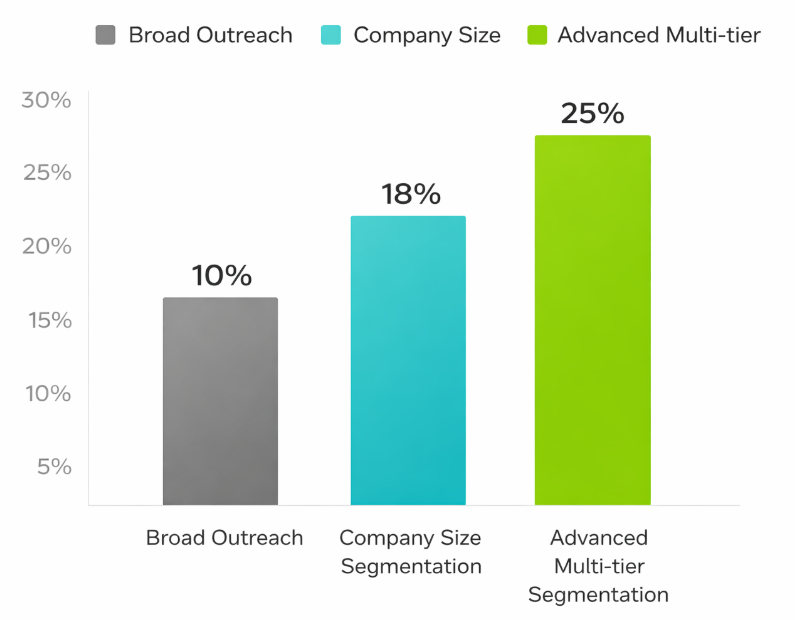
Response rates increase significantly when moving from broad outreach to advanced segmentation strategies
Growth is not about sending more emails. It is about sending the right message to the right audience at higher velocity without compromising quality.
Recommended Reading
Scaling during spring budget expansion can create disproportionate revenue acceleration when executed systematically. Organizations that treat performance infrastructure as seriously as budget allocation consistently outperform those that focus on spend alone.