For many B2B and B2C advertisers, Q1 performance is shaped by conservative budgets, post-holiday slowdowns, and strategic testing cycles. By contrast, Q2 historically brings increased buyer activity and improved engagement rates.
Recent industry benchmarks show:
-
Paid social ad spend increases by 12–18% in Q2 compared to Q1 across major platforms.
-
CTRs improve by approximately 8–11% as seasonal campaigns refresh creative environments.
-
Cost-per-lead (CPL) declines by 5–9% when advertisers rotate new creatives after 90+ days of static messaging.
-
Campaigns using refreshed audience exclusions see up to 15% improvement in conversion efficiency.
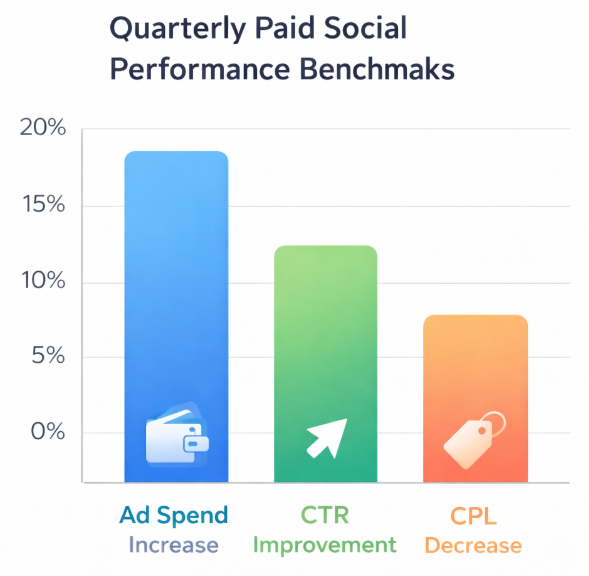
Comparison of key paid social metrics between Q1 and expected performance in Q2
Spring is not just about launching new campaigns. It is about systematically auditing what deserves renewed budget allocation and what should remain paused.
What to Turn Back On
1. High-Intent Retargeting Pools
Retargeting audiences that were deprioritized during budget tightening often contain warm prospects accumulated over several months.
Re-enable:
-
Website visitors from the last 180 days
-
High-engagement video viewers (50%+ completion)
-
CRM-based segmented lists
-
Form abandoners
Before relaunching, refresh creative assets and tighten frequency caps to prevent fatigue.
Performance note: Retargeting campaigns typically generate 2–3x higher conversion rates than cold acquisition campaigns when properly refreshed.
2. Lookalike Audiences Built from Q4 and Q1 Converters
If you paused expansion campaigns earlier in the year, now is the time to relaunch lookalike segments derived from:
-
Closed-won customers
-
Qualified leads
-
High-LTV cohorts
Use narrower similarity thresholds (1–3%) before scaling outward. In competitive verticals, refined lookalikes consistently outperform broad targeting by 10–20% in CPA efficiency.
3. Evergreen Lead Magnets with Proven CVR
Review assets that historically delivered strong conversion rates but were paused due to budget reallocation.
Turn back on:
-
Industry reports
-
Benchmark guides
-
ROI calculators
-
Webinar replays with sustained engagement metrics
However, update landing page messaging to reflect current market conditions. Even minor headline adjustments can increase CVR by 6–12%.
4. Campaigns Paused Due to Budget Constraints (Not Performance)
Audit Q1 campaign data and isolate initiatives that were paused strictly due to budget redistribution.
If the campaign:
-
Delivered stable CPL
-
Maintained acceptable CTR
-
Produced qualified pipeline
It deserves structured reactivation.
What to Leave Off
1. Fatigued Creative Sets
If frequency exceeded 3.5–4.0 and CTR declined consistently over a 30-day period, do not reactivate those assets without revision.
Creative fatigue is one of the primary drivers of rising CPM and declining conversion rates. Replace, do not recycle.
2. Broad Targeting Without Intent Signals
Spring resets should prioritize precision. Broad campaigns lacking behavioral filters often dilute budget efficiency.
If a campaign cannot demonstrate:
-
Clear ICP alignment
-
Qualified lead contribution
-
Stable cost efficiency
It should remain inactive until strategically redesigned.
3. Underperforming Platform Experiments
If certain placements or emerging channels consistently underperformed benchmarks by more than 20%, resist the temptation to “give them another try” without structural changes.
Spring optimization requires discipline, not optimism.
The Spring Audit Framework
To operationalize the reset, apply this structured evaluation model:
-
Segment campaigns into four buckets:
-
Scale
-
Optimize
-
Test
-
Retire
-
-
Compare Q1 performance against:
-
Historical seasonal benchmarks
-
Industry CPL averages
-
Pipeline contribution metrics
-
-
Validate tracking integrity:
-
Attribution model accuracy
-
CRM sync consistency
-
Pixel health
-
-
Refresh creative before scaling budgets.
Advertisers who conduct formal quarterly audits report up to 22% higher marketing efficiency ratios compared to those making reactive optimizations.
Budget Reallocation Strategy for Q2
A disciplined reactivation model typically follows this allocation pattern:
-
40% to proven performers
-
30% to retargeting and high-intent pools
-
20% to scaled lookalikes
-
10% to controlled experimentation
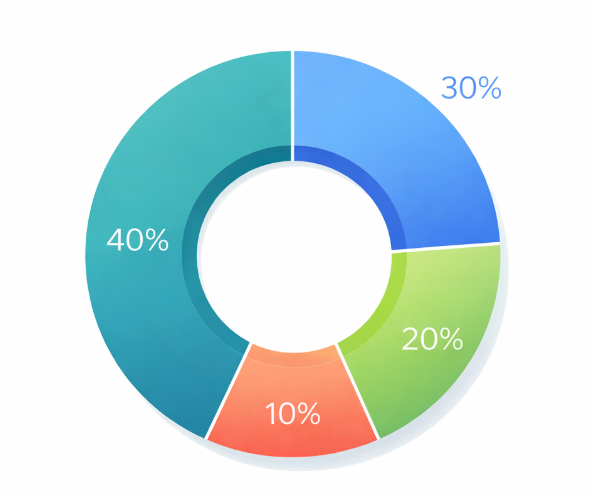
Recommended distribution of paid social budgets for optimal seasonal performance
This distribution maintains performance stability while allowing controlled expansion.
Final Considerations
Spring resets are not cosmetic adjustments. They are structural recalibrations based on data maturity from prior quarters.
Turn back on what has validated ROI.
Leave off what consumed budget without strategic return.
Refresh creative before increasing spend.
Prioritize intent over reach.
Paid social performance compounds when decisions are governed by evidence rather than habit.
Recommended Reading
To further refine your paid social strategy, consider reading:
A structured seasonal reset today positions your campaigns for sustained performance growth throughout Q2 and beyond.