Performance marketing is often associated with rapid results: immediate clicks, conversions, and measurable return on ad spend (ROAS). While short-term performance campaigns can deliver quick wins, organizations that rely exclusively on them frequently encounter diminishing returns, rising acquisition costs, and unstable revenue streams.
Sustainable performance marketing, by contrast, integrates paid acquisition with retention, brand equity, data infrastructure, and lifetime value optimization. The difference between the two approaches is not merely tactical — it is structural, financial, and strategic.
This article breaks down the operational and financial distinctions between short-term and sustainable performance marketing, supported by relevant industry data.
What Is Short-Term Performance Marketing?
Short-term performance marketing focuses on immediate, measurable outcomes within compressed timeframes. Typical objectives include:
-
Rapid lead generation
-
Promotional campaign spikes
-
Seasonal revenue boosts
-
Quick customer acquisition targets
These campaigns are often heavily dependent on paid media channels such as search and social advertising, with success measured primarily through:
-
Cost per acquisition (CPA)
-
Return on ad spend (ROAS)
-
Conversion rate
-
Short-term revenue lift
Characteristics of Short-Term Strategy
-
Budget allocated for rapid testing and scaling
-
Minimal emphasis on brand building
-
Limited lifecycle marketing integration
-
Optimization primarily at the ad and landing page level
While effective for product launches or time-sensitive promotions, this approach becomes risky when used as a permanent growth engine.
Limitations of Short-Term Performance Marketing
1. Rising Acquisition Costs
Customer acquisition costs have increased significantly across major advertising platforms. Industry research shows that digital advertising costs have risen more than 60% over the past five years in many competitive industries.
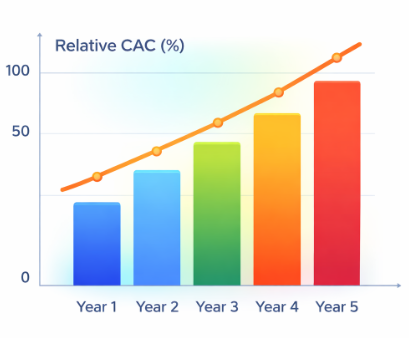
Customer acquisition costs have risen sharply over the last five years, highlighting the growing expense of short-term performance-only strategies
Without improvements in retention or lifetime value (LTV), increasing CPA directly compresses margins.
2. Diminishing Returns
Paid channels eventually reach audience saturation. Frequency increases, click-through rates decline, and incremental conversions become more expensive.
3. Revenue Volatility
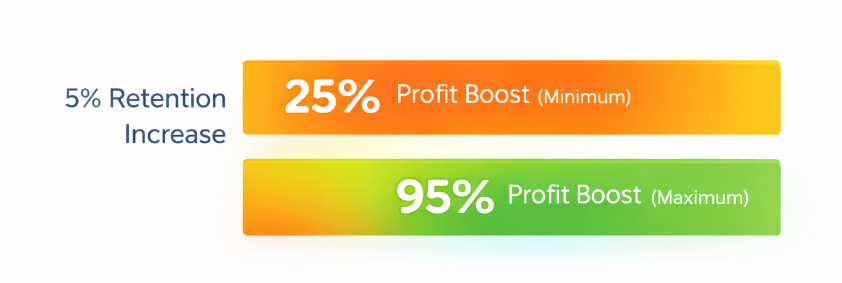
Small improvements in retention can yield disproportionately large increases in profitability
When performance depends solely on paid media spend, revenue fluctuates directly with budget. Reducing spend often results in immediate lead or sales decline.
4. Ignoring Customer Lifetime Value
Acquiring customers without optimizing post-conversion experience leads to low repeat purchase rates. Studies show that increasing customer retention by just 5% can increase profits by 25% to 95%, depending on industry.
What Is Sustainable Performance Marketing?
Sustainable performance marketing is an integrated, full-funnel strategy that balances immediate conversion goals with long-term profitability.
It aligns paid acquisition with:
-
Customer lifetime value modeling
-
Retention and remarketing systems
-
First-party data infrastructure
-
Brand demand generation
-
Conversion rate optimization at scale
Instead of asking, "How many conversions can we buy this month?" sustainable performance marketing asks, "How do we increase profitable customer acquisition while compounding revenue over time?"
Core Components of Sustainable Strategy
-
LTV-Driven Budget Allocation
Budget decisions are based on projected lifetime value rather than first-purchase revenue. -
Omnichannel Integration
Paid search, paid social, email, CRM automation, and content marketing operate as a unified system. -
Data Infrastructure
First-party tracking, attribution modeling, and predictive analytics guide decision-making. -
Continuous Conversion Optimization
Landing pages, funnels, and user journeys are iteratively tested. -
Retention and Upsell Mechanisms
Email automation, loyalty programs, and remarketing increase revenue per customer.
Financial Comparison: Short-Term vs Sustainable
| Dimension | Short-Term Approach | Sustainable Approach |
|---|---|---|
| Primary KPI | ROAS | LTV:CAC Ratio |
| Budget Focus | Acquisition only | Acquisition + Retention |
| Revenue Stability | Volatile | Compounding |
| Cost Efficiency | Declines over time | Improves with scale |
| Data Usage | Tactical | Strategic and predictive |
High-performing organizations often target an LTV:CAC ratio of 3:1 or higher. Without retention mechanisms, many short-term-focused campaigns struggle to maintain a 1.5:1 ratio over time.
Statistical Evidence Supporting Sustainability
-
Acquiring a new customer can cost five times more than retaining an existing one.
-
65% of a company’s revenue typically comes from existing customers.
-
Companies using advanced personalization strategies generate 40% more revenue than average competitors.
-
Brands that invest consistently in both performance and brand marketing see stronger long-term revenue growth compared to performance-only strategies.
These figures highlight why purely transactional acquisition models become economically fragile.
When Short-Term Performance Marketing Is Appropriate
Short-term strategies are not inherently flawed. They are appropriate when:
-
Launching a new product
-
Clearing inventory
-
Testing market demand
-
Validating messaging
-
Entering new geographic markets
However, they should operate within a broader strategic framework.
How to Transition to Sustainable Performance Marketing
-
Measure True Customer Lifetime Value
Include repeat purchases, retention rates, and churn in financial modeling. -
Improve Post-Conversion Experience
Optimize onboarding, customer support, and remarketing flows. -
Invest in First-Party Data
Reduce dependency on third-party cookies and platform-level attribution. -
Align Marketing and Finance Teams
Budget planning should consider payback periods and contribution margin. -
Diversify Channel Mix
Reduce over-reliance on one acquisition channel.
Strategic Outlook
Organizations that prioritize short-term performance metrics without long-term structure often face plateaued growth and unstable unit economics. Sustainable performance marketing creates compounding revenue systems by integrating acquisition, retention, and data intelligence.
In competitive markets where acquisition costs continue to rise, durable growth depends on profitability per customer — not just cost per click.
Suggested Articles for Further Reading
Short-term campaigns may deliver momentum. Sustainable performance marketing builds enduring growth.