In modern B2B and B2C marketing, lead generation is no longer just about filling the top of the funnel. The real challenge lies in balancing the quantity of leads with their likelihood to convert. While high-volume strategies promise scale, high-quality approaches aim for efficiency and revenue impact.
Understanding the economics behind these two models is essential for making informed decisions about budget allocation, sales alignment, and long-term growth.
Defining High-Quality vs High-Volume Leads
High-volume leads refer to large numbers of prospects generated through broad targeting strategies such as paid ads, content syndication, or mass outreach. These leads typically have lower intent and require significant nurturing.
High-quality leads, on the other hand, are prospects that closely match your ideal customer profile (ICP), demonstrate buying intent, and are more likely to convert within a shorter sales cycle.
The Cost Structure of Lead Generation
Cost Per Lead (CPL)
According to industry benchmarks, average CPL varies significantly by channel:
-
Paid search: $50–$150
-
Content marketing: $30–$100
-
Events and webinars: $150–$500
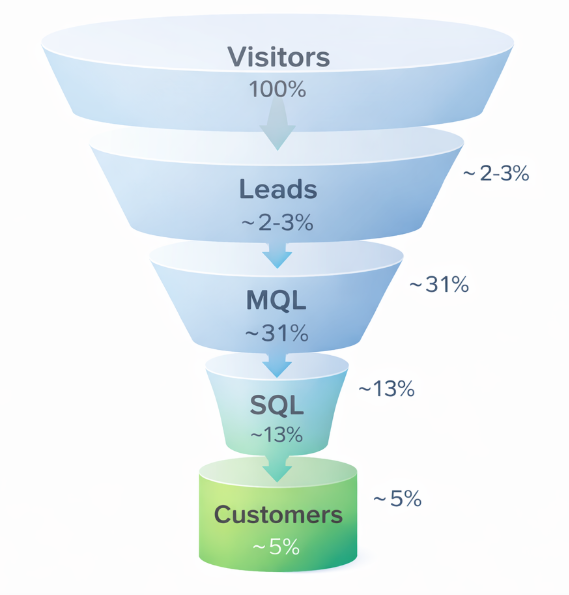
A typical B2B funnel shows dramatic drop-off from initial traffic to customers, demonstrating why high lead volume alone rarely translates into revenue
High-volume strategies often reduce CPL due to scale, but this metric alone can be misleading.
Cost Per Acquisition (CPA)
A more meaningful metric is CPA. Research shows that companies focusing on lead quality can reduce CPA by up to 60%, even if their CPL is higher.
For example:
-
High-volume model: $40 CPL × 5% conversion rate = $800 CPA
-
High-quality model: $120 CPL × 20% conversion rate = $600 CPA
Despite higher upfront costs, the quality-driven approach delivers better economic efficiency.
Conversion Rates and Sales Efficiency
Conversion rate is the most critical differentiator between the two strategies.
-
High-volume leads typically convert at 1–5%
-
High-quality leads can convert at 15–30%
Additionally, sales teams spend up to 50% less time on unqualified prospects when working with high-quality leads, significantly improving productivity and reducing operational costs.
Impact on Sales Cycle Length
Lead quality directly affects how quickly deals close.
-
High-volume leads often require extensive nurturing, resulting in longer sales cycles (3–9 months in B2B contexts)
-
High-quality leads frequently convert faster, reducing sales cycles by 20–40%
Shorter sales cycles improve cash flow and allow organizations to reinvest in growth more rapidly.
Lifetime Value (LTV) Considerations
High-quality leads tend to produce customers with higher lifetime value.
Studies indicate that:
-
Customers acquired through targeted strategies generate 20–50% higher LTV
-
They are more likely to renew, upsell, and refer others
In contrast, high-volume leads often result in lower retention rates and higher churn, eroding long-term profitability.
Marketing and Sales Alignment
A high-volume approach can create friction between marketing and sales teams, as sales representatives must sift through large numbers of low-intent leads.
Conversely, focusing on quality fosters alignment:
-
Marketing targets well-defined segments
-
Sales engages with pre-qualified prospects
-
Feedback loops improve continuously
Organizations with strong alignment achieve up to 36% higher customer retention and 38% higher sales win rates.
When High Volume Makes Sense
Despite its drawbacks, a high-volume strategy can be effective in certain scenarios:
-
Early-stage startups seeking market validation
-
Low-cost, high-frequency products
-
Brand awareness campaigns
In these cases, scale and data collection may outweigh efficiency concerns.
When High Quality Wins
High-quality lead generation is generally superior when:
-
Sales cycles are complex or consultative
-
Deal sizes are large
-
Resources are limited and efficiency is critical
For most B2B organizations, this approach delivers stronger ROI and sustainable growth.
Finding the Right Balance
The optimal strategy is rarely binary. Leading organizations combine both approaches:
-
Use high-volume channels to generate awareness and data
-
Apply filtering, enrichment, and segmentation to identify high-quality prospects
-
Continuously optimize based on conversion and revenue metrics
This hybrid model allows businesses to scale without sacrificing efficiency.
Сonclusion
The economics of lead generation clearly favor quality over sheer volume in most cases. While high-volume strategies can drive initial traction, long-term success depends on attracting and converting the right prospects.
By focusing on conversion rates, CPA, sales efficiency, and lifetime value, organizations can make smarter investments and build a more predictable revenue engine.
Recommended Reading