Digital advertising campaigns often experience unpredictable performance fluctuations. While marketers typically attribute these changes to audience fatigue, budget limitations, or seasonal effects, an overlooked factor frequently contributes to instability: campaign hierarchy.
Campaign hierarchy refers to the structural arrangement of campaigns, ad groups, targeting layers, and optimization rules. When this structure becomes overly complex or poorly organized, even well-designed campaigns can suffer from inconsistent delivery and volatile performance metrics.
Understanding how hierarchy affects campaign stability allows marketing teams to design more resilient campaign systems that maintain predictable performance over time.
What Campaign Hierarchy Means in Practice
Campaign hierarchy defines how different levels of a marketing campaign interact with one another. It includes:
-
Campaign-level budgets and objectives
-
Ad group segmentation
-
Audience targeting layers
-
Creative distribution rules
-
Optimization and automation triggers
A well-designed hierarchy ensures that each layer performs a specific function without conflicting with other layers. When hierarchy becomes fragmented or redundant, multiple campaign components may compete with each other or send conflicting optimization signals.
Why Hierarchy Strongly Influences Stability
Algorithm-driven advertising platforms rely heavily on structural signals to optimize delivery. When campaigns are fragmented across too many layers, optimization algorithms receive inconsistent signals, which increases volatility.
Several studies highlight the relationship between campaign structure and performance stability.
Research from marketing analytics platforms indicates that campaigns with simplified hierarchical structures can experience up to 30 percent lower performance volatility compared with highly segmented campaign structures.
Additionally, advertising teams that consolidate overlapping audience segments often report improvements in learning speed. Platform learning phases can be completed up to 20 percent faster when campaign structures reduce redundant segmentation.
These findings suggest that hierarchy plays a direct role in how quickly algorithms stabilize and how reliably campaigns perform.
Common Hierarchy Problems That Create Instability
Over-Segmentation
Marketers frequently divide campaigns into too many ad groups in an attempt to control targeting with extreme precision. While segmentation can improve relevance, excessive fragmentation spreads data across multiple micro-campaigns.
When data volume becomes too small within each segment, optimization algorithms struggle to learn effectively.
Conflicting Optimization Layers
Some campaigns contain multiple overlapping automation rules, bid strategies, and budget constraints across different hierarchy levels. When these mechanisms attempt to optimize simultaneously, they may counteract each other.
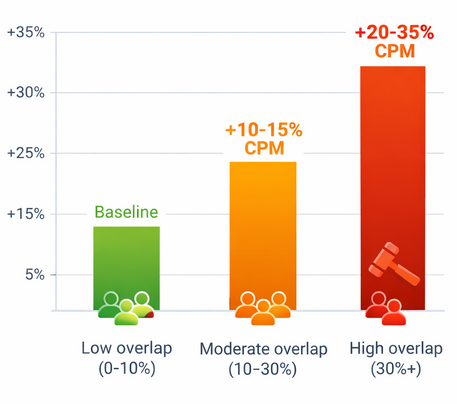
Audience overlap between campaigns can increase advertising costs as multiple campaigns compete for the same impressions
This often leads to unstable pacing and fluctuating cost metrics.
Redundant Audience Targeting
Audience overlap across campaigns is another hidden hierarchy issue. When multiple campaigns target nearly identical audiences, they may compete for the same impressions.
Internal competition can increase costs and produce inconsistent performance patterns.
Designing Campaign Hierarchies for Stability
Consolidate Campaign Structures
Instead of dividing campaigns by numerous minor variations, focus on grouping campaigns by meaningful strategic differences such as geography, funnel stage, or product category.
This approach concentrates performance data and improves algorithm learning efficiency.
Reduce Audience Fragmentation
Combine narrowly defined audience segments when possible. Larger audience pools provide stronger signals for optimization systems and reduce volatility in delivery.
Align Optimization Controls
Ensure that budget rules, bid strategies, and automation triggers operate at compatible hierarchy levels. Avoid stacking too many automated adjustments across different structural layers.
When optimization controls are clearly separated by hierarchy level, campaigns tend to perform more predictably.
Monitoring Structural Stability
Campaign hierarchy should not remain static. Regular structural audits help identify when complexity begins to undermine performance.
Key indicators that hierarchy may be causing instability include:
-
Frequent swings in daily performance metrics
-
Prolonged platform learning phases
-
High audience overlap across campaigns
-
Irregular budget pacing
Analyzing these signals allows marketing teams to simplify structures before instability escalates.
Conclusion
Campaign stability is often perceived as a function of creative quality, audience targeting, or budget allocation. However, the underlying campaign hierarchy can significantly influence how consistently campaigns perform.
By designing clear, streamlined campaign structures, marketers can improve algorithm learning, reduce volatility, and maintain stable campaign performance over time.