Prospecting campaigns are designed to bring new audiences into the funnel. Retargeting campaigns, on the other hand, focus on users who have already interacted with your brand. Both strategies are essential for performance marketing, but the relationship between them is often misunderstood.
A common issue appears shortly after retargeting campaigns go live: prospecting performance drops, cost per acquisition increases, and the overall efficiency of the funnel deteriorates. While many marketers blame ad fatigue or creative performance, the real causes are usually structural and algorithmic.
Understanding these dynamics is critical to maintaining a stable acquisition pipeline.
The Prospecting–Retargeting Balance
In a healthy advertising ecosystem, prospecting feeds retargeting. New audiences enter the funnel through discovery campaigns, interact with the website or content, and then become eligible for retargeting.
However, when retargeting campaigns launch, several changes occur simultaneously:
-
Auction dynamics change
-
Conversion attribution shifts
-
Budget allocation becomes distorted
-
Algorithms start optimizing toward easier conversions
These changes can unintentionally weaken prospecting campaigns.
1. Retargeting Absorbs the Easiest Conversions
Advertising platforms are designed to optimize for the highest probability of conversion. Retargeting audiences consist of users who already know the brand, have visited the site, or interacted with content. Because these users are significantly warmer, they convert at much higher rates.
Industry benchmarks show that:
-
Retargeted users are 70% more likely to convert than new visitors.
-
Retargeting ads can achieve click‑through rates up to 10× higher than standard display ads.
-
Conversion rates for retargeted audiences are often 3–5 times higher than prospecting campaigns.
When retargeting launches, algorithms quickly prioritize these high‑probability audiences. As a result, many conversions that previously would have been attributed to prospecting campaigns are now captured by retargeting campaigns.
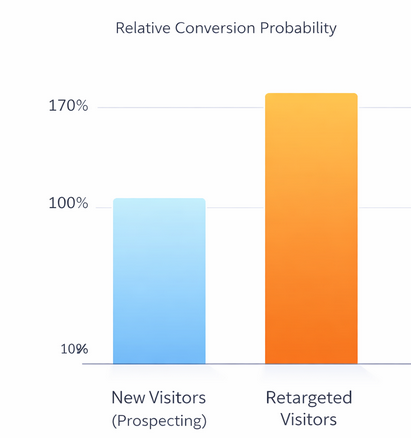
Retargeted users are significantly more likely to convert than new visitors
From a reporting perspective, it looks like prospecting performance collapsed — even though it may still be generating the same demand.
2. Attribution Shifts Create False Performance Drops
Most advertising platforms rely on last‑touch or near‑last‑touch attribution models. When retargeting campaigns are introduced, they frequently become the last interaction before a conversion.
For example:
-
A user first discovers a brand through a prospecting ad.
-
They visit the website but do not convert.
-
A retargeting ad appears later.
-
The user returns and converts.
In this scenario, the retargeting campaign receives full credit for the conversion, even though the prospecting campaign generated the initial interest.
Research across multiple ad platforms suggests that up to 40–60% of retargeting conversions involve users who would likely have converted anyway because they were already moving through the funnel.
This attribution shift can create the illusion that prospecting campaigns suddenly stopped working.
3. Budget Cannibalization Between Campaign Types
Another reason prospecting performance declines is budget cannibalization.
Because retargeting campaigns usually deliver lower cost‑per‑conversion metrics, automated budget optimization systems tend to shift more spend toward them. Over time, prospecting campaigns may receive progressively less budget.
When that happens, three things occur:
-
Audience reach decreases
-
Learning phases reset more often
-
Algorithms receive fewer signals to optimize effectively
The result is a downward spiral where prospecting campaigns appear less efficient simply because they no longer receive sufficient scale.
4. Audience Overlap Disrupts Optimization
Audience overlap is another hidden factor.
When users interact with your site or ads, they quickly move into retargeting pools. If audience exclusions are not configured properly, prospecting campaigns may continue competing for the same users as retargeting campaigns.
This overlap causes two problems:
-
Internal competition in ad auctions
-
Conflicting optimization signals
Platforms attempt to decide which campaign should show the ad. Since retargeting audiences have higher predicted conversion probabilities, the system typically favors retargeting campaigns.
As a result, prospecting campaigns lose access to valuable impressions.
5. Algorithmic Optimization Favors Shorter Paths
Modern advertising algorithms prioritize short conversion paths. Retargeting campaigns typically convert users faster because those users already have some familiarity with the brand.
If optimization goals focus purely on immediate conversions, platforms naturally shift delivery toward retargeting audiences.
Data from performance marketing studies indicates that retargeting audiences can convert 2–3 times faster than cold audiences.
While this improves short‑term metrics, it reduces top‑of‑funnel growth and can gradually shrink the pool of new prospects entering the funnel.
How to Prevent Prospecting Campaign Collapse
Maintaining a balanced funnel requires intentional campaign architecture.
1. Separate Budget Allocation
Avoid letting retargeting campaigns absorb the majority of the advertising budget. Prospecting campaigns should maintain stable funding to continuously generate new demand.
A common benchmark used by performance teams is allocating:
-
60–80% of spend to prospecting
-
20–40% to retargeting
This balance ensures the funnel continues expanding rather than recycling the same audiences.
2. Implement Clear Audience Exclusions
Prospecting campaigns should exclude:
-
Website visitors
-
Past converters
-
Active retargeting segments
This prevents internal competition and ensures prospecting campaigns focus purely on new audience discovery.
3. Evaluate Performance at the Funnel Level
Instead of analyzing campaigns individually, measure performance across the entire funnel.
Key indicators include:
-
Total acquisition cost
-
Incremental conversions
-
Funnel growth rate
When measured holistically, prospecting campaigns often reveal their true value as the primary source of new demand.
Final Thoughts
Prospecting campaigns rarely collapse because they suddenly stop working. More often, the perceived decline is caused by attribution shifts, algorithmic optimization, audience overlap, and budget redistribution once retargeting campaigns launch.
Understanding these dynamics allows advertisers to design more resilient campaign structures that maintain a healthy balance between discovery and conversion.
When prospecting and retargeting campaigns operate as complementary components of the same system, the acquisition funnel becomes far more stable and scalable.