Businesses often pursue rapid growth as a sign of success. Yet aggressive scaling can introduce hidden operational risks that threaten stability.
Scaling a business quickly is often seen as the ultimate objective for modern companies. Investors encourage rapid expansion, founders chase market share, and growth metrics dominate boardroom discussions. However, aggressive scaling frequently introduces operational fragility that can destabilize otherwise successful organizations.
The tension between stability and rapid growth is rarely discussed openly. Yet companies that fail to manage this trade-off often experience service disruptions, declining product quality, employee burnout, or customer churn.
Understanding how scaling impacts infrastructure, processes, and teams is critical for building organizations that grow without collapsing under their own weight.
Why Companies Pursue Aggressive Scaling
Several structural forces push companies toward fast expansion:
-
Competitive markets reward first movers.
-
Venture capital funding encourages rapid growth.
-
Digital platforms allow global reach at unprecedented speed.
According to data from the Startup Genome Report, nearly 74% of high-growth startups fail due to premature scaling. Companies expand marketing, hiring, and infrastructure before validating sustainable demand.
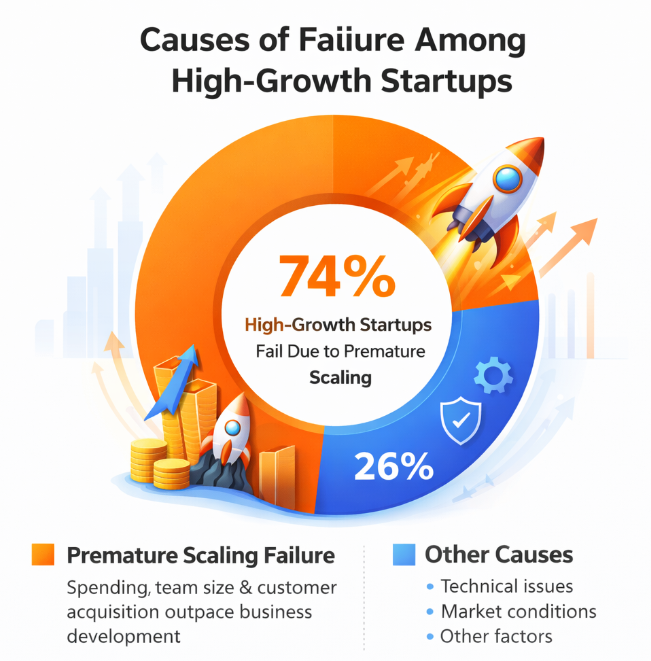
Startup failure analysis shows that premature scaling is the dominant cause of collapse among high-growth companies
Aggressive scaling may initially accelerate growth metrics, but it often exposes weaknesses in operational foundations.
Operational Fragility During Rapid Growth
When companies scale faster than their operational systems can support, several risks emerge.
Infrastructure Overload
Technical infrastructure frequently becomes the first bottleneck. Systems designed for thousands of users suddenly need to support millions.
Research from Google’s Site Reliability Engineering teams shows that systems operating beyond their designed capacity experience failure rates up to four times higher.
Process Breakdown
Operational processes that worked for small teams often collapse when organizations grow rapidly. Decision-making slows down, internal communication becomes fragmented, and accountability becomes unclear.
A Harvard Business Review study found that organizations growing faster than 40% annually experience a significant rise in coordination complexity.
Talent Strain
Rapid hiring can dilute company culture and introduce skill gaps. New employees may lack institutional knowledge, while existing teams struggle to maintain productivity during constant onboarding cycles.
LinkedIn workforce data suggests companies doubling headcount within 12 months see productivity decline by approximately 20% during the transition period.
The Stability Advantage
While aggressive scaling attracts attention, stability-focused growth often produces stronger long-term outcomes.
Organizations that prioritize operational maturity tend to build:
-
More reliable infrastructure
-
Stronger internal processes
-
Higher employee retention
-
More predictable customer experiences
McKinsey research indicates that companies combining steady growth with operational resilience outperform aggressive scalers by up to 30% in long-term profitability.
Stability does not mean avoiding growth. Instead, it requires aligning expansion with operational readiness.
Building a Balanced Growth Strategy
Companies that successfully scale without sacrificing stability typically follow several strategic principles.
Strengthen Infrastructure Early
Investing in scalable architecture before demand spikes can prevent catastrophic failures later. Cloud-native systems, distributed services, and automation reduce the risk of infrastructure bottlenecks.
Standardize Core Processes
Documented workflows, clear ownership structures, and operational playbooks allow teams to scale without losing efficiency.
Organizations that standardize key processes early reduce operational friction as they grow.
Scale Talent Thoughtfully
Strategic hiring focused on critical capabilities often produces better outcomes than aggressive headcount expansion.
Companies that emphasize mentorship, training, and knowledge transfer preserve institutional expertise during periods of growth.
Warning Signs of Premature Scaling
Recognizing early signals of instability can help organizations adjust their growth strategy before major problems emerge.
Common indicators include:
-
Declining product quality
-
Increased customer support volume
-
Growing technical debt
-
Slower decision cycles
-
Employee burnout
When these symptoms appear simultaneously, they often signal that growth is outpacing operational capacity.
Sustainable Scaling as a Competitive Advantage
In many industries, sustainable scaling becomes a differentiator. Companies that balance growth with operational resilience build stronger brands and more durable market positions.
Instead of pursuing growth at any cost, leaders increasingly focus on scalable systems, disciplined expansion strategies, and resilient teams.
The organizations that succeed long term are rarely the fastest growers. They are the ones that scale intelligently.
Conclusion
The pressure to scale aggressively can obscure the operational risks associated with rapid expansion. While growth remains essential, stability provides the foundation that allows organizations to sustain that growth over time.
Businesses that understand the hidden trade-off between stability and aggressive scaling are better positioned to build resilient systems, strong teams, and durable competitive advantages.
In the long run, disciplined scaling almost always outperforms uncontrolled growth.
Suggested Reading