As privacy regulations tighten and data noise increases, high-performing teams are shifting their focus from channel expansion to signal precision. This article explains how to build a streamlined advertising strategy driven by strong intent data, measurable engagement, and high-quality targeting.
The Shift From Channel Volume to Signal Quality
For years, digital advertising strategy was built on expansion. More platforms, more audiences, more creatives. The assumption was simple: broader reach equals better performance.
Today, that assumption no longer holds.
According to Statista, global digital advertising spending surpassed $600 billion in 2023. Yet conversion rates across many industries have stagnated between 2% and 4%. At the same time, customer acquisition costs (CAC) have increased by more than 60% over the past five years in competitive B2B sectors.
The issue is not visibility. It is signal dilution.
Modern advertising performance depends less on the number of channels and more on the quality of behavioral and intent signals used to guide targeting.
Why More Channels Often Reduce Performance
Operating across too many platforms introduces several structural inefficiencies:
-
Fragmented audience data
-
Inconsistent attribution modeling
-
Increased creative production overhead
-
Budget dispersion across low-signal traffic sources
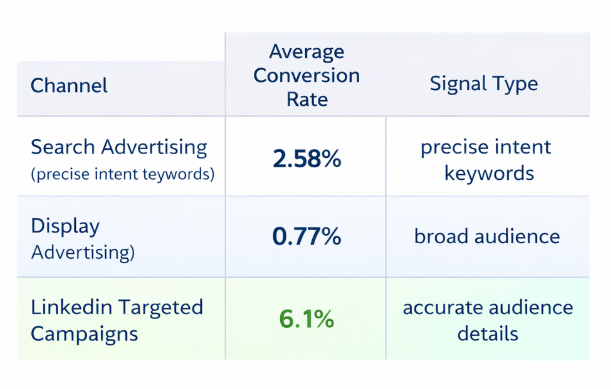
Conversion rates across different digital advertising channels show how targeted signals (e.g., LinkedIn campaigns) outperform broad reach placements
Research from Gartner indicates that marketing teams use an average of 20+ tools in their martech stack. However, fewer than 40% report full integration between advertising and CRM systems.
Without integration, advertising becomes activity-based rather than intelligence-based.
The result: impressions increase, but qualified pipeline does not.
The Case for Fewer Channels
A streamlined channel mix allows teams to:
-
Consolidate performance data
-
Improve attribution accuracy
-
Allocate budget based on conversion probability
-
Build stronger retargeting pools
In B2B environments, LinkedIn and Meta often outperform broader display networks when intent-based segmentation is applied correctly. Meanwhile, search campaigns driven by high-intent keywords can produce conversion rates 2–3x higher than awareness campaigns.
The objective is not channel elimination. It is channel prioritization based on signal density.
What Defines a “Better Signal”
A high-value signal is any measurable behavior that correlates with purchase intent or buying authority.
Examples include:
-
Website visits to pricing or integration pages
-
Repeated engagement with product-related content
-
Profile-level job title and company size alignment
-
Direct interactions such as form submissions or demo requests
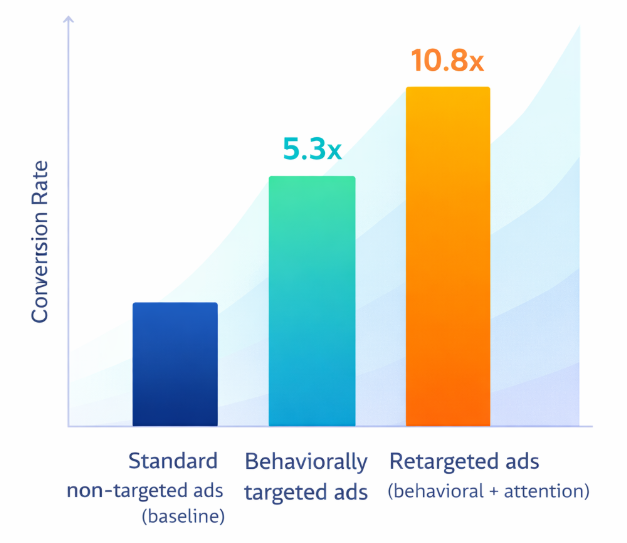
Conversion uplift by targeting intensity: behavioural and retargeted advertising significantly outperform non-targeted campaigns
According to HubSpot benchmarks, companies that leverage behavioral targeting see up to a 20% increase in sales opportunities compared to static demographic targeting.
Signal strength increases when multiple intent markers overlap.
For example:
Job title match + website visit + content engagement = significantly higher conversion probability than demographic targeting alone.
Building a Signal-Driven Advertising Framework
1. Define Your High-Intent Behaviors
Map your sales funnel and identify actions that historically correlate with closed deals. Analyze CRM data to determine which behaviors appear most frequently among converted customers.
2. Align Paid Campaigns With Funnel Stages
Instead of broadcasting one universal message, structure campaigns by funnel depth:
-
Awareness: content engagement
-
Consideration: case studies, product comparisons
-
Decision: demos, consultations, pricing pages
Each stage should collect progressively stronger signals.
3. Integrate Data Across Platforms
Consolidate advertising data with CRM and email marketing systems. Unified tracking improves lead scoring and budget allocation.
Companies with strong sales and marketing alignment generate 208% more revenue from marketing efforts, according to Aberdeen research.
4. Reduce Low-Signal Spend
Audit campaigns with high impressions but low engagement depth. Shift budget toward segments that demonstrate measurable buying intent.
The Economics of Signal Precision
A focused advertising strategy typically produces:
-
Lower cost per qualified lead
-
Higher conversion-to-opportunity rates
-
Reduced wasted ad spend
-
Shorter sales cycles
In competitive industries, even a 10% improvement in targeting precision can significantly impact annual revenue.
The economic advantage compounds over time because retargeting pools become more qualified, lookalike audiences become more accurate, and messaging becomes more personalized.
Technology’s Role in Signal Optimization
Modern data enrichment and targeting platforms allow marketers to:
-
Identify decision-makers within engaged accounts
-
Filter audiences by industry, role, or engagement depth
-
Extract qualified prospects from social platforms
-
Continuously refine segments based on behavior
Automation does not replace strategy. It strengthens it by increasing signal clarity.
Conclusion: Precision Over Presence
The modern digital advertising strategy is not about being everywhere. It is about being relevant where intent is strongest.
Fewer channels with better signals lead to:
-
Clearer attribution
-
Higher-quality leads
-
More predictable revenue outcomes
Instead of expanding your channel list, audit your signal quality. When targeting is grounded in verified behavioral and professional data, performance becomes measurable, scalable, and economically efficient.