Many advertisers think optimization means lowering cost per click, pausing underperforming ads, or refreshing creatives every few weeks. While these actions are part of the process, they are not optimization by themselves. True optimization focuses on improving the entire system behind paid media performance: audiences, messaging, delivery algorithms, and post-click experience.
Real optimization asks deeper questions:
-
Are we reaching people with real purchase intent?
-
Does the message match the user’s stage in the funnel?
-
Are we learning something actionable from every test we run?
Without clear answers, tactical changes rarely produce lasting results.
Data Without Direction Is Not Optimization
Modern ad platforms provide an overwhelming amount of data. Click-through rates, impressions, frequency, conversion value, and dozens of other metrics are available at any moment. However, more data does not automatically mean better decisions.
Industry research consistently shows that only about 20–30% of A/B tests reach statistical significance, meaning most experiments fail to produce clear insights. This does not indicate failure; it highlights the need for better test design and clearer hypotheses.
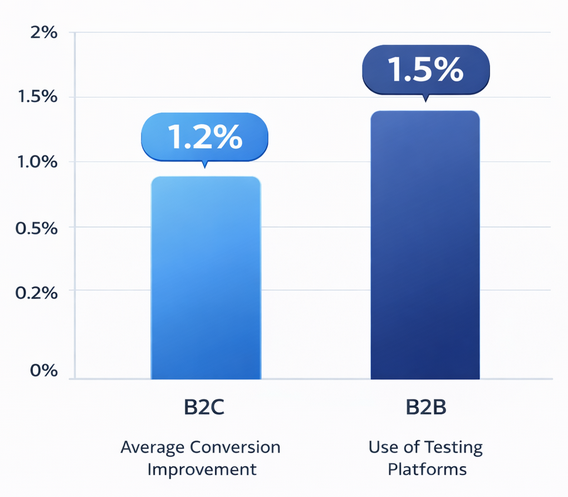
Comparison of average conversion rates for paid search/PPC between B2C and B2B campaigns
Effective optimization starts with prioritization. Instead of reacting to daily fluctuations, strong teams focus on:
-
Fewer, higher-impact tests
-
Clear success criteria before launch
-
Sufficient budget and time to reach reliable results
Optimization Is a Learning Loop
At its core, optimization is a feedback loop:
-
Hypothesis – Identify what you believe will improve performance and why.
-
Experiment – Test one meaningful variable at a time.
-
Measurement – Evaluate results using statistically sound methods.
-
Application – Apply learnings across campaigns, not just the winning ad.
Advertisers who follow this loop consistently see stronger long-term outcomes. Surveys show that nearly 80% of businesses report higher lead quality or sales when structured testing and optimization frameworks are in place. Winning tests can deliver conversion rate lifts of 20–40% or more, especially when they address audience relevance or landing page alignment.
The Role of Audiences in Real Optimization
One of the most overlooked areas of optimization is audience strategy. Platforms are increasingly automated, but they still depend heavily on the quality of input signals.
Refining audience structure often produces larger gains than creative changes alone. Advertisers who shift from broad, interest-heavy targeting to data-informed audience segments frequently see:
-
Lower cost per acquisition
-
More stable performance during algorithm changes
-
Faster learning cycles for new campaigns
Optimization here is not about constantly adding new audiences, but about maintaining clean, intentional audience logic that supports platform learning.
Creative Optimization Goes Beyond Design
Creative optimization is not limited to visuals or copy length. It is about relevance and clarity. High-performing creatives tend to:
-
Address a specific problem immediately
-
Match the promise of the landing page
-
Speak to one audience segment at a time
Data shows that ad fatigue can reduce click-through rates by 30–50% when frequency rises without creative variation. Structured creative testing, where each variation tests a single message or angle, helps avoid this decline while generating insights that can be reused across channels.
Optimization Is a Long-Term Discipline
The biggest misconception in paid media is expecting optimization to deliver instant breakthroughs. Sustainable performance comes from consistency, not shortcuts.
True optimization:
-
Compounds results over time
-
Reduces volatility in performance
-
Builds a repeatable growth system rather than one-off wins
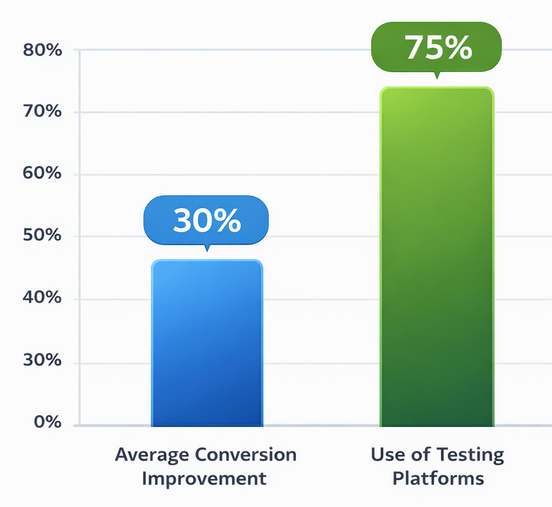
Average conversion uplift and adoption of structured A/B testing among leading retailers
When optimization is treated as a strategic discipline instead of a reactive task, paid media becomes more predictable, scalable, and resilient.
Related Articles You May Find Useful
To go deeper into related topics, consider exploring these articles:
Final Thoughts
Optimization in paid media is not about chasing metrics or reacting to short-term performance swings. It is about building a structured system that learns, adapts, and improves with every campaign. When done right, optimization becomes a competitive advantage that grows stronger over time.