Modern marketing is no longer defined by static audience lists or fixed schedules. Timing and relevance now determine performance. Behavioral triggers allow marketers to launch campaigns based on specific user actions, ensuring communication aligns precisely with customer intent.
Instead of sending messages based on assumptions, behavioral campaigns respond to observable signals: page visits, product views, pricing checks, cart additions, downloads, session frequency, and more. These signals indicate readiness, hesitation, or high purchase probability.
When implemented correctly, trigger-based campaigns consistently outperform batch campaigns in open rate, click-through rate, and revenue per user.
What Are Behavioral Triggers?
Behavioral triggers are predefined marketing actions activated when a user performs a specific activity. They rely on first-party behavioral data such as:
-
Website visits
-
Time spent on page
-
Product interactions
-
Abandoned carts
-
Repeat visits within a defined timeframe
-
Resource downloads
-
Demo requests
-
Subscription upgrades
These events signal intent and allow marketers to deploy timely, contextual messaging.
Why Timing Matters: Supporting Statistics
Research consistently demonstrates the performance advantage of trigger-based campaigns:
-
Triggered email campaigns generate 4–8 times higher revenue than standard batch emails.
-
Behavioral retargeting can increase conversion rates by up to 70% compared to non-retargeted traffic.
-
Personalized triggered messages improve click-through rates by 2–3 times compared to generic campaigns.
-
Businesses using behavioral segmentation report up to 20% higher sales opportunities.
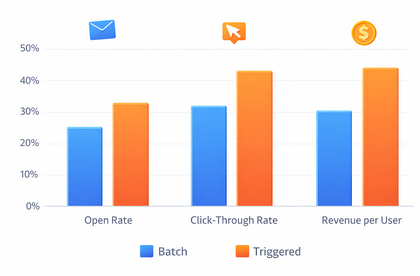
Comparison of key performance metrics between triggered and batch campaigns. Triggered campaigns show significant lifts in engagement and revenue
The common denominator across these statistics is relevance at the moment of intent.
Core Types of Behavioral Triggers
1. Engagement-Based Triggers
These activate when users demonstrate high interest. Examples include:
-
Visiting pricing pages multiple times
-
Spending more than a threshold time on a feature page
-
Returning within 24–48 hours
Such behaviors indicate evaluation-stage prospects and justify immediate, value-focused messaging.
2. Inactivity Triggers
Triggered when engagement declines. Examples:
-
No login for 14 days
-
No purchase within 30 days
-
Abandoned onboarding sequence
Inactivity triggers aim to reduce churn and recover pipeline opportunities.
3. Transactional Triggers
Based on commercial actions:
-
Cart abandonment
-
Subscription renewal windows
-
Upsell eligibility
-
Purchase completion follow-up
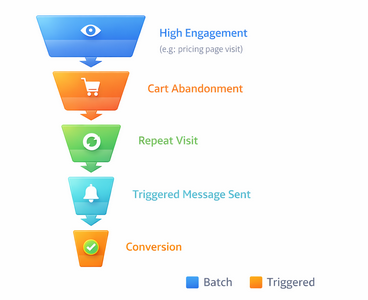
Funnel illustrating how key behavioral events trigger campaign activations that guide users toward conversion
These are among the highest-converting trigger categories because they align directly with buying intent.
4. Behavioral Milestones
Activated when users reach specific thresholds:
-
First purchase
-
Third login
-
100th session
-
Account anniversary
Milestone campaigns strengthen retention and customer lifetime value.
Building an Effective Trigger Framework
To launch timely campaigns effectively, implement the following structured approach.
Step 1: Define High-Intent Events
Map the customer journey and identify measurable actions that correlate strongly with conversion or churn. Prioritize events that historically precede purchases.
Step 2: Segment by Behavioral Intensity
Not all triggers are equal. A single page view differs from repeated engagement. Apply scoring logic:
-
Frequency
-
Recency
-
Depth of interaction
This prevents over-communication and increases signal accuracy.
Step 3: Automate Response Windows
Speed significantly impacts performance. Studies show that responding within the first hour after high-intent behavior dramatically improves conversion probability.
Establish automation rules such as:
-
Immediate follow-up for cart abandonment
-
24-hour educational follow-up after pricing page visits
-
7-day reactivation after inactivity threshold
Step 4: Personalize Message Context
Triggered campaigns must reflect the observed behavior. Generic messaging reduces impact. Include:
-
Referenced product or feature
-
Contextual benefits
-
Social proof relevant to that segment
Behavior-driven personalization increases engagement and reduces unsubscribes.
Avoiding Common Mistakes
-
Over-triggering: Excessive automation creates fatigue.
-
Ignoring data quality: Inaccurate tracking produces irrelevant communication.
-
Failing to test timing: Optimal delay varies by audience.
-
Treating triggers as static: Behavioral thresholds must evolve with campaign insights.
Regular performance audits ensure the trigger logic remains aligned with buyer behavior.
Measuring Success
Evaluate triggered campaigns using:
-
Conversion rate per trigger
-
Revenue per triggered user
-
Time-to-conversion reduction
-
Churn rate improvement
-
Engagement lift compared to batch campaigns
Triggered campaigns should consistently outperform standard campaigns on efficiency metrics.
Strategic Impact
Behavioral triggers transform marketing from reactive broadcasting into proactive engagement. Instead of pushing messages based on calendar schedules, campaigns activate based on real buyer signals.
This approach increases precision, reduces wasted impressions, and maximizes marketing ROI.
Conclusion
Behavioral triggers enable marketers to deliver timely, relevant campaigns aligned with genuine user intent. By defining meaningful events, automating response timing, and personalizing context, businesses can significantly improve conversion rates and long-term customer value.
Timely communication is no longer optional; it is a competitive advantage.