As social media platforms evolve, advertisers must continuously reassess where their budgets deliver the best results. Threads Ads and Instagram Reels represent two rapidly growing environments for performance marketing. Both formats rely on short-form, mobile-first content and algorithmic distribution, but their audience behaviors and engagement patterns differ significantly.
To allocate budgets effectively, marketers need a structured way to compare performance across these channels. This article outlines a framework that helps evaluate key metrics, interpret platform-specific behavior, and make informed optimization decisions.
Platform Context and Growth Trends
Instagram Reels has become one of the fastest-growing short‑form video environments. Meta reported that Reels accounts for more than 50% of time spent on Instagram, demonstrating its central role in content discovery. Reels advertising campaigns frequently benefit from the platform's mature targeting infrastructure and strong creator ecosystem.
Threads, launched as a text-first social platform integrated with Instagram accounts, quickly surpassed 100 million sign‑ups during its first week. As the platform evolves, advertising formats are expected to prioritize conversational engagement and real‑time discussion participation. Early campaign tests indicate that Threads content often generates higher discussion-driven engagement compared with traditional feed placements.
Key Performance Metrics for Comparison
When comparing Threads Ads with Instagram Reels campaigns, marketers should evaluate performance across four core dimensions.
1. Reach and Impression Efficiency
Reach metrics help determine how effectively each platform distributes content to unique audiences.
Typical indicators include:
-
Cost per thousand impressions (CPM)
-
Unique reach
-
Frequency per user
Short‑form video formats such as Reels typically achieve strong distribution through algorithmic recommendations. Campaign data from multiple social media benchmarks shows that Reels CPMs can be 15–25% lower than standard feed placements when creative is optimized for vertical video.
Threads placements, on the other hand, may initially show lower CPMs due to early inventory expansion as the advertising ecosystem matures.
2. Engagement Quality
Engagement signals provide insight into how audiences interact with content.
Important engagement metrics include:
-
Engagement rate
-
Comment-to-impression ratio
-
Average watch time (for video formats)
-
Share rate
Reels content typically delivers engagement rates between 1.5% and 3.5% depending on industry. However, Threads discussions can generate significantly higher comment density because the platform is designed for conversational interaction.
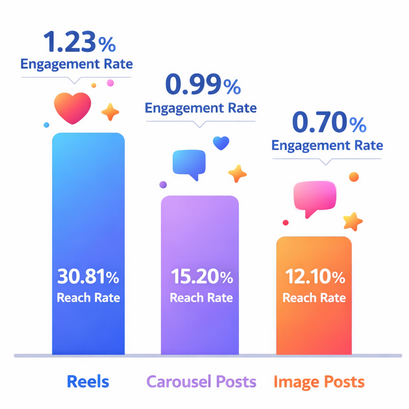
Average engagement performance of Instagram Reels compared with other Instagram post formats
For brands focused on community dialogue or thought leadership, Threads engagement may offer stronger qualitative value even when raw engagement numbers appear smaller.
3. Conversion Performance
Conversion performance ultimately determines advertising ROI.
Common indicators include:
-
Click-through rate (CTR)
-
Cost per acquisition (CPA)
-
Conversion rate
Industry benchmarks show that short-form video ads can achieve CTRs between 0.8% and 1.5%, particularly when the first three seconds of the video clearly communicate the value proposition.
Threads advertising is still emerging, but early beta campaigns suggest that conversational ad formats can drive higher intent traffic when the discussion context aligns closely with the promoted offer.
4. Content Production Efficiency
Creative production cost and scalability must also be considered.
Reels campaigns require:
-
Vertical video production
-
Strong editing and pacing
-
Consistent creator-style storytelling
Threads campaigns, by contrast, can be produced with lighter creative resources such as text-driven narratives, discussion prompts, and carousel-style visuals.
For teams with limited video production capacity, Threads placements may provide a cost-efficient experimentation channel.
Benchmark Comparison Table
| Metric | Threads Ads | Instagram Reels Ads |
|---|---|---|
| Primary format | Text-first social discussion | Short-form vertical video |
| Typical engagement behavior | Comments and conversation | Views, likes, shares |
| Average engagement rate benchmark | ~2–4% discussion engagement | ~1.5–3.5% video engagement |
| Creative complexity | Low to medium | Medium to high |
| Content production speed | Fast | Moderate |
These benchmarks should be interpreted cautiously, as platform maturity and audience behavior can change rapidly.
Testing Methodology for Accurate Comparison
To compare Threads Ads and Instagram Reels campaigns effectively, marketers should implement controlled testing structures.
Recommended approach:
-
Use identical audience targeting segments across both placements.
-
Run campaigns simultaneously for at least two weeks to reduce algorithmic volatility.
-
Allocate equal initial budgets to both formats.
-
Evaluate performance based on normalized metrics such as CPA and engagement per impression.
A structured testing window allows marketing teams to distinguish platform-driven performance differences from short-term algorithmic fluctuations.
Strategic Use Cases
Each platform may perform best in different marketing scenarios.
Threads Ads may be more effective for:
-
Thought leadership campaigns
-
Product discussions
-
Community engagement initiatives
Instagram Reels campaigns may be better suited for:
-
Product demonstrations
-
Visual storytelling
-
Influencer collaborations
Combining both formats within the same funnel can strengthen overall campaign performance.
For example, Reels campaigns can generate broad awareness while Threads discussions nurture deeper engagement and trust.
Conclusion
Threads Ads and Instagram Reels represent two distinct yet complementary advertising environments. While Reels currently benefits from a more mature video ecosystem and powerful discovery algorithms, Threads introduces a conversation‑driven engagement model that may influence future social advertising strategies.
By evaluating campaigns through a structured comparison framework—including reach efficiency, engagement quality, conversion performance, and production scalability—marketing teams can identify where each format contributes the greatest strategic value.
As both platforms evolve, continuous experimentation and data-driven optimization will remain essential to maximizing advertising results.
Suggested Reading
If you want to explore more strategies for optimizing social media advertising campaigns, consider these related articles: