Retargeting remains one of the highest-performing digital marketing strategies, yet many campaigns underperform due to poorly defined timing. Delivering the right message too early can feel intrusive, while engaging too late often results in lost intent. Precision in timing allows marketers to align messaging with user readiness, ultimately maximizing return on ad spend (ROAS).
Why Timing Matters in Retargeting
User intent decays over time. According to industry benchmarks, website visitors are up to 70% more likely to convert within the first 24–72 hours after their initial interaction. After one week, this probability can drop by more than 50%.
Additionally:
-
Around 96% of website visitors are not ready to convert on their first visit.
-
Retargeted users are 43% more likely to convert compared to non-retargeted users.
-
Conversion rates can increase by up to 150% when retargeting is aligned with high-intent time windows.
These figures highlight a simple truth: timing determines whether retargeting reinforces intent or misses it entirely.
Understanding Retargeting Windows
Effective retargeting depends on segmenting audiences based on how recently they interacted with your site or product.
1. Immediate Window (0–3 Days)
This is the highest-intent period. Users are actively considering options and are most responsive to reminders.
Best practices:
-
Show product-focused ads
-
Highlight urgency (limited availability, deadlines)
-
Use dynamic creatives reflecting viewed items
2. Consideration Window (4–14 Days)
Interest remains, but urgency begins to decline. Users may be comparing alternatives.
Best practices:
-
Emphasize differentiators
-
Include testimonials or social proof
-
Introduce value propositions (free trial, demo, pricing clarity)
3. Extended Window (15–30+ Days)
Intent is significantly weaker, and users may have shifted focus.
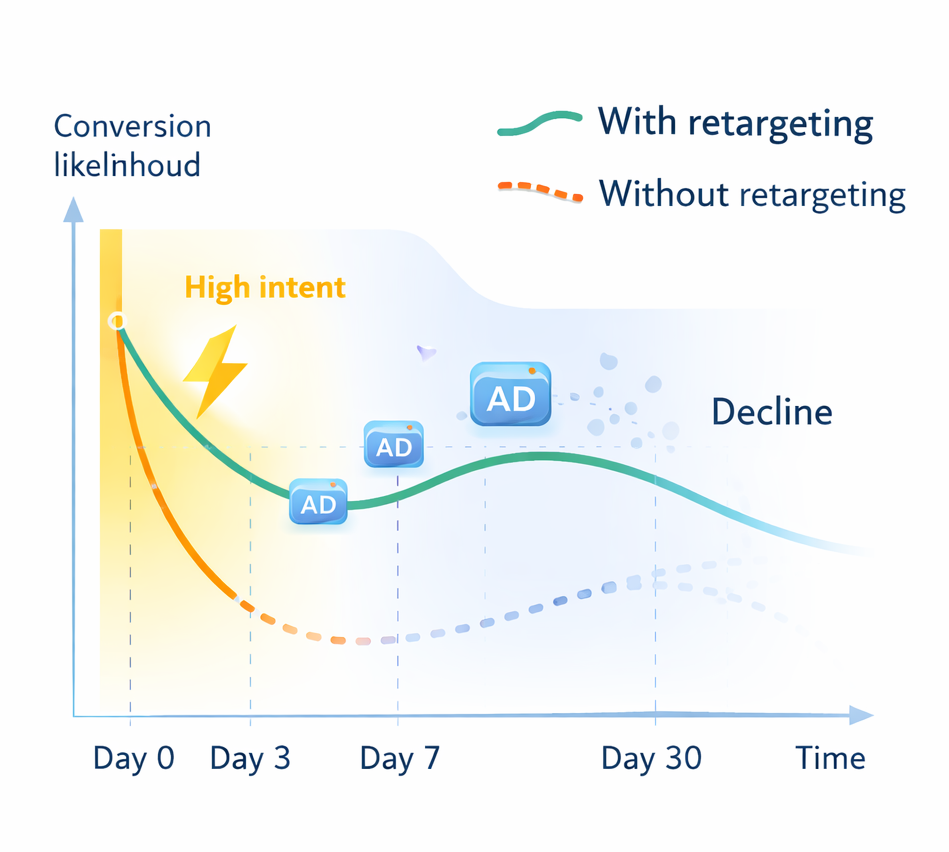
User intent declines rapidly after the first visit, but timely retargeting sustains and extends conversion potential
Best practices:
-
Use broader messaging
-
Offer incentives (discounts, bonuses)
-
Reframe the product’s value in a new context
Frequency and Timing Balance
Timing is not only about when to start retargeting but also about how often users see your ads.
Research suggests:
-
The optimal frequency range is typically 5–7 impressions per user per week.
-
Conversion rates tend to peak between the 3rd and 5th exposure.
-
Overexposure can reduce performance by up to 20% due to ad fatigue.
Balancing frequency ensures that campaigns stay visible without becoming intrusive.
Dayparting and Behavioral Timing
Beyond recency, behavioral timing adds another layer of optimization.
Key insights:
-
B2B audiences often convert during working hours (10 AM–4 PM).
-
E-commerce engagement peaks in the evening (7 PM–10 PM).
-
Mid-week (Tuesday–Thursday) tends to outperform weekends for high-consideration purchases.
Analyzing your own campaign data is essential, but these benchmarks provide a strong starting point.
Trigger-Based Retargeting
Modern campaigns benefit from event-driven timing rather than relying solely on fixed windows.
Examples of effective triggers:
-
Product page visits
-
Cart abandonment
-
Pricing page engagement
-
Content downloads
Triggered campaigns can improve conversion rates by up to 200% compared to generic retargeting because they align closely with user actions.
Creative Sequencing Over Time
Timing should influence not only when ads appear but also what they communicate.
A structured sequence might look like:
-
Reminder (Day 1–2): Reinforce awareness
-
Value (Day 3–7): Highlight benefits and differentiation
-
Proof (Day 7–14): Show testimonials, case studies
-
Incentive (Day 14+): Introduce offers or urgency
Sequential messaging ensures relevance at each stage of the decision-making process.
Measuring Timing Effectiveness
To optimize timing, track metrics beyond basic conversions:
-
Time-to-conversion
-
Conversion rate by recency segment
-
Frequency vs. conversion correlation
-
Drop-off points in retargeting windows
A/B testing different timing strategies can reveal hidden performance gains and prevent wasted ad spend.
Common Timing Mistakes
Avoid these frequent pitfalls:
-
Launching retargeting too late after the first visit
-
Using a single static retargeting window for all audiences
-
Ignoring frequency caps
-
Failing to adjust messaging over time
Each of these reduces campaign efficiency and limits overall ROI.
Conclusion
Timing is one of the most underutilized levers in retargeting strategy. By aligning campaigns with user intent decay, behavioral patterns, and trigger-based events, marketers can significantly improve engagement and conversion rates.
A structured approach to retargeting timing transforms campaigns from repetitive reminders into a dynamic, personalized journey that meets users exactly when they are ready to act.