Business details inside Meta Business Suite are easy to overlook until something changes.
A rebrand, new domain, new address, updated phone number, or website migration can create a mismatch between what your business actually is and what Meta has on record.
Meta’s help content indicates that business details can be edited through Business portfolio info → Business details → Edit, and that changes may proceed through a business verification flow.
For advertisers, this is not just an admin task. If business details are outdated or inconsistent, campaign operations, verification, trust signals, and access workflows can become harder to manage.
What is happening?
Business details are the information Meta uses to understand the business entity behind the portfolio. This is different from the personal name or email used by an individual portfolio user.
Meta’s verification-related help content refers to business details such as legal business name, address, phone number, and website, and says those details should match the details used for verification.
The website is especially important. Meta’s indexed help result states that an active HTTPS-compliant website is required to verify a business and maintain verified status. It also says that if website details change, they should be reflected accurately in Meta Business Suite to avoid verified-status issues.
For advertisers, that means a domain change or rebrand should not be treated only as a website project. It also needs to be reviewed through the lens of Meta Business Portfolio accuracy.
Why this affects campaign performance
Updating business details does not directly create better ads. But inaccurate business information can create operational and trust problems that affect campaign execution.
If your business details are outdated, your team may run into verification-related friction, partner onboarding delays, or confusion around which legal entity owns the ad account and assets.
That can slow campaign work in several ways:
- Agencies may hesitate to scale spend until ownership is clear.
- Internal teams may be unsure which portfolio is current.
- Verification workflows may require updated documentation or review.
- Domain or website changes may disrupt campaign planning.
- Launch timelines may stretch while business information is corrected.
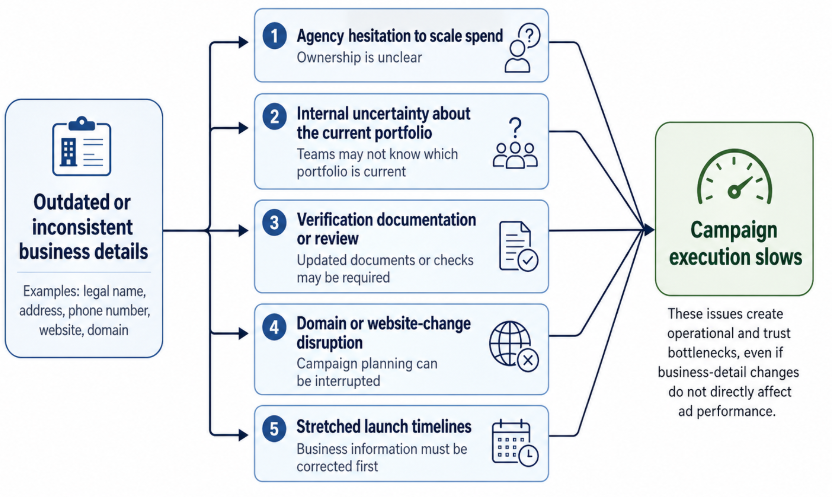
Outdated Meta Business details may not directly change ad performance, but they can create five operational bottlenecks that slow campaign execution, verification, onboarding, and launch timing
Performance marketing depends on clean signals. Business details are part of that foundation.
Business impact
The business impact can include:
- Delayed campaign launches after a rebrand or domain migration.
- Slower agency onboarding.
- Reduced confidence in asset ownership.
- More time spent resolving account and verification questions.
- Potential interruptions if verification status is affected.
- Less reliable planning during budget increases.
- Confusion over which business entity owns advertising assets.
The biggest risk is not usually a single bad CPC or CPA. The bigger risk is campaign disruption during moments when the business needs speed: product launches, seasonal campaigns, funding-driven growth pushes, ecommerce promotions, or agency transitions.
Typical scenarios where this applies
A company changes its domain
The business moves from an old domain to a new brand domain. The website is updated, but Meta Business Suite still contains old details. This can create confusion during verification or partner onboarding.
A startup rebrands after early traction
The company name, website, and offer change. Paid campaigns continue running, but the business portfolio still reflects the old entity. The team should review business details before scaling.
An ecommerce brand migrates its store
The brand moves to a new ecommerce site or consolidates multiple stores. Meta details, landing pages, product catalogs, and campaign URLs should be reviewed together.
A local business moves location
A service business changes address or phone number. If the business portfolio still shows old details, verification and account clarity may suffer.
An agency inherits a verified but outdated portfolio
The agency is ready to optimize campaigns, but the client’s portfolio contains old website or business information. Before testing new audiences or increasing budget, the agency should help the client verify the correct admin path.
In this situation, it is useful to first review personal portfolio info versus business details, because updating a user email is not the same as updating verified business data.
Risks and considerations
Advertisers should be careful when changing business details.
Key risks include:
- Verification review: Some changes may require review or additional confirmation.
- Incorrect portfolio: If several portfolios exist, confirm the correct one before editing. Use confirm the correct business portfolio before making edits.
- Website mismatch: The business website should accurately represent the business and remain active.
- Landing page quality: A valid website does not guarantee a strong conversion experience.
- Tracking continuity: Website or domain changes can affect campaign measurement if not planned carefully.
- Policy and compliance: Updated details do not guarantee policy approval or compliance.
- Campaign timing: Avoid major business-detail changes during high-spend periods unless they are necessary.
- Audience-message mismatch: If the business rebrands but campaigns still target old personas or use old creative, performance may suffer.
Business details are part of the foundation, not the entire performance strategy.
Prerequisites and dependencies
Before updating business details, confirm that you have:
- Access to the correct Meta Business Portfolio.
- Clear ownership of the business entity.
- Current legal business name.
- Current address and phone number.
- An active HTTPS-compliant website.
- Business documentation that matches the updated details.
- A plan for any domain or landing page changes.
- Active ad account visibility.
- Reliable conversion tracking.
- A clear campaign objective and success metrics.
- A communication plan for agencies or partners.
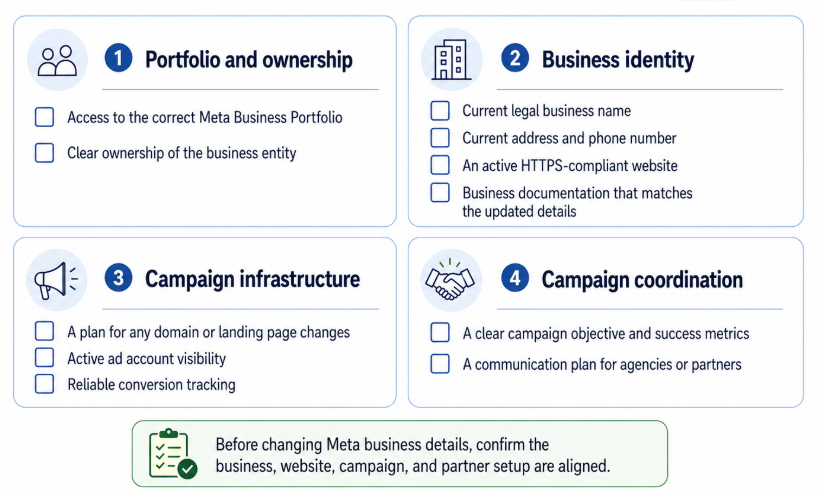
Before changing Meta business details, advertisers should confirm 11 readiness items across ownership, business identity, campaign infrastructure, and partner communication
If the business is actively scaling paid media, coordinate the update with the media team. They need to know whether campaign URLs, landing pages, conversion events, or audience rules will change.
How LeadEnforce helps
LeadEnforce does not manage business verification, legal business details, or Meta’s review process.
It helps advertisers improve audience relevance once the business and campaign foundation is stable.
That matters after a business-detail change because rebrands, new domains, new markets, and updated offers often require audience strategy changes too.
For example:
- A SaaS company rebrands and moves upmarket. LeadEnforce can help build audiences around more relevant professional profiles or industry communities.
- An ecommerce brand launches a new category. LeadEnforce can help identify Instagram competitor engagers or Facebook groups aligned with that category.
- A local business expands into a new service area. LeadEnforce can help explore communities and social signals that match the updated buyer base.
The key is to connect administrative accuracy with market accuracy. Your business details should reflect who you are. Your audiences should reflect who you want to reach.
Practical recommendations
Review business details before budget increases
Before scaling spend, confirm that the business name, website, address, and phone number are accurate.
Treat website changes as campaign events
A domain migration or website update can affect more than verification. It can affect landing page performance, conversion tracking, audience rules, and campaign reporting.
Keep personal info and business details separate
If only the portfolio user email is outdated, fix that separately. If the business entity or website changed, review business details.
Align audiences with the updated business direction
If the business has changed markets, offers, or positioning, do not keep targeting the same old audience by default. Rebuild audience hypotheses around the current ICP.
Do not scale until the foundation is stable
A verified, accurate, well-organized portfolio does not guarantee better ROAS. But it reduces unnecessary operational risk before budget increases.
Final takeaway
Business-detail accuracy is part of paid social readiness.
When your legal details, website, portfolio ownership, and campaign structure are aligned, your team can focus on the work that actually improves performance: better audiences, stronger creative, clearer offers, and smarter budget allocation.
Join the free 7-day LeadEnforce trial period to test more precise paid social audiences before committing more budget.