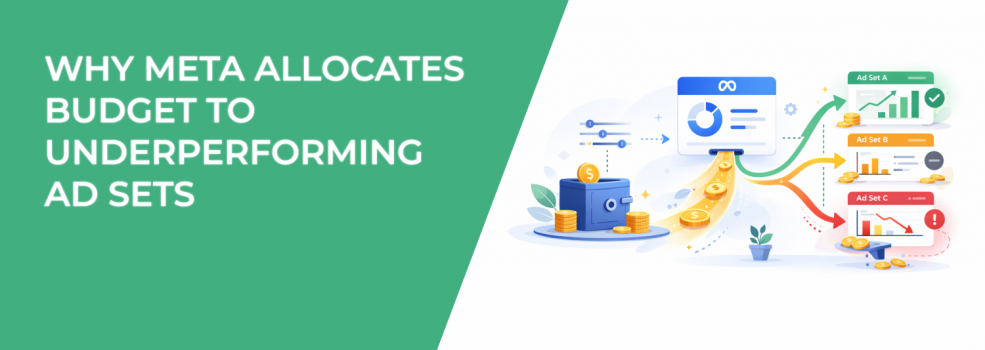
Meta often shifts budget toward ad sets that appear weaker on the surface. Many advertisers see this as a mistake. In reality, the system follows a different logic than manual evaluation.
Performance inside Ads Manager is a snapshot. Meta optimizes on probability curves and predicted outcomes. When you understand that difference, allocation patterns start to make sense.
How Meta Actually Decides Where Budget Goes
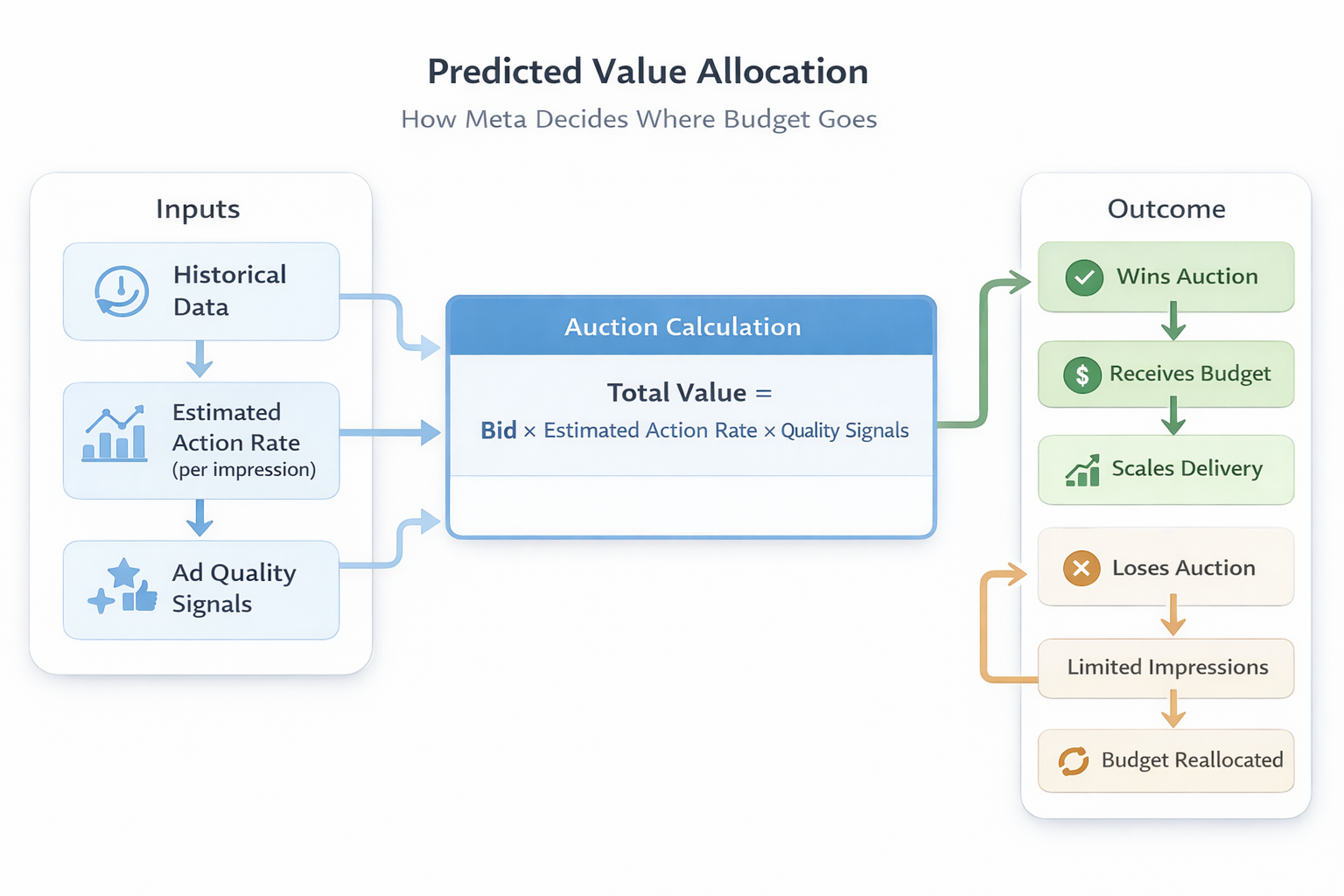
Budget distribution is based on expected value, not current averages. The system estimates which ad set is most likely to produce the next desired action at the lowest cost.
Historical data matters. So does conversion probability at the impression level. Short-term metrics rarely tell the full story.
If you want a deeper breakdown of allocation mechanics, read how Meta ads decide where to spend budget.
Estimated Action Rate Drives Delivery
Meta calculates an estimated action rate for each impression. That estimate updates constantly as new signals enter the model.
An ad set with a higher predicted action rate can receive more spend, even if recent results look worse. The system optimizes forward, not backward.
If one ad set had two expensive conversions but strong predictive signals, it may still win auctions. Another ad set with cheaper past results but weaker signals may lose delivery.
Auction Dynamics Affect Allocation
Every impression enters an auction. The winner is determined by total value, not just bid or CPA.
Total value includes:
-
Bid or cost control settings; these set the maximum tolerance for cost and influence competitiveness.
-
Estimated action rate; higher predicted engagement increases auction strength.
-
Ad quality signals; user feedback and interaction history affect competitiveness.
If an ad set loses auctions, it cannot scale. Budget shifts toward the one that wins more impressions at acceptable value.
For a detailed look at auction mechanics, see how the Facebook ad auction works.
Short-Term Metrics Mislead Advertisers
Many allocation complaints come from short time windows. Advertisers compare ad sets after one or two days of data.
That view ignores variance. Conversion performance fluctuates heavily at low volume.
Learning Phase Volatility
During the learning phase, delivery is intentionally exploratory. Meta distributes impressions across different pockets of the audience.
This exploration often inflates CPA temporarily. An ad set may look inefficient before the model stabilizes.
If you stop it too early, you interrupt signal accumulation. The system reallocates budget to ad sets with more stable data instead.
If your campaigns struggle to exit learning, review how to use the Facebook ads learning phase to your advantage.
Delayed Conversions Skew Perception
Not all conversions happen immediately after a click. Some occur hours or days later.
An ad set that appears weak today may receive delayed attributed conversions tomorrow. Meta accounts for this lag in its internal modeling.
Advertisers often judge performance before the attribution window matures. Budget decisions then appear irrational.
To understand this effect, explore why conversion delays matter in Facebook and Instagram ads .
Structural Reasons Budget Favors “Weaker” Ad Sets
Sometimes the issue is not algorithmic. It is structural.
Campaign setup heavily influences how budget flows, especially in CBO campaigns.
Audience Overlap Suppression
When ad sets target overlapping audiences, they compete internally. Meta prevents self-competition by limiting delivery.
If one ad set overlaps heavily with another, it may receive less spend even if its CPA looks strong. The system prioritizes efficiency at the campaign level.
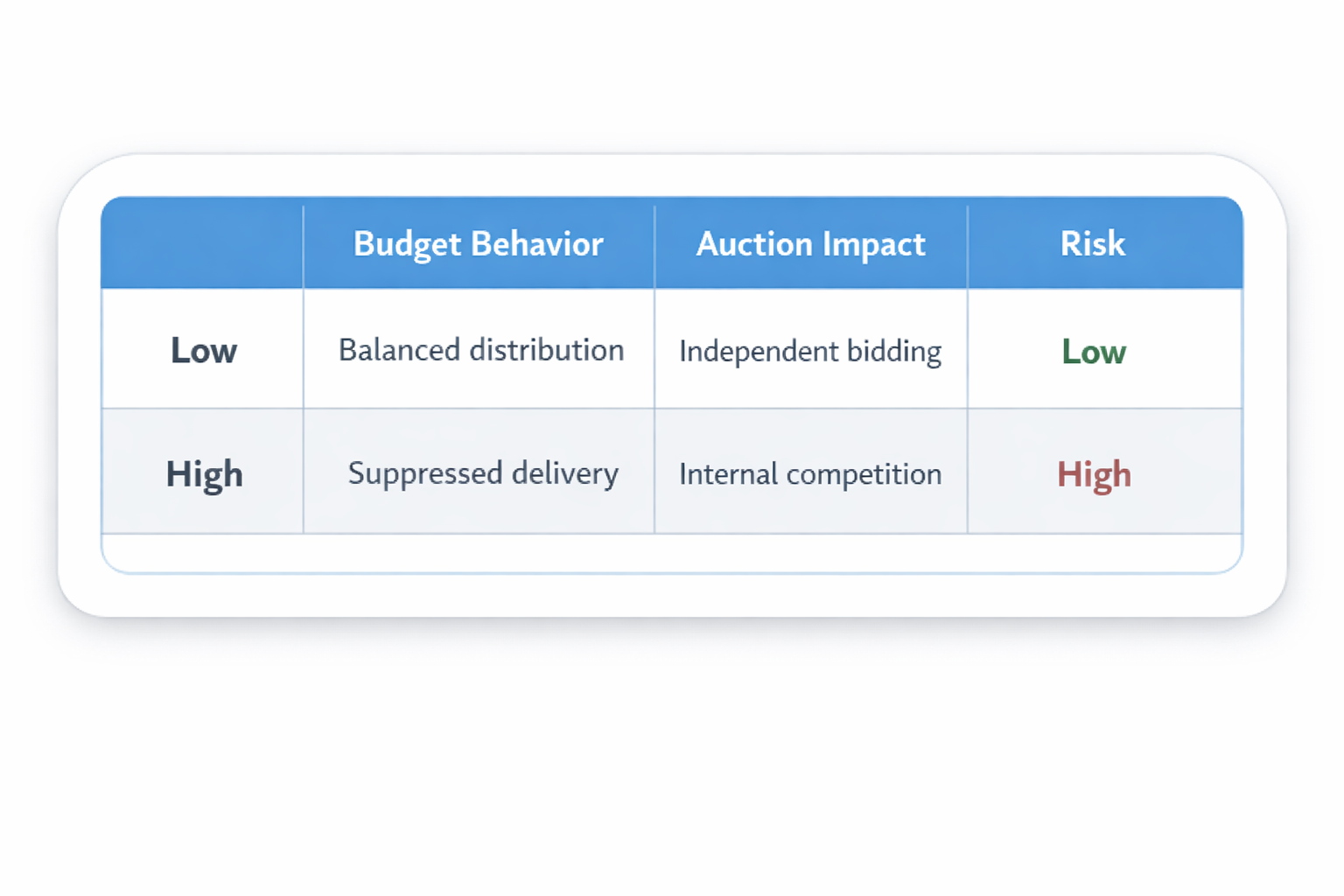
This makes one ad set appear underfunded. In reality, it protects overall results.
For a focused explanation, read why audience overlap is killing your Facebook ad performance.
Event Volume Concentration
Meta prefers ad sets with consistent event volume. Predictability improves optimization.
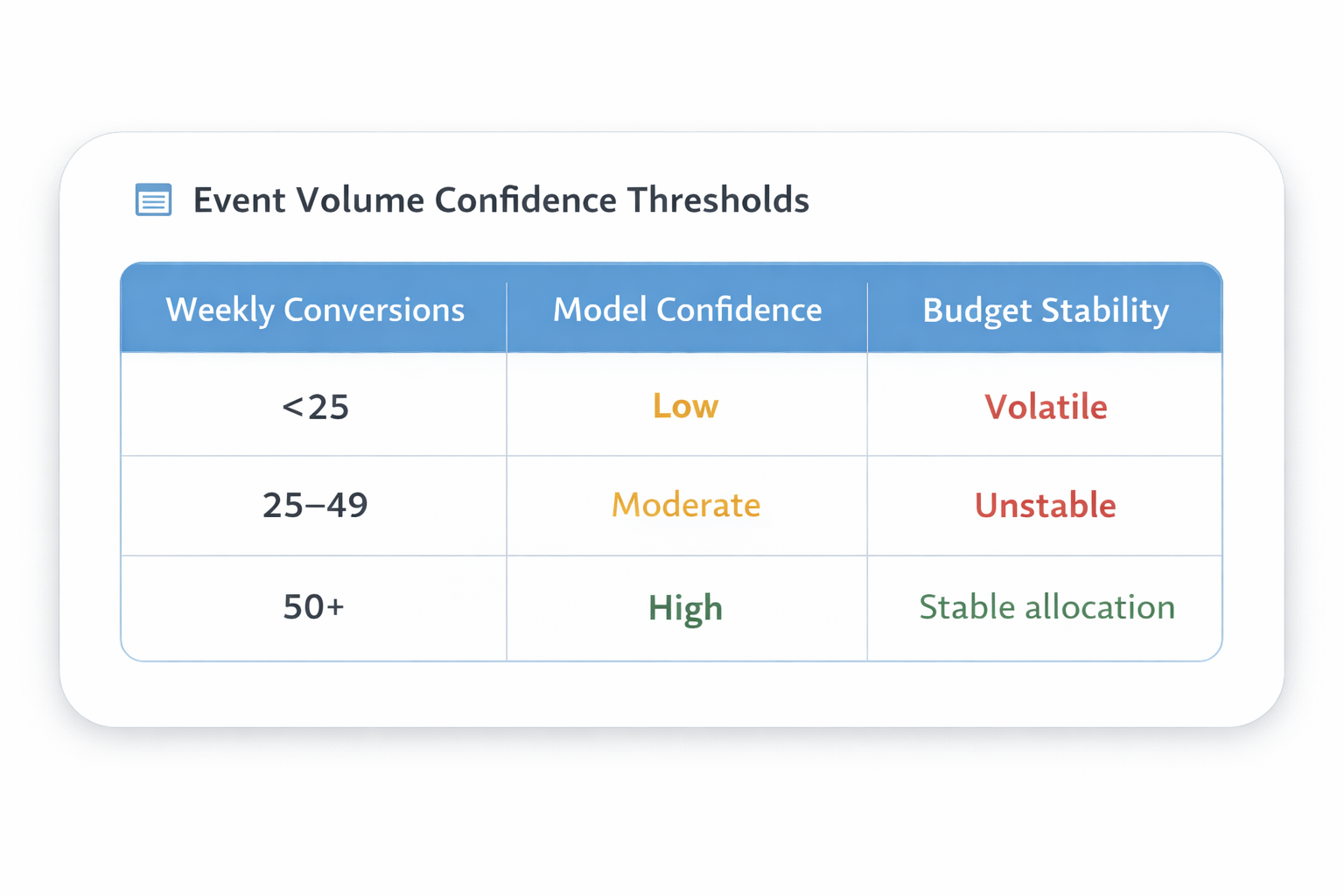
If one ad set produces sporadic conversions and another generates steady signals, budget shifts toward the steadier one. Stability often beats occasional low CPA spikes.
Low event density reduces model confidence. The system compensates by funding stronger signal pools.
Optimization Goal Mismatch
Budget allocation also reflects the selected optimization event. Many advertisers choose an event that does not match their real objective.
If you optimize for leads but evaluate on sales, allocation will look wrong. Meta optimizes exactly what you instruct it to optimize.
Micro vs Macro Conversion Signals
Top-of-funnel events generate more volume. That volume creates cleaner signal patterns.
If one ad set generates more optimized events, even low-quality ones, it can receive more budget. The algorithm rewards density of the selected event.
To align allocation with revenue:
-
Optimize for the deepest viable event; choose the lowest funnel action that still produces enough weekly volume.
-
Ensure at least 50 conversions per ad set weekly; this supports stable learning and reduces volatility.
-
Avoid mixing drastically different audience temperatures inside one campaign; cold and retargeting signals distort optimization.
Without alignment, underperformance reflects evaluation criteria, not algorithm failure.
Why Killing Underperforming Ad Sets Can Hurt Performance
Manual intervention often reduces overall efficiency. Advertisers pause ad sets that seem inefficient.
This resets learning. It also removes data diversity from the campaign.
A supposedly weak ad set may serve a niche segment with higher lifetime value. CPA alone does not capture downstream revenue.
When you eliminate it, the system concentrates spend on narrower audience slices. Over time, frequency increases and costs rise.
How to Audit Budget Allocation Properly
Instead of reacting to daily fluctuations, analyze structure and signal flow.
Start with these checks:
-
Compare performance over at least seven days; short windows distort variance.
-
Evaluate conversion volume, not just CPA; low volume exaggerates swings.
-
Review overlap diagnostics; internal competition explains many delivery gaps.
-
Confirm optimization event alignment with business goals; mismatches create false conclusions.
Then review campaign-level performance. Meta optimizes at the campaign level in CBO structures, not per ad set in isolation.
If the campaign CPA meets targets, internal allocation is often working as intended.
When Budget Allocation Truly Signals a Problem
There are cases where allocation reveals real issues.
Watch for these patterns:
-
One ad set consumes most spend with consistently high CPA over two weeks; this indicates persistent misalignment.
-
Other ad sets receive minimal impressions despite strong historical performance; audience size or bid constraints may limit competitiveness.
-
Sudden shifts after creative changes; new ads can reset delivery patterns and skew allocation.
In these cases, structural adjustments help more than emotional reactions.
Final Perspective
Meta allocates budget based on predictive probability, auction strength, and signal density. That logic differs from manual CPA comparison.
When allocation feels wrong, examine data depth, event alignment, and structural setup. Most apparent underperformance reflects short-term noise or misaligned evaluation.
The goal is not equal distribution. The goal is expected value across the campaign.