Most marketers obsess over positive signals: clicks, conversions, and engagement spikes. But every campaign generates another equally valuable dataset—negative signals. These include non-clicks, drop-offs, unsubscribes, ignored impressions, and low-quality engagements. When analyzed correctly, negative signals reveal friction, misalignment, and wasted spend that positive metrics alone cannot expose.
According to industry research, up to 60–70% of ad spend is often wasted due to poor targeting, irrelevant messaging, or frequency fatigue. Campaigns that actively use exclusion logic and negative feedback loops consistently outperform those that don’t.
What Are Negative Signals?
Negative signals are user actions—or inactions—that indicate a lack of relevance or intent. Common examples include:
-
Impressions without engagement after repeated exposure
-
Clicks that result in immediate bounces
-
Video views under 3 seconds
-
Form starts with no completion
-
Unsubscribes or ad hides
-
Conversions followed by refunds or inactivity
While none of these signals alone should trigger drastic changes, patterns across volume provide clear optimization direction.
Why Negative Signals Matter More Than You Think
Positive signals tell you who might convert. Negative signals tell you who definitely won’t—and that distinction saves budget.
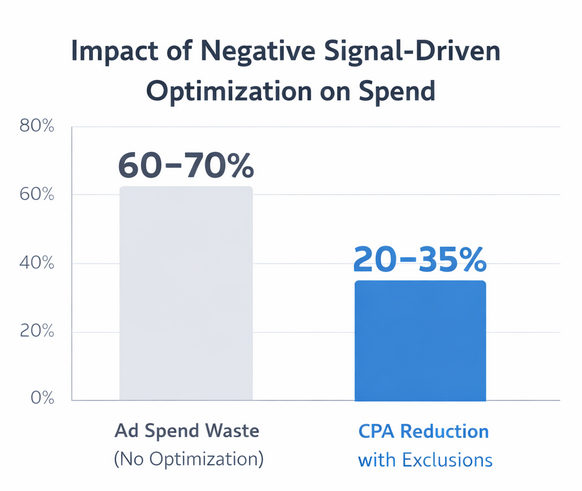
Comparison of typical ad spend waste versus cost per acquisition reduction when negative signals are used to exclude low-quality segments
Studies show that:
-
Excluding low-quality segments can reduce cost per acquisition by 20–35%
-
Campaigns that refresh exclusions every 7–14 days maintain 25% higher engagement rates over time
-
Frequency beyond 5–7 impressions without interaction leads to a 40% drop in click-through rate
Ignoring negative signals leads to audience saturation, inflated costs, and misleading performance metrics.
Turning Negative Signals Into Actionable Insights
1. Build Smarter Exclusions
Instead of broad exclusions, use layered logic. For example:
-
Exclude users who saw an ad 5+ times and didn’t click
-
Remove users who clicked but bounced in under 10 seconds
-
Suppress audiences that repeatedly engage with content but never convert
This approach preserves reach while eliminating proven non-performers.
2. Diagnose Message–Audience Mismatch
High impressions with low engagement usually indicate relevance issues. Negative signals help answer questions like:
-
Is the offer too advanced for this audience?
-
Is the creative misaligned with user intent?
-
Is the traffic source over-promising?
When campaigns adjust messaging based on these insights, conversion rates improve by an average of 15–25%.
3. Improve Funnel Efficiency
Drop-off points are negative signals inside your funnel. For example:
-
80% abandonment on step two of a form
-
High add-to-cart rate with low checkout completion
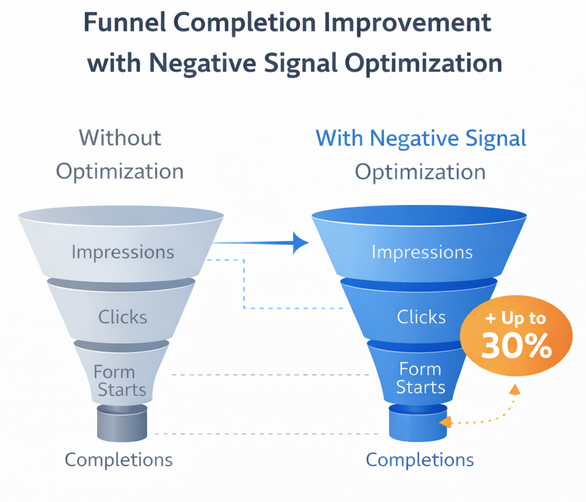
Funnel comparison showing how campaigns that apply negative signal insights improve completion rates by up to 30%
Each drop-off highlights friction. Marketers who actively optimize based on abandonment data see up to 30% higher funnel completion rates.
Using Negative Signals for Audience Refinement
Negative signals are especially powerful when refining audiences over time. By continuously removing low-intent users, remaining audiences become more concentrated around true buyers.
This refinement process results in:
-
Smaller but higher-converting audiences
-
More stable performance during scaling
-
Clearer learning signals for algorithms
In practice, campaigns that regularly prune audiences based on negative feedback achieve up to 2x higher return on ad spend compared to static audience strategies.
Common Mistakes to Avoid
-
Overreacting to small samples: Always validate negative signals with sufficient volume
-
Excluding too aggressively: Removing users too early can limit learning
-
Ignoring time lag: Some users convert after multiple touchpoints
Negative signals are guidance tools—not instant stop signs.
Conclusion
Optimization isn’t just about finding winners; it’s about systematically removing losers. Negative signals provide a clearer, faster path to efficiency by highlighting what to stop doing. When used consistently, they reduce waste, sharpen targeting, and unlock sustainable performance gains across campaigns.