Generic lead generation strategies are no longer sufficient in a market where buyers expect personalization, relevance, and speed. According to HubSpot, 61% of marketers say generating traffic and leads is their top challenge, while 74% report that converting those leads into customers is even harder.
The root cause is often a lack of vertical alignment. Each industry has distinct buyer journeys, compliance constraints, and decision-making processes. A one-size-fits-all approach leads to inefficient acquisition costs and low conversion rates.
This article outlines practical playbooks for high-performing verticals, providing actionable tactics, benchmarks, and optimization strategies.
Why Vertical-Specific Playbooks Matter
Industry-specific targeting significantly improves performance across the funnel:
-
Campaigns with industry personalization see up to 2x higher conversion rates
-
Account-based marketing (ABM) initiatives generate 208% more revenue than traditional marketing (ITSMA)
-
80% of B2B buyers expect personalized experiences (Salesforce)
Vertical playbooks enable:
-
Precise audience segmentation
-
Tailored messaging aligned with industry pain points
-
Efficient channel selection
-
Faster sales cycles
SaaS Lead Generation Playbook
Key Characteristics
-
Long consideration cycles
-
Multiple stakeholders
-
High reliance on product-led growth
Effective Strategies
-
Free Trials and Freemium Models
Lower friction entry points increase top-of-funnel volume. OpenView reports that product-led companies grow 2x faster than traditional SaaS companies. -
Retargeting with Behavioral Segmentation
Segment users based on in-app actions and engagement depth. -
Content-Led Acquisition
SEO and educational content drive 3x more leads than paid ads in SaaS environments.
KPIs to Track
-
Trial-to-paid conversion rate
-
Customer acquisition cost (CAC)
-
Product-qualified leads (PQLs)
E-commerce Lead Generation Playbook
Key Characteristics
-
Short purchase cycles
-
High competition
-
Price sensitivity
Effective Strategies
-
Email Capture Incentives
Offering discounts can increase sign-ups by up to 30%. -
Dynamic Retargeting Ads
Personalized product ads can increase conversion rates by 70%. -
Social Proof and UGC
User-generated content improves conversion rates by 29% (Stackla).
KPIs to Track
-
Conversion rate
-
Average order value (AOV)
-
Return on ad spend (ROAS)
Real Estate Lead Generation Playbook
Key Characteristics
-
High-value transactions
-
Localized targeting
-
Trust-driven decisions
Effective Strategies
-
Geo-Targeted Advertising
Local targeting improves relevance and reduces wasted spend. -
Lead Magnets (Guides, Market Reports)
Educational assets can increase lead capture rates by 20–40%. -
CRM Automation and Follow-Ups
Speed to lead is critical—responding within 5 minutes increases conversion likelihood by 9x (InsideSales).
KPIs to Track
-
Cost per lead (CPL)
-
Lead-to-appointment rate
-
Deal close rate
Healthcare Lead Generation Playbook
Key Characteristics
-
Strict compliance (HIPAA, GDPR)
-
High trust requirements
-
Informational search behavior
Effective Strategies
-
Educational Content and SEO
77% of patients begin their journey with search engines. -
Reputation Management
Reviews influence 72% of patient decisions. -
Secure Lead Capture Forms
Compliance-friendly forms increase trust and conversions.
KPIs to Track
-
Appointment booking rate
-
Cost per acquisition (CPA)
-
Patient lifetime value (LTV)
B2B Services Lead Generation Playbook
Key Characteristics
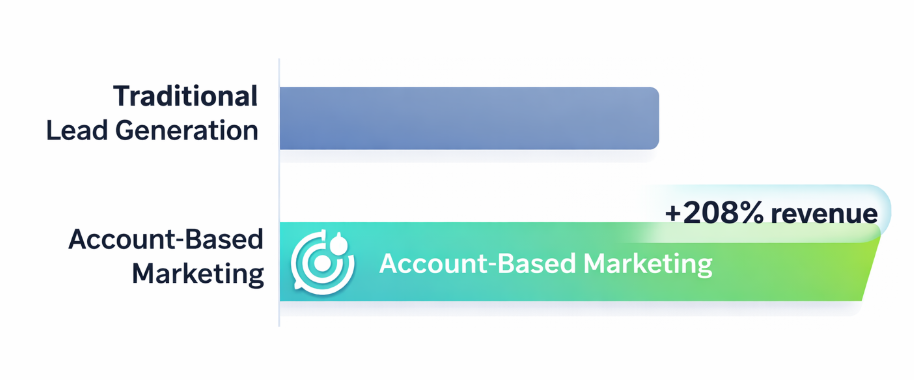
Account-based marketing dramatically increases revenue compared to traditional lead generation approaches
-
Long sales cycles
-
High deal value
-
Relationship-driven
Effective Strategies
-
Account-Based Marketing (ABM)
Targeting specific companies improves win rates significantly. -
LinkedIn Outreach and Ads
80% of B2B leads from social media come from LinkedIn. -
Thought Leadership Content
Whitepapers and case studies build authority and trust.
KPIs to Track
-
Marketing qualified leads (MQLs)
-
Sales qualified leads (SQLs)
-
Pipeline velocity
Optimization Framework for All Verticals
Regardless of industry, high-performing teams follow a structured optimization loop:
-
Data Collection – Track granular user behavior across channels
-
Segmentation – Group audiences by intent, demographics, and actions
-
Experimentation – Run A/B tests on creatives, offers, and landing pages
-
Attribution Modeling – Identify high-performing channels
-
Scaling – Allocate budget to top-performing segments
Companies that adopt data-driven optimization are 23x more likely to acquire customers (McKinsey).
Common Mistakes to Avoid
-
Using generic messaging across industries
-
Ignoring compliance requirements in regulated verticals
-
Over-reliance on a single acquisition channel
-
Failing to align marketing and sales teams
-
Not tracking full-funnel metrics
Conclusion
Vertical-specific lead generation is no longer optional—it is a competitive necessity. By aligning strategies with industry dynamics, businesses can significantly improve lead quality, reduce acquisition costs, and accelerate growth.
The playbooks outlined above provide a foundation, but continuous testing and adaptation are critical to sustained success.
Recommended Reading