The learning phase is a critical period in digital advertising when the platform’s algorithm is gathering data to optimize delivery. While it is often described as temporary, many advertisers experience campaigns that remain stuck in this phase for days or even weeks. Understanding the mechanics behind this state is essential for diagnosing performance issues and making informed adjustments.
What the Learning Phase Really Means
During the learning phase, the delivery system explores different audience segments, placements, and bidding patterns to determine what produces the best results. The algorithm prioritizes data collection over efficiency, which means performance may fluctuate significantly.
Most major ad platforms require approximately 50 optimization events within a 7-day window to exit the learning phase. If this threshold is not met, the campaign remains in a constant state of recalibration.
Why Campaigns Get Stuck
1. Insufficient Conversion Volume
The most common reason campaigns fail to exit learning is a lack of conversion signals. Without enough data points, the algorithm cannot confidently optimize delivery.
-
Campaigns generating fewer than 10–20 conversions per week are highly likely to remain in learning
-
Low daily budgets often restrict reach, further limiting data collection
2. Frequent Edits Reset Learning
Every significant change forces the algorithm to restart its learning process. This includes:
-
Budget changes above 20–30%
-
Creative swaps
-
Audience modifications
Frequent adjustments can trap a campaign in a perpetual learning loop.
3. Audience Size Constraints
Overly narrow targeting reduces the available pool of users, slowing down data acquisition.
-
Audiences under 100,000 users often struggle to generate enough signals
-
Highly segmented campaigns may compete against themselves
4. Optimization Event Misalignment
Choosing an optimization goal that is too deep in the funnel (e.g., purchases instead of clicks) can delay learning.
-
Purchase-optimized campaigns can take 2–3x longer to exit learning compared to higher-funnel events
What Happens Behind the Scenes
While a campaign is stuck in learning, several processes are continuously running:
-
Exploration: The system tests multiple delivery paths simultaneously
-
Volatility: Cost per result can fluctuate by up to 50% during this period
-
Limited Stability: Performance metrics are not reliable indicators of long-term outcomes
This phase is not inherently negative, but prolonged learning leads to inefficient spend and inconsistent scaling.
The Hidden Cost of Staying in Learning
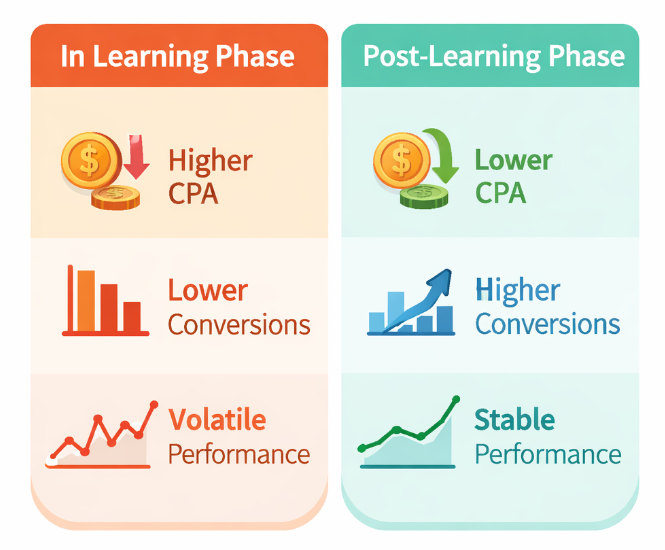
Campaigns that exit the learning phase achieve more stable performance, lower CPA, and higher conversion efficiency
Campaigns that remain in learning tend to underperform compared to stabilized campaigns:
-
Up to 20% higher cost per acquisition (CPA)
-
30% lower conversion consistency
-
Increased budget waste due to inefficient delivery
These inefficiencies compound over time, especially in high-budget accounts.
How to Get Out of the Learning Phase
1. Increase Signal Volume
-
Consolidate ad sets to pool data
-
Raise budget strategically to generate more conversions
-
Optimize for higher-funnel events if necessary
2. Reduce Unnecessary Changes
-
Allow campaigns to run for at least 3–5 days without edits
-
Batch changes instead of making incremental adjustments
3. Broaden Targeting
-
Expand audience size to improve delivery flexibility
-
Avoid excessive segmentation
4. Align Optimization Goals
-
Start with events that occur more frequently
-
Transition to deeper funnel goals once sufficient data is collected
When to Let It Run vs. When to Intervene
It is important to distinguish between healthy learning and stagnation.
Let it run if:
-
Conversion volume is steadily increasing
-
Cost trends are stabilizing
Intervene if:
-
No conversions occur after 3–5 days
-
CPA continues to rise without improvement
Conclusion
The learning phase is not just a waiting period—it is an active process of data modeling and optimization. When campaigns get stuck, it signals a breakdown in data flow, targeting, or strategy.
By understanding the underlying mechanics and applying structured adjustments, advertisers can shorten the learning phase, improve efficiency, and unlock consistent performance.
Recommended Reading