Most advertising platforms promise clarity: dashboards full of metrics, neat charts, and real-time results. At a glance, everything looks measurable and controllable. Yet many marketers sense a gap between reported performance and real business outcomes.
That gap exists because platforms are optimized to show you activity, not truth. Impressions, clicks, and even conversions can look impressive while revenue, retention, or lifetime value quietly stagnate.
Understanding what platforms don’t highlight is often the difference between scalable growth and wasted spend.
Vanity Metrics Are Designed to Look Good
Ad platforms emphasize metrics that update quickly and frequently:
-
Impressions
-
Click-through rate (CTR)
-
Video views
-
Cost per click (CPC)
These numbers create the illusion of momentum. But multiple industry studies show that over 60% of digital ad clicks result in no meaningful on-site engagement, such as scrolling, form interaction, or product views.

Average click-through rates for different ad formats show that display ads generate significantly lower engagement compared to search ads
High CTR does not automatically correlate with high-quality traffic. In many accounts, campaigns with the best CTR produce lower revenue per visitor than campaigns that look weaker on the surface.
What’s missing: indicators of user intent, depth of interaction, and post-click behavior.
Conversion Attribution Is Often Over-Credited
Platforms tend to attribute conversions generously to their own ecosystem. View-through conversions, last-touch bias, and short attribution windows inflate perceived performance.
According to multi-channel attribution analyses:
-
Up to 40% of reported conversions would have happened without the ad exposure
-
Last-click models can overvalue retargeting by 2–3× compared to first-touch analysis
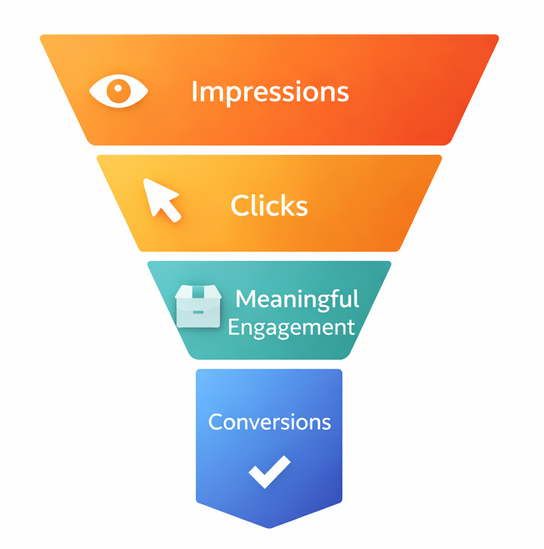
A visual funnel showing how engagement sharply drops from impressions to actual conversions, highlighting that high click counts rarely equate to proportionate business results
This doesn’t mean ads don’t work. It means performance is often overstated when viewed only inside a single platform’s reporting system.
Audience Size Matters More Than Platforms Admit
Most ad systems quietly favor scale. Larger audiences allow platforms to spend budgets faster and stabilize delivery. However, performance data consistently shows the opposite effect for many advertisers.
Smaller, more defined audiences typically outperform broad targeting:
-
Narrow audiences often generate 25–45% higher conversion rates
-
Cost per acquisition increases significantly once audiences exceed relevance thresholds
When platforms recommend “going broader,” they rarely highlight how diminishing relevance impacts efficiency.
Frequency Fatigue Is Underreported
Ad dashboards rarely warn you when your audience is tired.
In reality:
-
Conversion rates can drop by over 50% after frequency exceeds 3–4 impressions
-
Cost per conversion often rises sharply after the first week of continuous exposure
Without proactive monitoring, campaigns appear stable while silently losing efficiency.
Why Platform Optimization Isn’t the Same as Business Optimization
Platforms optimize for:
-
Spend consistency
-
Click likelihood
-
Short-term engagement signals
Businesses optimize for:
-
Revenue
-
Retention
-
Customer lifetime value
These goals overlap—but they are not the same. When marketers rely solely on in-platform metrics, they optimize for what the algorithm values, not what the business needs.
How to Read Performance More Accurately
To move beyond surface-level metrics, focus on signals platforms rarely emphasize:
-
Post-click engagement time
-
Funnel drop-off by audience segment
-
Conversion quality (not just quantity)
-
Performance decay over frequency and time
When these factors guide decision-making, ad performance becomes clearer—and more predictable.
Recommended Articles
If you want to dive deeper into performance reality and audience strategy, explore these related articles:
Final Thought
Ad platforms are powerful tools—but their dashboards are not neutral. They show what helps systems spend efficiently, not always what helps businesses grow sustainably.
Marketers who understand what’s missing from performance reports gain a lasting advantage: they stop chasing attractive numbers and start building campaigns that actually move the business forward.