Retargeting often creates the illusion that a struggling funnel is improving. Early conversions appear, cost per purchase looks reasonable, and the campaign seems stable.
A few weeks later the pattern changes — frequency climbs, CPA increases, and conversions flatten even though nothing in the campaign setup changed.
In most cases the retargeting structure is not the problem — the offer itself never converted well enough.
Retargeting Only Converts Existing Interest
Retargeting campaigns show ads to people who already interacted with your business.
Typical audiences include:
-
Website visitors.
-
Product viewers.
-
Add-to-cart users.
-
Video viewers or page engagers.
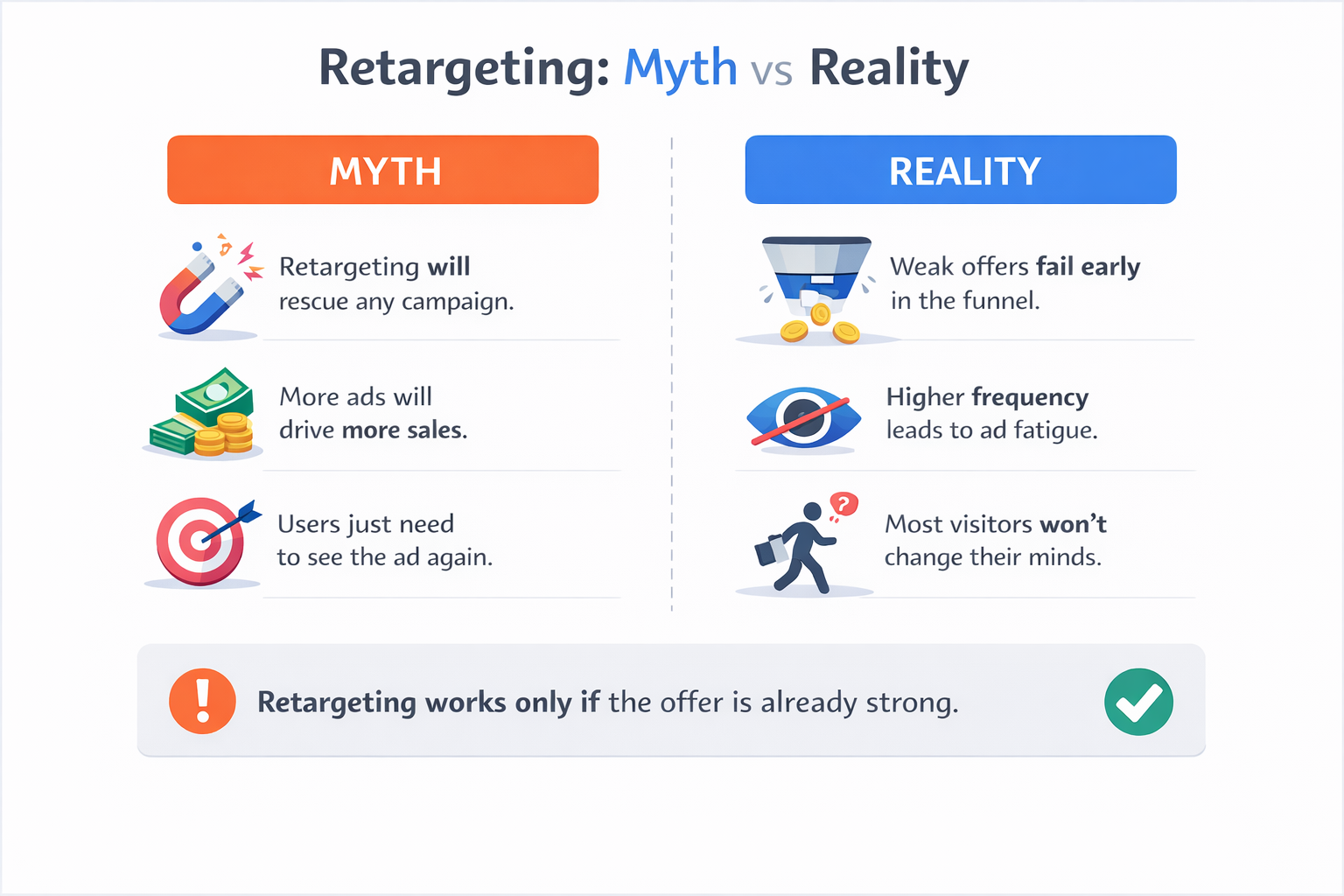
These users already showed interest. Retargeting attempts to convert that existing intent — it does not create new demand.
If the offer is strong, many users purchase during the first visit and retargeting converts the remaining hesitant group. When the offer is weak, most visitors leave after reviewing the page, and the retargeting ads simply repeat the same message.
If you want to understand the mechanics behind this process, see How Retargeting Works on Facebook: Best Facebook Retargeting Strategies.
The Funnel Breaks Before Retargeting Matters
You can usually identify the problem by reviewing funnel progression metrics.
A healthy funnel might look like:
-
1,000 clicks.
-
120 add-to-cart events.
-
60 checkout initiations.
-
40 purchases.
When the offer does not resonate, the collapse happens immediately after the click:
-
1,000 clicks.
-
25 add-to-cart events.
-
10 checkout initiations.
-
5 purchases.
At that point retargeting has very little leverage. Showing ads again to those visitors rarely changes the outcome.
The barrier typically sits on the landing page — pricing, positioning, credibility, or perceived value. Improving the offer itself usually has a bigger impact than adjusting campaign tactics.
For a deeper breakdown of conversion bottlenecks, see 8 Ways to Improve the Conversion Rate.
Frequency Cannot Repair Value Perception
When retargeting performance weakens, advertisers often increase frequency or expand the retargeting window.
The platform then shows the same ad repeatedly to the same users.
The pattern typically looks like this:
-
First visit:
The user evaluates the product and decides not to buy. -
Second exposure:
The retargeting ad repeats the same message. -
Multiple exposures:
The user ignores the ads entirely.
In Ads Manager, this appears as:
-
rising frequency;
-
declining CTR;
-
stable or falling conversions.
This dynamic is closely related to ad fatigue — a problem explained in How to Avoid Ad Fatigue and Keep Optimal Ads Costs.
Signals That Retargeting Is Masking an Offer Problem
Several platform signals usually appear when the offer is the real limitation.
Slow audience growth
-
Website visitor audiences grow slowly.
-
Add-to-cart audiences remain small.
-
Purchase volume stagnates.
Frequency rising faster than conversions
-
Frequency quickly exceeds 6–8.
-
CPM increases due to audience saturation.
-
Conversion volume stays flat.
Weak conversion among high-intent users
-
Product page visitors convert below roughly 1–2%.
-
Add-to-cart users frequently abandon checkout.
-
Retargeting CPA approaches prospecting CPA.
If these patterns appear, the issue usually lies inside the purchase experience rather than the campaign structure.
You can also compare these signals with broader campaign diagnostics in Simple Questions for Measuring Facebook Ad Effectiveness.
Practical Takeaway
Retargeting accelerates conversions — it does not create value.
If the offer fails to convince users during their first visit, additional impressions rarely change the outcome. Advertising platforms can repeat the message, but they cannot repair pricing, positioning, or trust.
When retargeting performance declines, the most useful diagnostic question is simple:
Why did the user decide not to buy the first time they saw the offer?
Once the offer converts consistently, retargeting campaigns start performing as expected.