Over the past decade, advertising platforms like Meta and Google have transitioned from manual targeting controls to machine learning-driven delivery systems. These systems rely heavily on bid strategies to determine how, when, and to whom ads are shown.
According to recent industry data, campaigns using automated bid strategies achieve up to 30% lower cost per acquisition (CPA) compared to manual bidding approaches. Additionally, Meta reports that its algorithm can evaluate thousands of signals per user in real time—far beyond human capability.
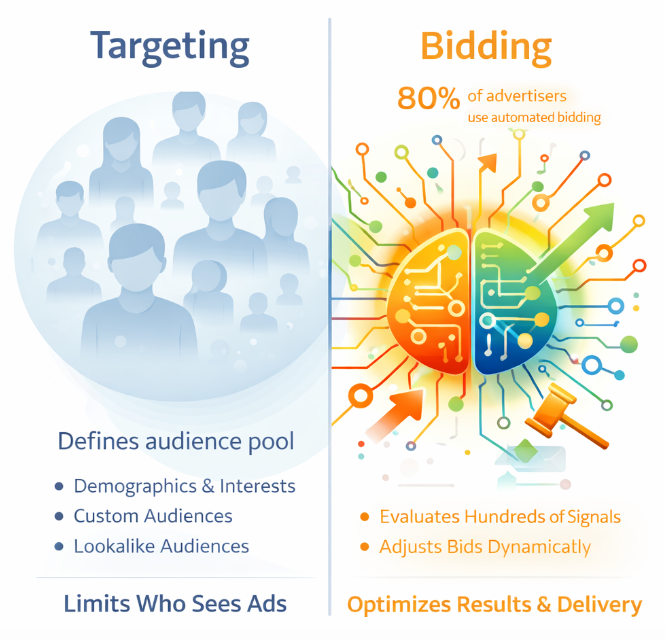
While targeting defines the audience boundaries, bid strategy determines real-time delivery and performance
This means that while targeting defines a pool, bid strategy determines actual delivery.
Why Bid Strategy Now Outweighs Targeting
1. Algorithms Expand Beyond Defined Audiences
Even when advertisers select detailed targeting parameters, platforms often extend delivery beyond those constraints. For example, Meta’s Advantage+ and Google’s Smart Bidding systems actively explore users outside initial audiences if they predict higher conversion probability.
As a result, overly narrow targeting can limit performance, while a strong bid strategy allows algorithms to find high-value users dynamically.
2. Conversion Signals Drive Optimization
Modern bidding models prioritize conversion events such as purchases, sign-ups, or leads. Campaigns optimized for conversions can improve performance by 20–50% compared to traffic-based optimization, depending on data volume.
The more consistent and high-quality your conversion signals are, the better the algorithm performs—regardless of how broad your targeting is.
3. Budget Efficiency Is Controlled by Bidding
Bid strategy directly influences how efficiently your budget is spent. Whether using target CPA, maximize conversions, or value-based bidding, the system allocates budget based on predicted outcomes.
Google’s internal studies indicate that Smart Bidding can increase conversion value by up to 35% when paired with sufficient data.
In contrast, precise targeting without an effective bid strategy often leads to higher costs and limited scale.
When Targeting Still Matters
While bid strategy is increasingly dominant, targeting is not irrelevant. It still plays a role in:
-
Defining geographic and demographic constraints
-
Excluding irrelevant audiences
-
Supporting early-stage campaigns with limited data
However, its role has shifted from precision control to boundary setting.
Practical Strategies for Marketers
1. Broaden Your Targeting
Allow algorithms more flexibility by avoiding overly restrictive audience definitions. Broad targeting combined with strong conversion signals typically outperforms narrow segments.
2. Prioritize High-Quality Conversion Data
Ensure your tracking is accurate and consistent. Feed platforms with meaningful conversion events, not just surface-level metrics like clicks.
3. Choose the Right Bid Strategy
Match your bid strategy to your campaign goals:
-
Use maximize conversions for growth
-
Use target CPA for cost control
-
Use value-based bidding for revenue optimization
Test and iterate regularly to identify what delivers the best results.
4. Allow Learning Time
Algorithmic systems require time to optimize. Avoid making frequent changes that reset the learning phase, as this can negatively impact performance.
Common Mistakes to Avoid
-
Over-segmenting audiences
-
Switching bid strategies too frequently
-
Optimizing for the wrong event (e.g., clicks instead of conversions)
-
Ignoring data volume requirements for machine learning
The Future of Paid Media Optimization
As machine learning continues to advance, the importance of manual targeting will likely decline further. Platforms are investing heavily in automation, predictive modeling, and AI-driven bidding.
Marketers who embrace this shift—focusing on data quality and strategic bidding—will gain a competitive advantage.
Suggested Articles
Conclusion
The balance of power in digital advertising has shifted. While targeting still defines the playing field, bid strategy determines the outcome. By adapting to this reality and aligning campaigns with algorithmic strengths, marketers can unlock better performance, lower costs, and greater scalability.