
Many advertisers believe tighter targeting improves performance. They split campaigns into many small ad sets. Each one targets a slightly different audience.
That structure often weakens results instead of improving them. Consolidation can produce lower CPA, more stable delivery, and cleaner scaling.
This article explains why that happens and how to decide what to change.
Why Micro-Segmentation Often Fails Today
Micro-segmentation made sense when targeting signals were limited. Advertisers relied on interests, behaviors, and manual exclusions. Precision felt like an advantage.
Meta now optimizes around behavioral data and conversion signals. The algorithm cares more about who converts than how you label them.
When you restrict delivery with many small audiences, you restrict learning. That creates structural inefficiency.
If you want a deeper look at how excessive segmentation hurts results, read Over-Segmentation in Facebook Ads: Why Too Many Campaigns Kill Efficiency.
Small Ad Sets Create Weak Learning Loops
Each ad set needs enough optimization events to stabilize performance. If it does not get enough events, the model keeps recalibrating.
Weak learning loops cause:
-
Volatile CPA; performance swings every few days.
-
Delayed scaling; spend increases break stability.
-
False negatives; good creatives look bad due to limited data.
If five ad sets each get ten conversions per week, none of them stabilizes. One ad set with fifty conversions usually performs better.
If your campaigns are stuck in learning, review Why Some Campaigns Never Exit Learning for structural causes.
Overlap Quietly Raises Costs
Interest clusters often overlap heavily. Lookalikes built from similar sources overlap even more.
When you separate overlapping audiences, they compete in the same auction. You raise your own CPM.
Consolidation removes internal bidding pressure. The system distributes impressions without artificial barriers.
To understand this dynamic in detail, see Why Audience Overlap Is Killing Your Facebook Ad Performance.
Why Consolidation Works in Practice
Consolidation does not mean broad and careless targeting. It means fewer structural limits.
When you merge ad sets, you increase signal density. The algorithm sees more conversion patterns within one dataset. That improves prediction accuracy.
More Data Per Ad Set Improves Optimization
Machine learning models perform better with larger datasets. This is basic math.
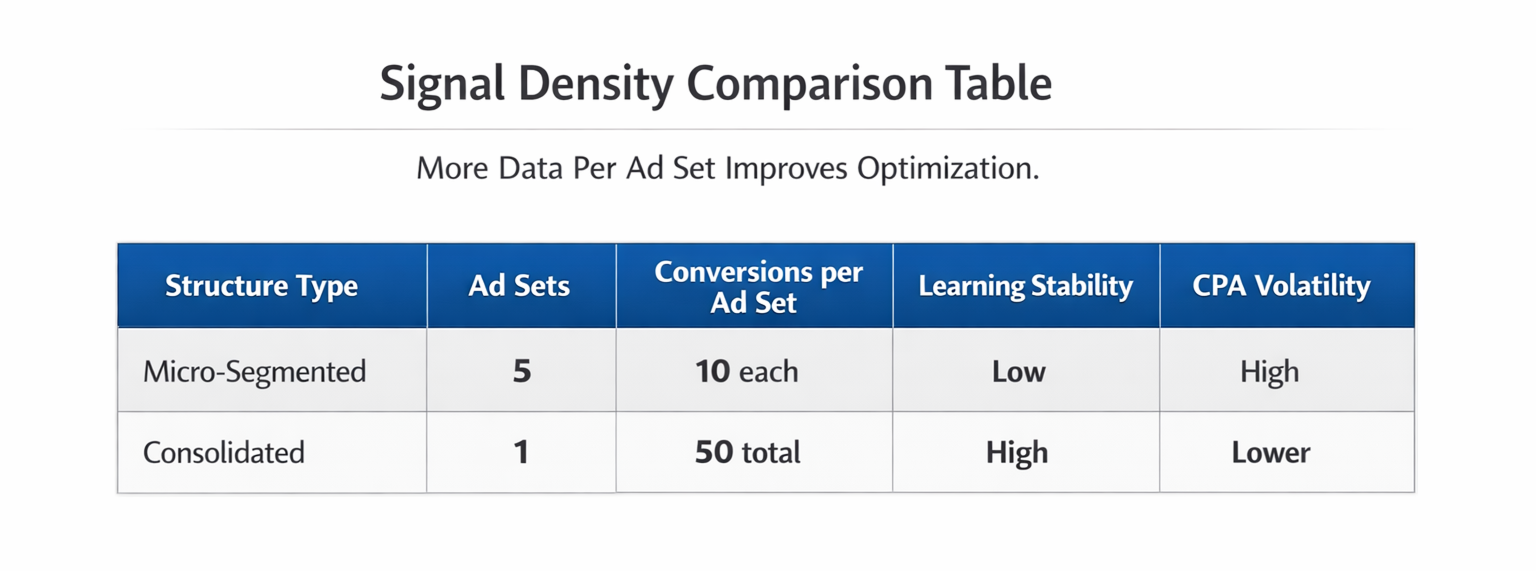
Higher data density gives you:
-
Faster learning phase exits; performance stabilizes earlier.
-
Clearer trend signals; you can spot real shifts, not noise.
-
Smarter budget allocation; spend flows to high-intent users automatically.
Instead of manually deciding which audience deserves budget, you let conversion behavior decide.
This approach aligns with what Meta prioritizes internally. As explained in Why Meta Ads Favor Patterns Over Precision, pattern recognition beats manual slicing in most cases.
Budget Concentration Reduces Waste
Fragmented budgets often create artificial ceilings. An ad set capped at a small daily budget cannot explore properly.
Consolidated budgets allow:
-
Deeper exploration of user segments inside the audience.
-
More efficient testing of creatives.
-
Fewer performance resets during scaling.
You reduce the number of decision points that can break delivery.
When Consolidation Delivers the Biggest Gains
Consolidation is not always the right move. It works best under specific conditions.
Limited Conversion Volume
If most ad sets generate fewer than fifty optimization events per week, you are starving the system. That is common in lead generation and mid-budget ecommerce accounts.
Consolidating helps the model learn from a larger event pool. CPA often drops simply because noise decreases.
Identical Creative Across Audiences
If every segment sees the same ad, segmentation rarely adds value. The message does not change.
In that case, separating audiences only divides data. Merge them and allow the system to prioritize responders.
Scaling Struggles Despite Strong Creative
If creatives convert well at low spend but break at higher budgets, structure may be the issue. Fragmented ad sets limit scaling headroom.
Consolidation increases available reach inside a single learning environment. That often stabilizes expansion.
When Micro-Segmentation Still Makes Sense
Micro-segmentation is useful when it reflects real strategic differences.
Distinct Messaging by Segment
If your messaging changes by audience, segmentation supports clarity. Each segment should receive tailored value propositions.
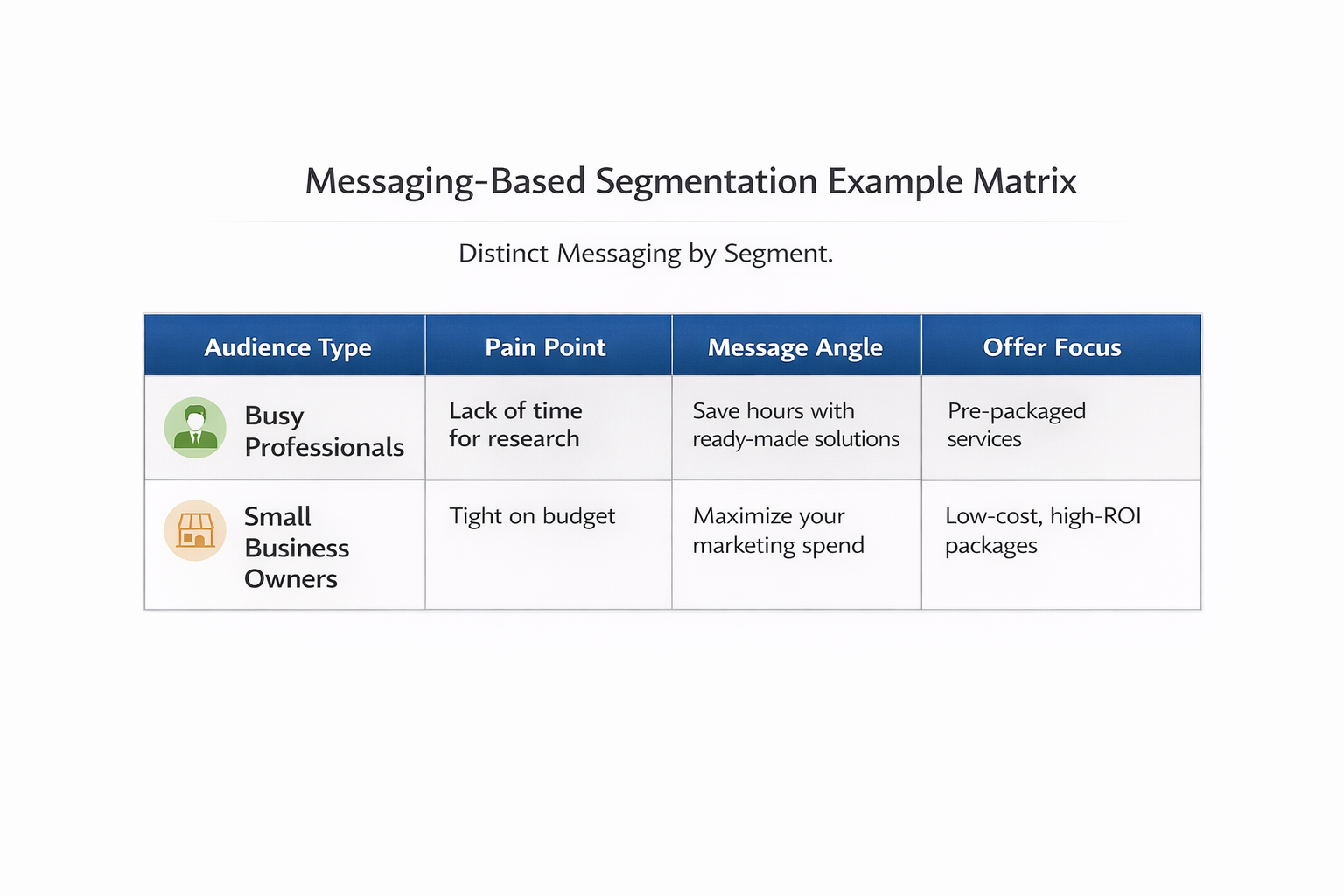
For example:
-
Enterprise decision-makers; emphasize compliance and integration depth.
-
Small business owners; focus on simplicity and fast implementation.
-
Agencies; highlight multi-account control and reporting efficiency.
Here, segmentation supports communication logic. It is not just structural habit.
Large Budgets With Strong Event Volume
High-spend accounts with hundreds of weekly conversions per segment can sustain multiple ad sets. Each segment still produces strong signals.
In those cases, segmentation becomes a scaling lever rather than a constraint.
Hidden Structural Problems to Audit
Before you add new audiences, review your current structure.
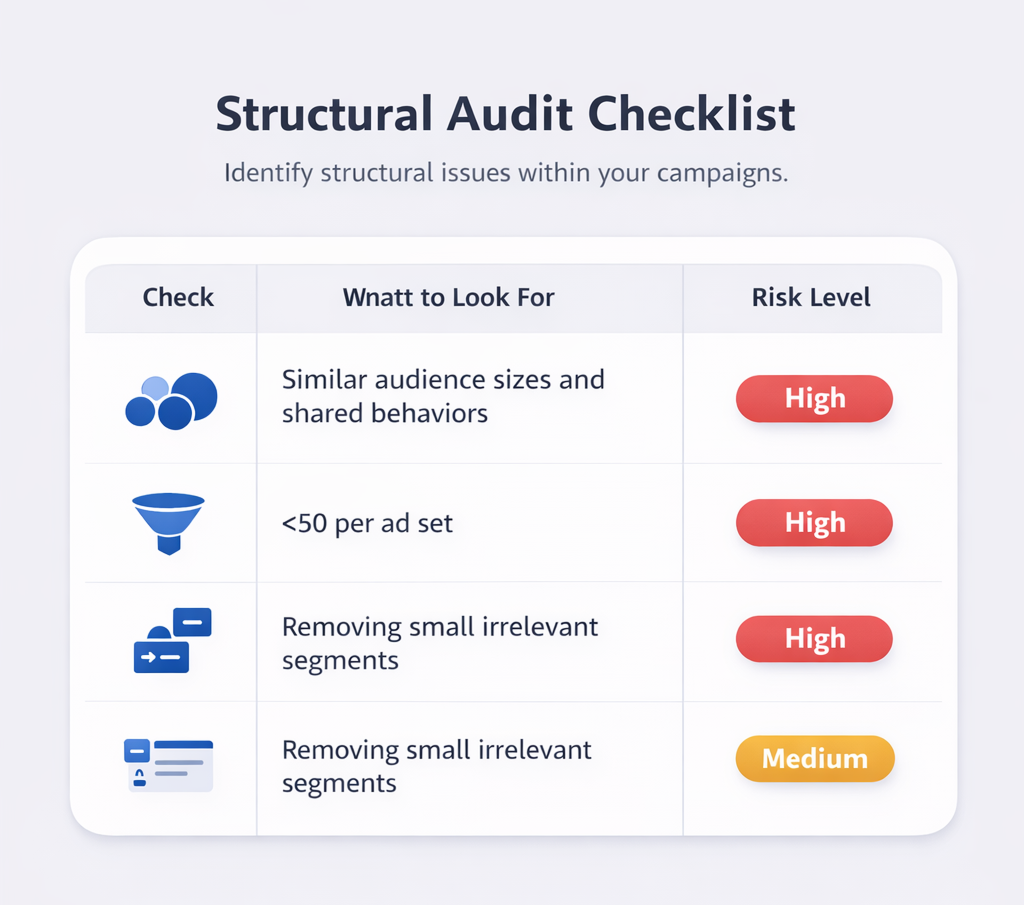
Look for these issues:
-
Duplicate interest clusters that differ only slightly; they split data without expanding reach.
-
Excessive exclusions; they shrink audiences without measurable CPA improvement.
-
Too many campaign layers; they block smooth budget flow.
Most performance issues blamed on creative are structural.
A Simple Decision Framework
Use this checklist before restructuring.
Events Per Ad Set
Count weekly optimization events per ad set. If most sit below fifty, consolidation is likely beneficial.
Budget Per Ad Set
Compare daily budget to average CPA. If you barely afford a few conversions per day, learning will remain unstable.
Audience Overlap
Check overlap between major segments. If overlap is high, consolidation reduces internal competition.
Creative Variation
Ask whether each segment has truly different messaging. If not, simplify.
What Changes After You Consolidate
Expect short-term fluctuation after merging ad sets. The system recalibrates to the new structure.
Within a few weeks, you should see:
-
More stable CPA trends.
-
Cleaner scaling at higher budgets.
-
Fewer random performance drops.
Consolidation is not about making campaigns simpler. It is about increasing signal concentration. When data flows into fewer containers, optimization improves.
Many advertisers try to solve structural problems with new creatives or higher bids. Often, the real fix is structural discipline.