
Custom audiences have long been a reliable way to drive conversions, retarget users, and maximize return on ad spend. Built from website visitors, CRM data, or app users, these audiences typically outperform broader targeting due to their high intent and familiarity with a brand.
But performance does not scale indefinitely. As audiences shrink or become overused, advertisers often encounter rising costs, declining engagement, and limited delivery. Understanding the dynamics behind audience size and performance is essential to maintaining efficiency in modern advertising ecosystems.
Why Custom Audiences Shrink
1. Data Decay and Signal Loss
User data has a limited lifespan. Cookies expire, users change devices, and identifiers become less reliable over time. Studies show that up to 30% of CRM data becomes outdated each year, reducing match rates and audience size.
Additionally, privacy frameworks and platform restrictions have significantly reduced the amount of trackable user data. With the deprecation of third-party cookies and increased adoption of opt-out mechanisms, advertisers are seeing smaller usable audiences.
2. Audience Saturation
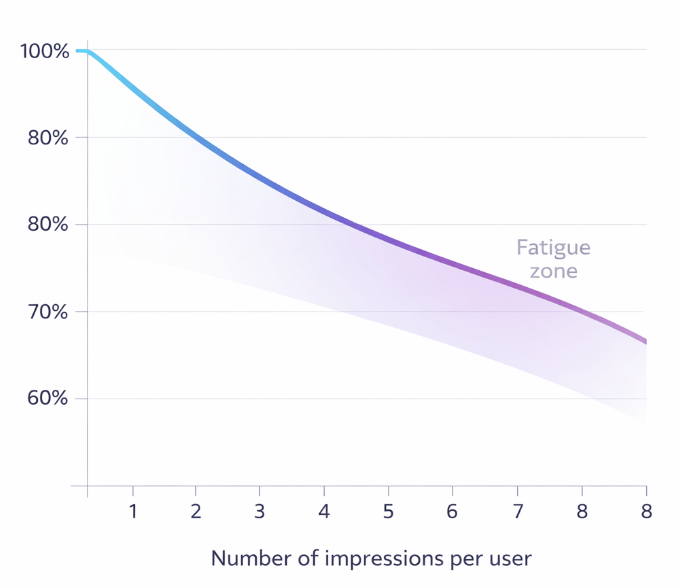
CTR declines significantly as frequency increases, with performance typically dropping 20–30% once audiences are repeatedly exposed to the same ads
Repeatedly targeting the same group leads to saturation. Frequency increases while incremental conversions decline. Research indicates that after 5–7 impressions per user, click-through rates can drop by more than 40%, signaling fatigue.
3. Limited Seed Pools
Many advertisers rely on small seed audiences—such as recent converters or high-value customers—to build campaigns. When these pools are too narrow, scaling becomes impossible without expanding criteria.
4. Platform Optimization Constraints
Ad platforms require sufficient data to optimize effectively. When audience sizes fall below certain thresholds (often around 1,000 users depending on the platform), delivery algorithms struggle, leading to unstable performance and higher costs per acquisition.
Key Warning Signs
Recognizing when your custom audience is too small is critical. Common indicators include:
-
Rising CPM and CPA with no change in creative or bidding strategy
-
Declining reach despite stable budgets
-
High frequency (e.g., above 6–8) with diminishing returns
-
Inconsistent delivery or limited impressions
These signals often appear gradually but can quickly compound into significant inefficiencies.
The Performance Impact
Small audiences limit both scale and learning. Campaigns become constrained in two major ways:
-
Reduced Auction Competitiveness
With fewer eligible users, your ads enter fewer auctions, reducing opportunities to win impressions at efficient prices. -
Algorithmic Instability
Machine learning models depend on sufficient conversion volume. When events are sparse, optimization becomes less accurate, often increasing CPA by 20–50%.
In practical terms, advertisers may see strong initial performance followed by rapid degradation as the audience is exhausted.
How to Fix the Problem
1. Expand Audience Windows
Instead of targeting only recent users (e.g., 7–14 days), extend lookback windows to 30, 60, or even 180 days where appropriate. This increases audience size while maintaining relevance.
2. Layer Behavioral Signals
Combine multiple engagement signals—such as site visits, content interaction, and email engagement—to build more robust audiences. This helps compensate for individual data gaps.
3. Use Lookalike Modeling Strategically
Lookalike audiences can extend reach while preserving intent signals. However, they should be refreshed regularly and based on sufficiently large, high-quality seed data.
4. Rotate and Refresh Creatives
Creative fatigue accelerates audience saturation. Introducing new messaging and formats can improve engagement and extend the usable lifespan of smaller audiences.
5. Diversify Data Sources
Relying on a single source (e.g., website traffic) increases vulnerability. Incorporate CRM, offline conversions, and first-party data collection strategies to stabilize audience volume.
6. Consolidate Fragmented Audiences
Over-segmentation often leads to multiple small audiences competing against each other. Consolidating similar segments can improve delivery and algorithmic learning.
Strategic Considerations
In today’s environment, audience strategy must balance precision with scale. While hyper-targeting can deliver strong short-term results, it often limits long-term growth.
Advertisers should continuously evaluate whether their targeting strategy allows platforms to optimize effectively. In many cases, slightly broader audiences outperform highly restricted ones due to better data density and learning opportunities.
Suggested Reading
To deepen your understanding of audience strategies and performance optimization, consider these additional articles:
Conclusion
Custom audiences remain a powerful tool, but they are not immune to structural limitations. As data signals weaken and competition increases, maintaining sufficient audience size becomes critical to sustaining performance.
By proactively monitoring audience health, expanding data inputs, and adapting targeting strategies, advertisers can avoid the pitfalls of undersized audiences and continue to drive consistent, scalable results.