
Retargeting is one of the most effective performance marketing tactics, with studies showing that retargeted users are up to 70% more likely to convert compared to first-time visitors. However, as retargeting strategies become more sophisticated and fragmented across platforms, many companies face a less visible but costly problem: their own campaigns begin to compete against each other.
This internal competition drives up costs, reduces efficiency, and distorts attribution models. Understanding why this happens is essential for any organization running multi-channel or multi-segment retargeting strategies.
What Does "Campaign Competition" Mean?
Campaign competition occurs when multiple retargeting campaigns target overlapping audiences simultaneously. Instead of coordinating efforts, campaigns enter the same ad auctions, bid against each other, and deliver redundant impressions.
For example, a user who visited a product page may be included in:
-
A general website retargeting campaign
-
A product-specific retargeting campaign
-
A cart abandonment campaign
-
A cross-sell or upsell campaign
Without proper exclusion logic, these campaigns compete for the same impression, often within milliseconds.
Why Retargeting Campaigns Compete With Each Other
1. Audience Overlap Across Segments
Audience segmentation is rarely mutually exclusive. Research indicates that up to 40–60% of retargeting audiences overlap across typical funnel stages (e.g., product viewers vs. cart abandoners).
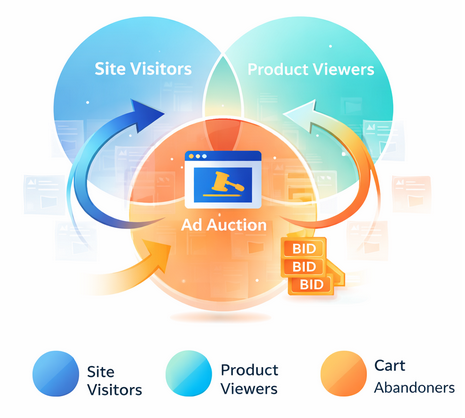
Overlapping audience segments cause multiple campaigns to bid for the same user, increasing costs and ad fatigue
When segmentation rules are not strictly hierarchical, users qualify for multiple campaigns at once, triggering internal bidding conflicts.
2. Platform Fragmentation
Most companies run retargeting across multiple platforms (e.g., display networks, social media, and programmatic platforms). Each platform operates in its own auction environment and lacks visibility into campaigns running elsewhere.
As a result, the same user may be targeted simultaneously across multiple channels, increasing frequency and cost without proportional gains in conversions.
3. Lack of Suppression Logic
Suppression (or exclusion) rules are often underutilized. For example, users who have already converted or moved to a deeper funnel stage should be excluded from broader campaigns.
Without suppression, higher-intent campaigns (e.g., cart abandonment) compete with lower-intent campaigns (e.g., homepage visitors), diluting performance.
4. Independent Campaign Optimization
Marketing teams frequently optimize campaigns in isolation, focusing on metrics like CTR or CPA at the campaign level rather than system-wide efficiency.
This siloed optimization leads to situations where multiple campaigns are "successful" individually but inefficient collectively.
5. Attribution Model Limitations
Many attribution models (especially last-click) fail to account for internal competition. Campaigns that deliver the final touchpoint receive full credit, even if other campaigns influenced the conversion earlier.
This encourages overinvestment in overlapping campaigns, reinforcing the competition problem.
The Cost of Internal Competition
The impact of competing retargeting campaigns is significant:
-
Higher CPMs and CPCs: Internal bidding increases auction pressure, raising costs.
-
Ad fatigue: Users may see multiple ads from the same brand in a short period, reducing engagement.
-
Inefficient frequency distribution: Instead of controlled exposure, users are over-served ads.
-
Distorted performance data: Attribution inaccuracies make it difficult to identify truly effective campaigns.
According to industry benchmarks, poorly structured retargeting setups can waste 20–30% of ad spend due to overlap and redundancy.
How to Prevent Retargeting Campaign Competition
1. Implement Hierarchical Audience Segmentation
Structure audiences in a clear funnel hierarchy:
-
Bottom funnel (highest priority): cart abandoners, checkout visitors
-
Mid funnel: product page viewers
-
Top funnel: general site visitors
Ensure that each level excludes users from higher-intent segments.
2. Use Strict Exclusion Rules
Apply exclusion logic systematically:
-
Exclude converters from all retargeting campaigns
-
Exclude lower-funnel users from upper-funnel campaigns
-
Exclude users already engaged in active campaigns with higher priority
This prevents overlap and ensures clean audience boundaries.
3. Coordinate Across Platforms
Develop a unified retargeting strategy across channels:
-
Align frequency caps across platforms
-
Use centralized audience definitions where possible
-
Monitor cross-channel exposure
Even though platforms are siloed, strategic coordination reduces redundancy.
4. Consolidate Campaigns Where Possible
Instead of running multiple narrowly defined campaigns, consider consolidating them into fewer, well-structured campaigns with dynamic creatives.
This reduces auction competition and simplifies optimization.
5. Optimize for Incrementality, Not Just Conversions
Shift focus from raw conversion metrics to incremental lift. Controlled experiments (e.g., holdout groups) can reveal whether additional campaigns truly add value or simply cannibalize existing ones.
Key Takeaways
Retargeting campaigns compete with each other primarily due to audience overlap, platform fragmentation, and insufficient coordination. While each campaign may appear effective in isolation, the combined system often suffers from inefficiencies that inflate costs and reduce overall ROI.
By implementing structured segmentation, exclusion logic, and cross-channel coordination, marketers can eliminate internal competition and unlock the full potential of their retargeting strategies.