Cold traffic presents one of the most challenging environments in digital marketing. Audiences have no prior exposure to your brand, no established trust, and limited attention spans. In this context, the type of creative you use determines whether a user scrolls past—or stops and engages.
While many marketers default to rational creatives—highlighting features, pricing, or technical advantages—evidence increasingly shows that emotional creatives deliver superior performance when targeting cold audiences.
This article explores why emotional creatives outperform rational ones in cold traffic, supported by data, behavioral psychology, and practical application strategies.
The Psychology Behind Cold Traffic
Cold audiences operate under three key constraints:
-
Low trust
n- Low attention -
Low intent
Under these conditions, users rely on fast, instinctive decision-making processes. According to research from behavioral science, up to 95% of purchasing decisions are subconscious and driven by emotion rather than logic.
This aligns with the dual-system theory of thinking:
-
System 1: Fast, emotional, intuitive
-
System 2: Slow, rational, analytical
Cold traffic interacts almost exclusively through System 1.
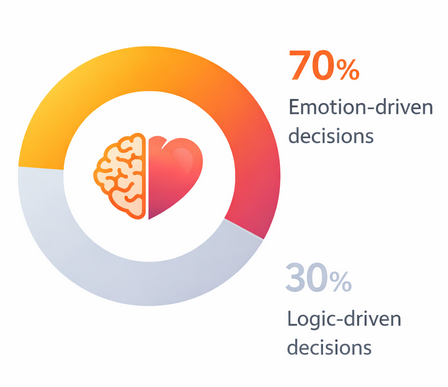
Most decisions in cold traffic environments are driven by emotion, not rational analysis
Rational creatives require System 2 engagement—which simply does not activate at the top of the funnel.
Why Rational Creatives Underperform
Rational creatives typically focus on:
-
Product features
-
Specifications
-
Pricing structures
-
Logical comparisons
These elements require cognitive effort to process. In a cold environment, users are not motivated to invest that effort.
Statistics support this:
-
Ads with purely informational messaging show up to 30–40% lower click-through rates compared to emotionally driven ads
-
Users spend on average less than 2 seconds evaluating a new ad in a feed
If your message cannot trigger immediate relevance or emotional resonance, it gets ignored.
Why Emotional Creatives Win
Emotional creatives succeed because they align with how users naturally process unfamiliar information.
1. They Capture Attention Instantly
Emotionally charged visuals and headlines interrupt scrolling behavior. Whether it is curiosity, fear of missing out, or aspiration, emotion creates pattern disruption.
Studies show that emotionally engaging ads can increase attention by up to 70% compared to neutral creatives.
2. They Build Instant Relevance
Cold audiences do not care about your product—they care about their problems, desires, and identity.
Emotional creatives position the user at the center of the narrative:
-
"Struggling to find qualified leads?"
-
"Tired of wasting ad budget with no results?"
This creates immediate personal relevance without requiring prior brand familiarity.
3. They Reduce Cognitive Load
Instead of asking users to evaluate features, emotional creatives communicate value through feeling.
For example:
-
Rational: "Advanced targeting algorithm with multi-layer segmentation"
-
Emotional: "Finally reach the people who actually want what you offer"
The second message is processed faster and requires less effort.
4. They Drive Higher Engagement and Conversion
Multiple studies indicate that campaigns with emotional messaging outperform rational ones in:
-
Click-through rate (CTR): +20–50%
-
Conversion rate: +10–30%
-
Ad recall: +40% or more
Emotional creatives not only attract attention—they sustain it long enough to drive action.
When Rational Messaging Still Matters
This does not mean rational creatives are useless. They play a critical role at later stages:
-
Retargeting campaigns
-
Bottom-of-funnel decision-making
-
Product comparisons
Once trust is established, users become more receptive to detailed information.
However, using rational creatives too early creates friction and reduces overall funnel efficiency.
How to Build High-Performing Emotional Creatives
To leverage emotional performance in cold traffic, focus on the following principles:
1. Start With a Core Emotion
Identify the dominant emotional driver behind your offer:
-
Pain (frustration, inefficiency)
-
Desire (growth, success)
-
Fear (missing opportunities)
-
Relief (simplification, clarity)
Your creative should amplify this emotion immediately.
2. Use Visual Storytelling
Images and videos should communicate the emotional outcome—not the product itself.
Examples:
-
Before/after scenarios
-
Expressions of frustration or success
-
Clear transformation narratives
3. Simplify the Message
Cold audiences do not read—they scan.
Keep messaging:
-
Short
-
Direct
-
Outcome-focused
Avoid technical jargon in initial touchpoints.
4. Align Copy With Audience Identity
Use language that reflects how your audience sees themselves.
Instead of generic messaging, speak directly to:
-
Founders
-
Marketers
-
Sales teams
This strengthens emotional resonance.
5. Test Variations Systematically
Emotional impact varies across segments. Test different angles:
-
Pain vs aspiration
-
Urgency vs curiosity
-
Simplicity vs ambition
Data will reveal which emotional triggers perform best.
Common Mistakes to Avoid
Even when using emotional creatives, execution matters. Avoid:
-
Overloading creatives with information
-
Mixing too many emotional signals
-
Using vague or generic messaging
-
Ignoring visual quality
Clarity and focus are critical for emotional effectiveness.
Conclusion
Cold traffic is not a rational environment. It is fast, emotional, and instinct-driven.
Marketers who rely on logic-first creatives often struggle to capture attention and generate engagement at the top of the funnel.
Emotional creatives, on the other hand, align with how users actually think and behave. They reduce friction, increase relevance, and ultimately drive stronger performance across key metrics.
If your campaigns are underperforming, the issue may not be your offer—it may be how you are communicating it.