
A common assumption in digital advertising is that more audiences equal more opportunities. In practice, building dozens of narrowly segmented audiences often leads to fragmented data, unstable performance, and slower learning. Platforms optimize best when they receive clear signals, and over-segmentation can dilute those signals.
Modern ad platforms rely heavily on machine learning. When audiences are split too finely, each segment receives fewer impressions, clicks, and conversions. As a result, algorithms struggle to identify winning patterns, causing higher costs and inconsistent delivery.
Why Fewer Audiences Often Win
1. Faster Learning and Stabilization
Ad platforms typically require a minimum number of conversion events to optimize effectively. Industry benchmarks suggest that campaigns performing best usually reach 40–50 conversions per week per ad set. When audiences are split across many ad sets, most never reach this threshold, keeping campaigns in a perpetual learning phase.
By consolidating audiences, conversion data accumulates faster, allowing algorithms to stabilize and optimize delivery more efficiently.
2. Lower CPM Through Broader Reach
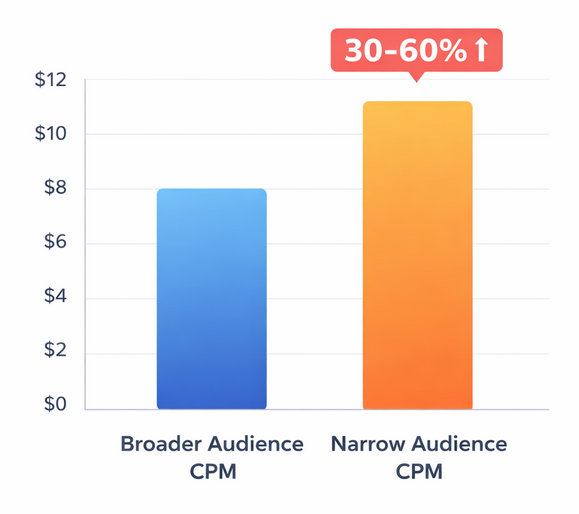
Comparison of average CPM between broader and narrowly segmented audiences
Overly narrow audiences tend to drive up competition in auctions. Multiple studies across social advertising platforms show that highly restricted targeting can increase CPM by 30–60% compared to broader audience approaches. Fewer, well-structured audiences reduce overlap and allow platforms to find lower-cost impressions.
3. Stronger Signal Quality
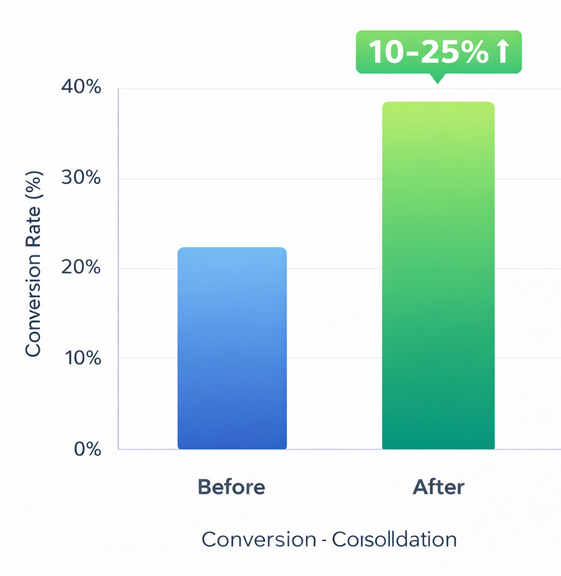
Conversion rate increases observed after consolidating fragmented audiences
When audiences are simplified, the system receives clearer feedback on which users convert and why. This improves predictive accuracy. Advertisers often see 10–25% improvements in conversion rates after consolidating overlapping or underperforming audience segments.
When Simplification Works Best
Fewer audiences are especially effective in the following scenarios:
-
Conversion-focused campaigns where learning speed is critical
-
Mid- to high-budget campaigns that benefit from scale
-
Accounts experiencing audience overlap warnings
-
Campaigns stuck in learning limited status
In contrast, extreme segmentation is usually only justified when messaging, creative, or offers differ significantly between groups.
A Practical Framework for Reducing Audiences
-
Merge similar interest or behavioral groups instead of separating minor variations.
-
Prioritize performance-based audiences that generate consistent conversion signals.
-
Pause audiences that fail to exit the learning phase after sufficient spend.
-
Monitor overlap and frequency, not just CTR or CPC.
Advertisers who regularly audit and consolidate audiences often achieve more predictable scaling with fewer structural changes.
Performance Data Snapshot
-
Consolidated campaigns commonly exit the learning phase 2–3x faster than fragmented setups.
-
Accounts reducing audience count by half often see 15–30% lower cost per acquisition within the first optimization cycle.
-
Broader audience pools consistently outperform narrow segments in long-term ROAS stability.
Recommended Reading
Final Thoughts
Simplification is not about giving up control—it is about enabling algorithms to work with stronger, clearer data. Fewer audiences create better learning conditions, reduce auction pressure, and unlock sustainable performance improvements. In many cases, less structure delivers more results.