
Media Mix Modeling (MMM) offers a broader perspective by analyzing how different marketing activities contribute to overall business outcomes. In situations where attribution tools struggle with fragmented data, privacy restrictions, and cross‑channel complexity, MMM can provide more reliable insights for strategic decision‑making.
Modern marketing operates across dozens of channels: paid search, social media, display advertising, email, influencers, and offline campaigns. Each platform offers its own attribution model designed to prove the value of its inventory. However, these models rarely agree with each other, often leading to inconsistent and misleading performance insights.
This is where Media Mix Modeling becomes valuable. Instead of assigning credit based on individual user journeys, MMM analyzes historical performance data and statistical relationships between marketing inputs and business outcomes. In certain scenarios, this approach produces significantly more accurate strategic insights than platform‑level attribution.
Understanding Platform Attribution
Platform attribution models assign conversion credit based on interactions that occur within a specific ecosystem. Common examples include last‑click attribution in analytics tools or platform‑specific models in advertising dashboards.
While these systems provide fast feedback, they suffer from several structural limitations:
-
Walled gardens. Each platform measures performance within its own environment.
-
Self‑attribution bias. Platforms naturally credit themselves for conversions whenever possible.
-
Incomplete cross‑device tracking. Users often switch between devices before converting.
-
Privacy limitations. Modern privacy regulations and browser restrictions reduce tracking accuracy.
According to multiple industry studies, marketers frequently observe attribution discrepancies of 30–50% across platforms when comparing reported conversions.
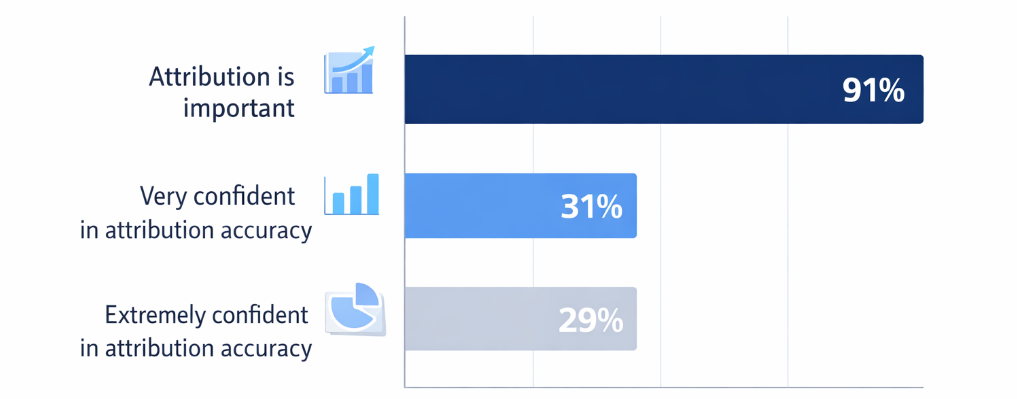
Confidence in Marketing Attribution vs Its Importance
In addition, over 60% of marketers report low confidence in cross‑channel attribution accuracy, particularly after recent privacy changes affecting cookies and mobile identifiers.
What Is Media Mix Modeling?
Media Mix Modeling uses statistical analysis to evaluate how marketing activities influence revenue, conversions, or other business metrics over time. Instead of focusing on individual user paths, MMM examines aggregated performance patterns across channels.
Typical MMM inputs include:
-
Advertising spend by channel
-
Campaign impressions
-
Seasonality
-
Pricing changes
-
Promotions
-
External factors such as holidays or macroeconomic trends
Advanced MMM models apply regression techniques or machine learning algorithms to estimate how each variable contributes to performance outcomes.
Because the approach does not rely on user‑level tracking, it remains resilient even when cookies or device identifiers disappear.
When Media Mix Modeling Outperforms Attribution
1. Cross‑Channel Campaigns
Modern campaigns rarely exist within a single platform. A typical customer journey may include social discovery, search research, and retargeting before conversion.
Platform attribution struggles to evaluate these interactions objectively because each system sees only part of the journey.
MMM evaluates total marketing impact instead of platform‑specific conversions, making it more reliable when campaigns span multiple ecosystems.
2. Privacy‑Restricted Environments
The marketing landscape has changed dramatically in recent years.
-
Over 40% of global internet traffic now occurs in environments where third‑party cookies are blocked.
-
Major mobile platforms require explicit consent for tracking.
-
Many users actively disable cross‑app tracking.
These changes significantly reduce the reliability of user‑level attribution data.
Media Mix Modeling avoids this issue entirely because it relies on aggregated performance data rather than individual tracking signals.
3. Offline and Brand Marketing
Attribution models perform poorly when marketing efforts influence behavior outside digital channels.
Examples include:
-
TV advertising
-
Out‑of‑home media
-
Podcasts
-
Sponsorships
-
Brand awareness campaigns
Studies show that brand marketing can account for up to 60% of long‑term sales growth, yet these effects rarely appear in attribution dashboards.
MMM captures both short‑term and long‑term effects, making it far better suited for evaluating upper‑funnel marketing investments.
4. Long Purchase Cycles
For products with extended decision processes — such as B2B software, financial services, or high‑value consumer goods — conversions may occur weeks or months after the first interaction.
Attribution models often assign credit to the final touchpoint while ignoring earlier marketing influence.
MMM analyzes performance trends across long time periods, revealing how awareness, consideration, and remarketing stages contribute to revenue over time.
5. Budget Allocation Decisions
Attribution data is typically optimized for tactical decisions such as keyword bids or ad placements.
Media Mix Modeling, on the other hand, is designed for strategic planning.
It can answer questions like:
-
Which channels truly drive incremental revenue?
-
What is the optimal budget distribution across channels?
-
Where does diminishing return begin for each marketing investment?
Organizations using MMM for planning often improve marketing efficiency by 10–20% through optimized budget allocation.
Why Many Companies Combine Both Methods
The most effective measurement frameworks rarely rely on a single methodology.
Instead, organizations combine:
-
Attribution models for day‑to‑day campaign optimization
-
Media Mix Modeling for strategic budgeting and long‑term performance evaluation
This hybrid approach provides both short‑term operational insights and long‑term strategic clarity.
Key Takeaways
Platform attribution remains useful for campaign optimization, but it cannot fully capture the complexity of modern marketing ecosystems. Privacy restrictions, cross‑channel fragmentation, and offline marketing influence all reduce attribution accuracy.
Media Mix Modeling offers a complementary perspective by analyzing aggregated marketing performance and identifying true drivers of business growth.
When used in the right scenarios — especially cross‑channel campaigns, privacy‑restricted environments, and brand marketing analysis — MMM often delivers more reliable insights for strategic decision‑making.