Retargeting campaigns are designed to keep your brand top of mind. However, there is a tipping point where repetition stops reinforcing awareness and starts generating resistance.
This tipping point is often difficult to detect because performance decline doesn’t happen instantly. Instead, it manifests gradually through subtle indicators:
-
Declining click-through rates (CTR)
-
Increasing cost per acquisition (CPA)
-
Lower conversion rates despite stable traffic
According to industry benchmarks, CTR can drop by more than 30% after a user sees the same ad more than 5–7 times, while conversion rates begin to decline after 8–10 impressions.
Why Frequency Becomes “Invisible”
Marketers rarely notice frequency fatigue in time because standard reporting masks the issue.
Aggregated Metrics Hide Individual Experience
Campaign dashboards typically display averages. While overall CTR or CPA may look acceptable, subsets of your audience may already be oversaturated.
Attribution Models Blur the Signal
Multi-touch attribution spreads credit across interactions. This can make repetitive impressions appear valuable even when they no longer influence behavior.
Delayed Impact on Performance
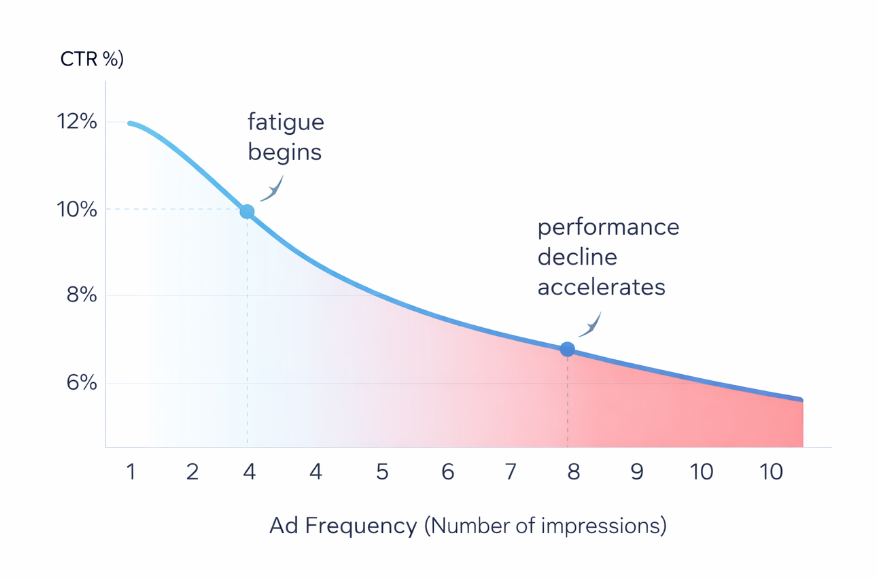
CTR declines rapidly as ad frequency increases, with noticeable fatigue beginning after just a few repeated exposures
The negative effects of overexposure accumulate over time. Users don’t immediately disengage—they gradually ignore ads, making the problem harder to isolate.
The Real Cost of Overexposure
Excessive frequency doesn’t just waste impressions—it actively damages campaign efficiency.
Budget Drain
Showing ads to users who have already disengaged leads to inefficient spend. Studies suggest that up to 26% of retargeting budgets can be wasted on users who are no longer responsive.
Brand Fatigue
Repeated exposure can create irritation. Research indicates that 61% of users feel negatively about brands that show the same ad too often.
Reduced Incrementality
High-frequency impressions often fail to generate additional conversions. Instead, they cannibalize results that would have occurred organically.
Signals That You’ve Crossed the Line
Even if frequency fatigue is hard to see directly, several signals can help identify it:
-
Frequency steadily rising while conversions plateau
-
Increasing CPM without proportional lift in results
-
Higher bounce rates from retargeted traffic
-
Shorter session durations from returning users
These patterns indicate diminishing returns from repeated exposure.
How to Control Retargeting Frequency Effectively
Avoiding invisible fatigue requires a more granular and proactive approach.
1. Implement Frequency Caps Based on Funnel Stage
Different audiences require different exposure levels:
-
Top-of-funnel: 2–4 impressions per week
-
Mid-funnel: 4–6 impressions per week
-
Bottom-of-funnel: 6–8 impressions per week
Tailoring caps ensures relevance without overexposure.
2. Rotate Creatives Aggressively
Creative fatigue often appears before audience fatigue. Rotating visuals and messaging every 7–14 days can help maintain engagement.
Dynamic creative optimization can further reduce repetition by adapting content to user behavior.
3. Use Time-Based Exclusions
Exclude users who have been exposed to your ads repeatedly without converting. For example:
-
Exclude after 10–12 impressions without interaction
-
Pause targeting for 7–14 days
This approach preserves budget and prevents negative brand perception.
4. Segment High-Frequency Users
Identify users with excessive exposure and treat them differently. Options include:
-
Serving alternative messaging
-
Offering stronger incentives
-
Removing them from campaigns entirely
5. Monitor Frequency-to-Conversion Ratio
Track how conversion rates change relative to frequency levels. This helps identify the point of diminishing returns.
Rethinking Retargeting Strategy
Instead of maximizing exposure, effective retargeting focuses on timing and relevance.
Modern strategies prioritize:
-
Sequential messaging instead of repetition
-
Behavioral triggers rather than static audiences
-
Incremental impact over raw impression volume
This shift allows marketers to maintain visibility without overwhelming users.
Conclusion
Retargeting frequency becomes dangerous when it goes unnoticed. While campaigns may appear stable at a surface level, hidden overexposure can quietly reduce performance, waste budget, and damage brand perception.
By monitoring frequency more precisely, adapting creative strategies, and segmenting audiences intelligently, marketers can prevent invisible fatigue and maintain strong campaign efficiency.
Recommended Reading