
Optimization is a cornerstone of digital marketing. Marketers continuously adjust bids, creatives, targeting, and budgets to squeeze more performance out of campaigns. However, not every campaign can be salvaged through incremental changes. In some cases, continued optimization leads to diminishing returns, wasted budget, and misleading data.
Understanding when to rebuild a campaign instead of optimizing it is essential for maintaining efficiency and scaling performance.
The Limits of Optimization
Optimization assumes that the campaign structure, audience targeting, and creative direction are fundamentally sound. When these foundations are flawed, improvements become marginal.
According to industry benchmarks, campaigns that undergo more than 10–15 optimization changes without a significant lift (10%+ improvement in key KPIs) are unlikely to recover through further adjustments alone. Additionally, studies show that ad fatigue can reduce click-through rates by up to 40% within the first two weeks of exposure, limiting the effectiveness of creative tweaks.
Key Signs It’s Time to Rebuild
1. Performance Has Plateaued
If your key metrics—such as CTR, conversion rate, or cost per acquisition—have stagnated despite repeated adjustments, this indicates structural limitations. A plateau lasting more than 7–10 days in active campaigns is a strong signal that optimization has reached its ceiling.
2. Poor Data Quality or Learning Issues
Platforms rely on sufficient and consistent data to optimize effectively. If your campaign is stuck in a learning phase or generating inconsistent results, it may be due to fragmented audience targeting or overly complex structures. Research indicates that campaigns with fewer, more consolidated ad sets can improve learning efficiency by up to 30%.
3. Mismatch Between Targeting and Offer
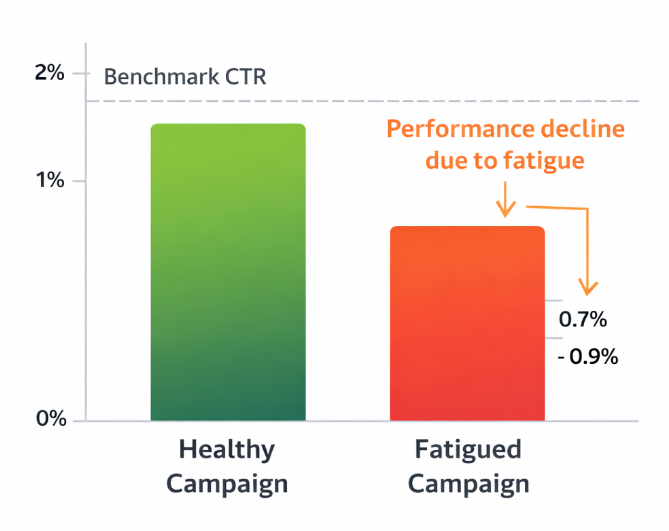
A drop below the average 1.4% CTR benchmark is a strong indicator that a campaign may be fatigued or structurally ineffective
When the audience does not align with the value proposition, no amount of bid or budget optimization will fix the issue. Low engagement rates (CTR below 1% in most industries) often signal a disconnect between message and audience.
4. Creative Fatigue
If frequency is high and engagement continues to drop, your creatives have likely exhausted their effectiveness. While refreshing creatives can help, persistent underperformance across multiple variations suggests a need for a new campaign direction.
5. Inefficient Campaign Structure
Over-segmentation, overlapping audiences, and conflicting optimization goals can prevent platforms from delivering efficiently. Simplifying or rebuilding the structure often leads to better delivery and lower costs.
When Optimization Still Makes Sense
Before deciding to rebuild, confirm that optimization has been properly executed. Optimization is still viable when:
-
Performance is trending upward, even slowly
-
Changes result in measurable improvements
-
The campaign is still within its learning phase
-
There is clear alignment between audience, creative, and offer
If these conditions are met, continued optimization is justified.
Benefits of Rebuilding a Campaign
Rebuilding is not a failure—it is a strategic reset. Starting fresh allows you to:
-
Eliminate historical bias in delivery algorithms
-
Redefine audience segments with cleaner data
-
Introduce entirely new creative angles
-
Simplify campaign architecture for better optimization
Marketers who rebuild underperforming campaigns often report up to a 25–35% improvement in cost efficiency compared to heavily optimized legacy campaigns.
How to Rebuild Effectively
1. Audit the Previous Campaign
Identify what worked and what did not. Focus on high-performing audiences, creatives, and placements, and use these insights as a foundation.
2. Simplify Structure
Avoid overcomplication. Use fewer ad sets and broader targeting to allow algorithms to optimize more effectively.
3. Refresh Creatives and Messaging
Develop new angles rather than minor variations. Address different pain points or value propositions.
4. Reset Optimization Goals
Ensure your campaign objective aligns with your business goal. Misaligned objectives can significantly reduce performance.
5. Allow Proper Learning Time
Once rebuilt, avoid excessive changes during the initial learning phase. Stability is crucial for accurate optimization.
Common Mistakes to Avoid
-
Rebuilding without analyzing past data
-
Repeating the same structural issues
-
Making frequent changes immediately after launch
-
Ignoring audience overlap
Conclusion
Optimization is powerful, but it has limits. Recognizing when a campaign has reached those limits is essential for maintaining efficiency and growth. By rebuilding at the right time, marketers can unlock new performance potential and avoid the diminishing returns of over-optimization.