Cost per purchase rarely moves in a straight line. One day a campaign delivers profitable conversions, and the next day the same ad set suddenly costs 40–60% more per sale.
When this happens, many advertisers assume something is “wrong” with the campaign: the creative stopped working, the audience became saturated, or the algorithm lost optimization signals.
In reality, most cost fluctuations come from structural changes inside the delivery system rather than obvious campaign mistakes. Ad platforms constantly recalculate auction competition, user intent signals, and budget allocation across thousands of impressions.
Understanding these mechanics helps explain why performance can change even when nothing in the campaign settings has been modified.
Daily Auction Competition Constantly Changes
Every impression in Meta, Google, or TikTok ads is allocated through an auction. Your ad does not compete against a fixed group of advertisers; the competitive landscape shifts continuously as budgets activate, pause, or change targeting.
This means your campaign can experience cost fluctuations simply because different competitors enter the same audience auctions.
Several auction-level dynamics can cause noticeable CPA variation:
-
New advertisers entering the same audience pool.
If a large advertiser launches a campaign targeting the same demographic or interest cluster, the number of bids per impression increases. The platform may need to raise the effective bid required to win those impressions. -
Budget increases from competing campaigns.
Many advertisers scale budgets mid-week or during promotional periods. As their budgets expand, their campaigns begin entering more auctions, raising overall competition in those audience segments. -
Time-of-day demand spikes.
CPM frequently rises during peak traffic hours. If your campaign happens to win more auctions during these expensive windows, the cost per purchase can temporarily increase even if conversion rates stay stable.
If you want a deeper explanation of how auction competition affects delivery, read Facebook Ad Auction: Do Ad Sets Compete Against Each Other?.
Inside Ads Manager, this often appears as CPM increasing while CTR and conversion rate remain roughly the same. The campaign is still reaching similar users, but the cost of accessing those impressions has risen.
Because auctions are recalculated continuously, these shifts can happen overnight without any change to your campaign settings.
The Algorithm Rotates Through Different Audience Segments
Most advertisers assume their targeting defines exactly who sees the ad. In practice, targeting only creates an initial candidate pool. The algorithm then distributes impressions across many behavioral clusters within that pool.
This distribution changes constantly as the system gathers new performance signals.
A campaign might initially deliver heavily to users who are actively researching the product category. These users often convert at a higher rate because they are closer to a purchase decision.
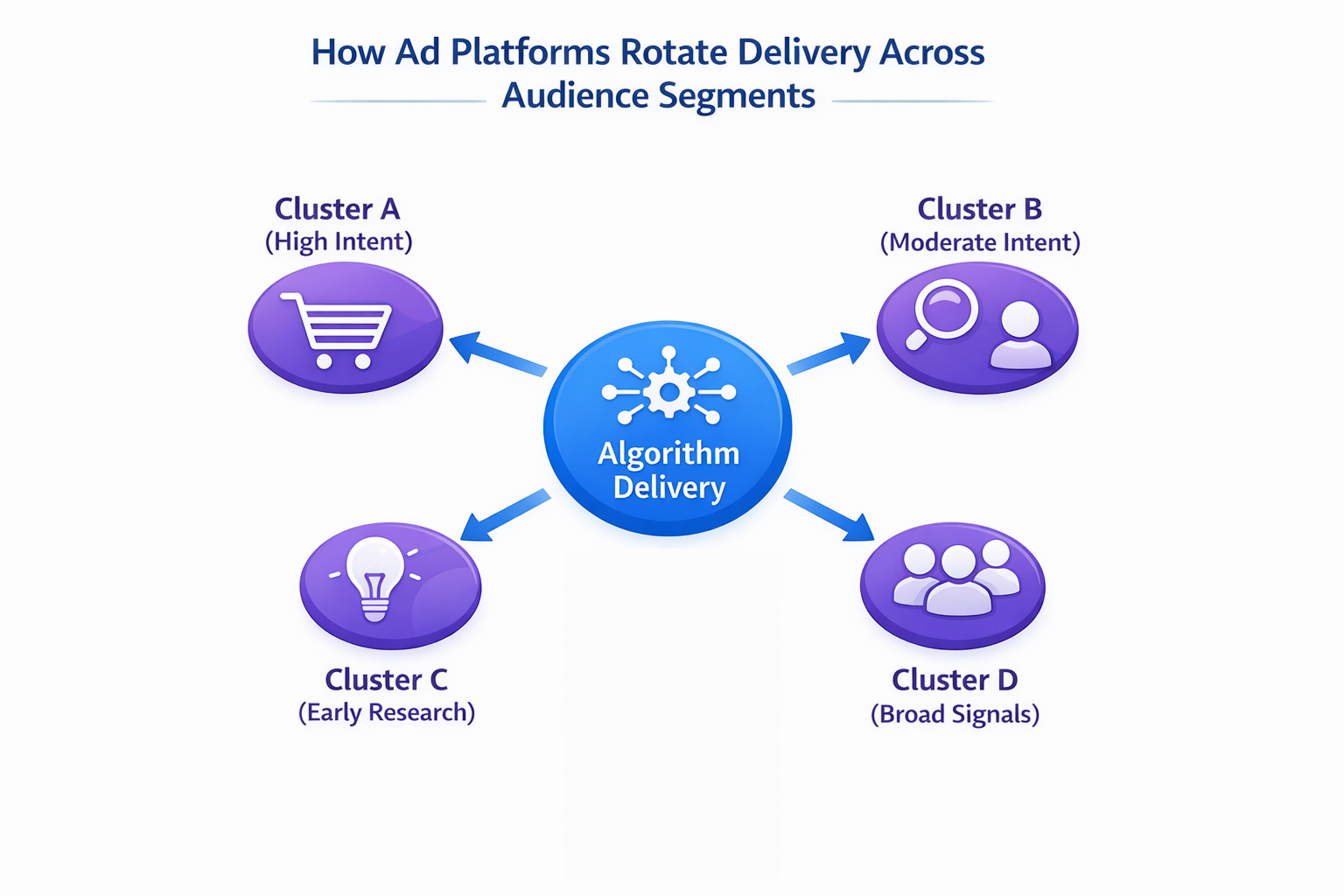
Later, the algorithm may expand delivery into slightly broader behavioral segments such as:
-
Users who recently interacted with similar content.
They show early interest signals but may not yet be comparing products. -
Lookalike clusters with weaker behavioral similarity.
These audiences share some attributes with converters but not the full behavioral profile. -
Users browsing informational content instead of pricing or product pages.
They are still inside the broader category but earlier in the research process.
Understanding how targeting interacts with algorithmic delivery is important. A detailed breakdown can be found in Facebook Ads Targeting 101: How to Reach the Right Audience.
When delivery shifts toward these segments, the conversion probability naturally declines. The campaign may still generate purchases, but the number of impressions required to produce each conversion increases.
This change often appears as stable CPM combined with declining conversion rate, which pushes the cost per purchase higher.
Conversion Events Occur in Uneven Clusters
Another reason CPA fluctuates is simple statistical clustering. Purchases do not happen evenly across impressions.
Instead, conversions tend to arrive in bursts when the algorithm finds a cluster of users with similar high-intent behavior.
For example, a campaign might receive:
-
three purchases within a short sequence of impressions delivered to similar users;
-
a long stretch of impressions that generate clicks but no conversions;
-
another cluster of two or three conversions later in the day.
When these clusters happen early in the reporting window, the CPA appears extremely efficient. If the conversions arrive later, the same campaign can temporarily look expensive until the next cluster occurs.
This effect is particularly noticeable in campaigns with lower daily conversion volume, such as:
-
high-ticket products with fewer daily purchases;
-
B2B lead generation campaigns with strict qualification filters;
-
new campaigns that are still building optimization data.
Short-term fluctuations are common, which is why advertisers often misinterpret performance changes. A deeper explanation of this pattern is discussed in Why Facebook Ads Performance Can Fluctuate Daily.
In these cases, short-term CPA swings are often statistical noise rather than a structural performance change.
Budget Allocation Across Ad Sets Changes Hourly
Campaign budget optimization and automated bidding systems constantly redistribute spend across ad sets.
If multiple ad sets compete within the same campaign, the algorithm shifts budget toward the one currently producing the strongest signals.
This reallocation can influence cost per purchase in several ways:
-
High-performing ad sets temporarily receive more spend.
If the algorithm identifies strong conversion signals from one segment, it increases delivery there. Once the immediate opportunity is exhausted, CPA may rise again. -
Lower-performing segments still receive exploratory spend.
The platform periodically tests additional impressions in other audiences to confirm whether performance patterns remain consistent. -
Budget pacing adjustments occur during the day.
If the campaign spends slower or faster than expected, the system adjusts bidding behavior to reach the daily budget target.
These shifts mean the campaign may be optimizing toward slightly different users from one hour to the next. Even small changes in audience composition can influence the conversion rate.
Creative Fatigue Doesn’t Happen Instantly — But It Can Start Gradually
Creative fatigue is a real driver of rising costs, but it usually develops gradually rather than causing sudden performance shifts.
When an ad begins repeating frequently to the same audience, engagement tends to decline in stages:
-
Early repetition reduces curiosity. Users who already saw the ad may scroll past it more quickly.
-
Click-through rate begins to drop. Lower engagement signals reduce the algorithm’s predicted action rate.
-
The system must win more impressions to find converters. As engagement signals weaken, the campaign may require additional impressions to generate the same number of purchases.
For a deeper breakdown of how to diagnose this issue, see Ad Fatigue on Facebook: How to Spot It Early and Fix It Fast.
This progression often appears in Ads Manager as:
-
frequency slowly rising above 2–3;
-
CTR gradually declining;
-
CPM increasing slightly as predicted action rate decreases.
When these indicators appear together, creative fatigue may be contributing to the CPA fluctuation.
Short-Term CPA Fluctuations Are Normal
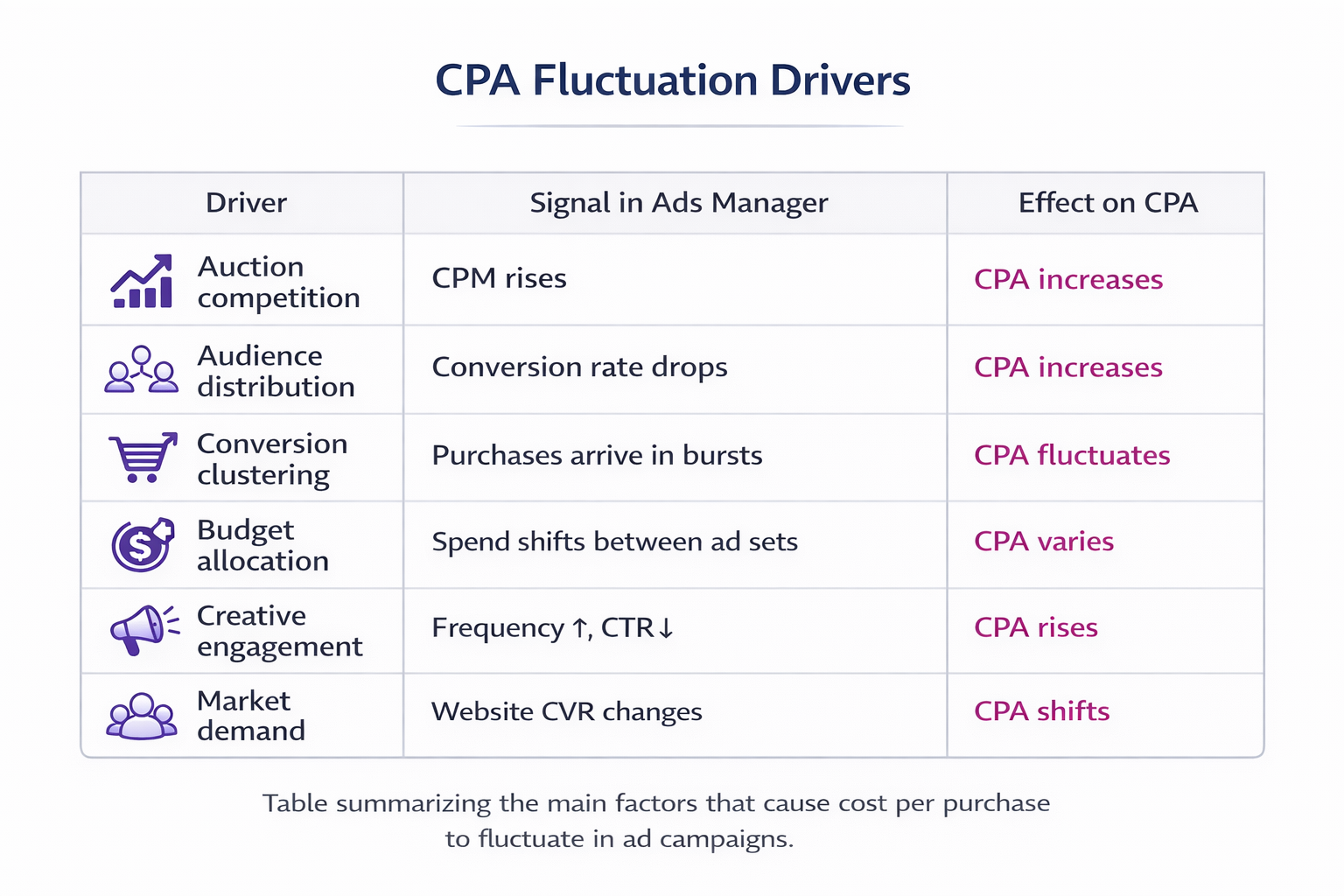
Cost per purchase reflects the interaction of several constantly changing factors:
-
auction competition
-
audience distribution
-
statistical clustering of conversions
-
automated budget allocation
-
creative engagement signals
-
real-world demand patterns
Because these systems shift continuously, CPA will almost always fluctuate from day to day.
Trying to eliminate these variations entirely often leads advertisers to overreact by pausing campaigns or making unnecessary adjustments.
A more reliable approach is to evaluate performance across a longer window.
Most experienced media buyers review:
-
3–7 day averages for active scaling campaigns
-
7–14 day windows for lower-volume accounts
These timeframes smooth out short-term auction and conversion variability, revealing whether the campaign’s underlying efficiency is actually changing.
The Real Question Is Trend, Not Daily Cost
Daily CPA fluctuations can look alarming, but they rarely indicate a structural problem by themselves.
What matters is whether the campaign shows a consistent upward trend over multiple days combined with diagnostic signals such as:
-
rising frequency
-
declining CTR
-
increasing CPM across several auctions
-
falling conversion rate on the website
If the fluctuations appear randomly while overall weekly performance remains stable, the campaign is simply responding to the natural volatility of ad auctions.
Recognizing this difference helps prevent unnecessary optimization changes and keeps campaigns aligned with the larger performance trend.