
Attribution windows define the period during which a conversion is credited to a specific interaction, such as a click or an impression. While they are intended to clarify performance, they frequently introduce bias and misinterpretation. Advertisers who rely solely on default attribution settings risk making decisions based on incomplete or misleading data.
What Are Attribution Windows?
An attribution window is the timeframe after an ad interaction during which a conversion can be attributed to that interaction. Common configurations include:
-
1-day click
-
7-day click
-
1-day view
-
28-day click (historically used on some platforms)
These windows vary by platform and campaign objective, creating inconsistencies across reporting environments.
Why Attribution Windows Can Be Misleading
1. Over-Credit to Lower-Funnel Channels
Longer attribution windows tend to favor channels that capture users closer to conversion. For example, retargeting campaigns often receive disproportionate credit because they interact with users who are already highly intent-driven.
According to industry benchmarks, retargeting campaigns can appear up to 2–3x more effective under a 28-day click window compared to a 1-day click window.
2. Underestimating Upper-Funnel Impact
Upper-funnel campaigns, such as awareness and prospecting, typically influence users earlier in the journey. Short attribution windows fail to capture their contribution.
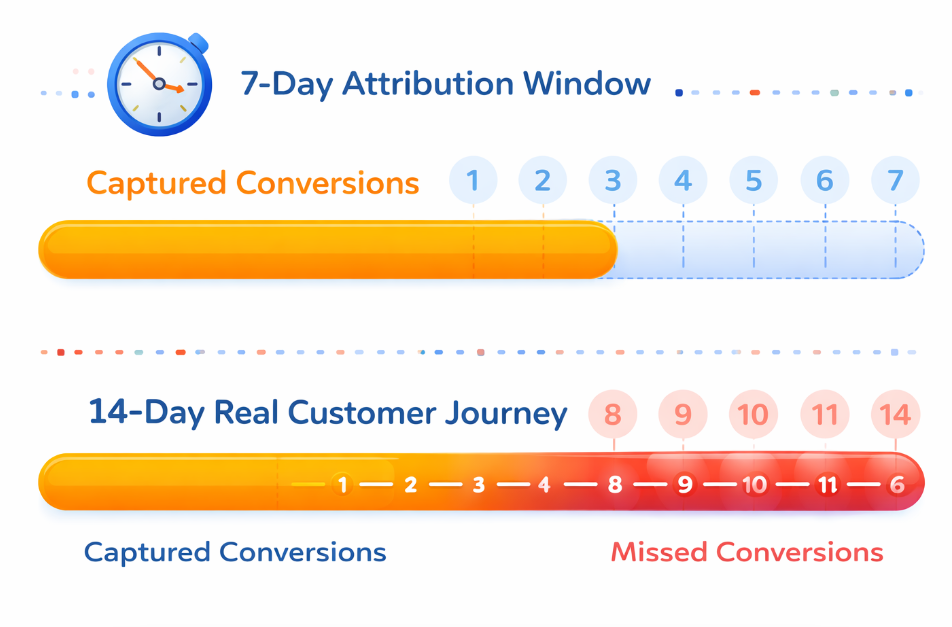
Short attribution windows can miss a significant portion of actual conversions
A study by Nielsen found that brand awareness campaigns can contribute up to 47% of total conversions when longer attribution windows or multi-touch models are used.
3. Cross-Device and Cross-Channel Gaps
Users frequently switch devices before converting. Attribution windows tied to a single device or platform fail to account for this behavior, leading to incomplete tracking.
Google reports that over 60% of consumers start a purchase on one device and finish on another, complicating attribution accuracy.
4. Platform-Specific Bias
Each advertising platform uses its own attribution logic. This results in overlapping credit where multiple platforms claim the same conversion.
It is not uncommon for total reported conversions across platforms to exceed actual conversions by 20–30% due to duplication.
5. View-Through Inflation
View-through attribution assigns credit to impressions without clicks. While useful in some contexts, it can inflate performance metrics significantly.
In some campaigns, up to 70% of attributed conversions may come from view-through data, which may not reflect true causal impact.
The Business Impact of Misleading Attribution
Misinterpreting attribution windows can lead to:
-
Misallocation of budget toward lower-funnel channels
-
Underinvestment in brand-building efforts
-
Overestimation of campaign ROI
-
Poor strategic planning
Over time, this creates a feedback loop where short-term gains are prioritized at the expense of sustainable growth.
How to Approach Attribution More Effectively
1. Compare Multiple Attribution Windows
Instead of relying on a single default window, analyze performance across multiple windows (e.g., 1-day, 7-day, 28-day). This helps identify how sensitive your results are to attribution settings.
2. Use Incrementality Testing
Run controlled experiments to measure the true impact of campaigns. Incrementality tests help distinguish correlation from causation.
3. Combine Attribution Models
Leverage a mix of attribution approaches, including last-click, first-click, and data-driven models, to gain a more comprehensive view.
4. Focus on Business Outcomes
Shift attention from platform-reported conversions to broader metrics such as revenue, customer lifetime value, and acquisition cost.
5. Align Attribution with Sales Cycles
Choose attribution windows that reflect your actual customer journey length. Longer consideration cycles require longer attribution windows.
Conclusion
Attribution windows are a useful but imperfect tool. When used without critical analysis, they can distort performance insights and lead to suboptimal decisions. Advertisers should treat attribution as a directional signal rather than an absolute truth and adopt a more holistic measurement strategy.
Recommended Reading