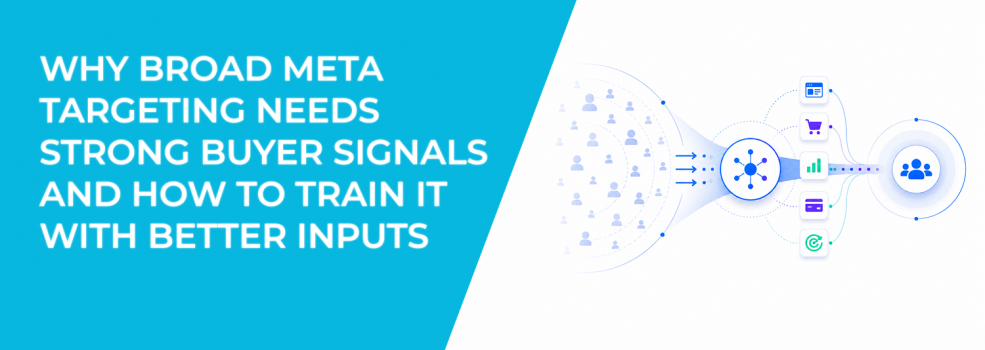
Broad targeting gives Meta more room to find buyers. But broad does not mean Meta automatically understands who your best customers are.
If the campaign feeds Meta weak signals, broad targeting can scale the wrong behavior. You may get cheaper clicks, more form fills, or more engagement, but not better customers.
This is why broad targeting works well for some advertisers and fails for others. The difference is often the quality of the signals Meta receives early.
Broad targeting needs data to learn from
When you use broad targeting, you give Meta fewer audience restrictions. That means the algorithm depends more on conversion data, creative signals, engagement behavior, and post-click actions.
If those signals are strong, Meta can find useful patterns. If they are weak, Meta may optimize toward people who are easy to reach or easy to engage.
For example, an ecommerce brand with steady purchases may do well with broad targeting because Meta can learn from real buyers. A new lead generation campaign with cheap but unqualified form fills may struggle because Meta is learning from low-quality actions.
This is why broad targeting needs better data. The wider the audience, the more important the input quality becomes.
What weak signals look like in broad campaigns
Weak signals are not always obvious. A campaign can look active and still be learning from the wrong users.
You may see high CTR, low CPC, or cheap leads. Those numbers feel positive, but they do not always mean the campaign is finding buyers.
Common weak signals include:
- Low-intent engagement. Likes, short video views, and casual clicks can train Meta toward people who engage but do not buy.
- Unqualified form fills. If most leads do not match your customer profile, Meta may find more of the same.
- Mixed website traffic. Blog readers, job seekers, customers, and casual visitors should not always feed the same audience.
- Broad creative hooks. Ads that attract everyone can make broad targeting even less precise.
Broad targeting does not create the problem by itself. It exposes the quality of the signals you are giving Meta.
How to train broad targeting with better inputs
The goal is to help Meta learn from people who are closer to real business value. That means choosing better conversion events, better engagement sources, and better audience seeds.
For ecommerce, optimize toward purchases when there is enough volume. If purchase volume is too low, use stronger mid-funnel events like checkout starts or add-to-cart actions instead of shallow page views.
For lead generation, avoid treating every form submission as equal. If possible, send qualified lead data back to Meta or build audiences from people who booked calls, replied to sales, or matched your buyer criteria.
A cleaner training setup can include:
- Higher-quality conversion events. Optimize toward actions that show real intent, not the easiest event to collect.
- Better retargeting pools. Separate high-intent visitors from casual content readers.
- Stronger creative filters. Use ad copy that speaks to the actual buyer, not the largest possible audience.
- Sales feedback loops. Use CRM data to understand which leads became real opportunities.
If you want to go deeper on this, lead quality checks before scaling spend is a useful next step.
Why qualified engagement matters
Engagement can help Meta, but not all engagement is useful.
Someone watching three seconds of a video is not the same as someone saving a post, clicking through to a pricing page, or opening a lead form after reading the offer. Broad targeting needs signals that separate casual attention from serious intent.
This is especially important for B2B, high-ticket services, local businesses, and niche ecommerce products. These campaigns often cannot rely on simple engagement volume because the wrong users may engage more easily than the right buyers.
For example, a marketing agency running broad targeting may attract freelancers, students, and other marketers with educational content. That engagement is not useless, but it may not train Meta toward business owners who can afford the service.
This is where using engagement signals to refine targeting can help. You need to separate engagement that predicts buying from engagement that only shows curiosity.
Final takeaway
Broad targeting works best when Meta has strong buyer signals. Without them, the campaign may scale cheap attention instead of real demand.
Before blaming broad targeting, check what Meta is learning from. Improve the conversion event, clean the engagement signals, qualify the leads, and use better source audiences. Once the inputs improve, broad targeting has a much better chance of finding the right people.