
For years, marketers have chased scale. Bigger lists, broader reach, and expanding audiences have often been seen as the primary path to growth. However, data increasingly shows that audience size alone does not guarantee performance. In fact, poorly structured campaigns often underperform even with massive reach.
What truly drives results is campaign architecture — the way campaigns are designed, segmented, sequenced, and optimized. A well-architected campaign ensures that the right message reaches the right person at the right time, regardless of audience size.
The Myth of “Bigger Is Better”
It is easy to assume that doubling an audience will double results. In reality, this rarely happens. According to industry benchmarks, increasing audience size by 100% typically results in only a 20–40% increase in conversions when campaign structure remains unchanged.
Additionally, research shows that:
-
Segmented campaigns can drive up to 760% more revenue than non-segmented campaigns.
-
Targeted messaging improves engagement rates by 2–3x compared to generic campaigns.
-
Poorly structured campaigns can waste up to 50% of media spend due to irrelevant targeting.
These numbers highlight a critical point: inefficiency scales with audience size. Without proper architecture, expanding reach often amplifies waste rather than performance.
What Is Campaign Architecture?
Campaign architecture refers to the strategic framework behind a marketing campaign. It includes:
-
Audience segmentation and prioritization
-
Message hierarchy and personalization
-
Channel orchestration
-
Timing and sequencing of touchpoints
-
Feedback loops and optimization mechanisms
Instead of treating campaigns as single blasts, architecture organizes them into systems that guide prospects through a structured journey.
Why Architecture Outperforms Audience Size
1. Precision Beats Volume
A smaller, well-defined audience with tailored messaging consistently outperforms a broad, generic audience. Precision ensures relevance, which directly impacts engagement and conversion rates.
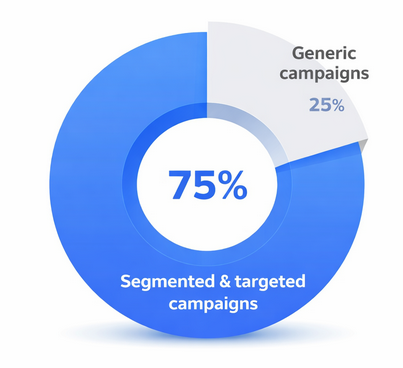
The majority of marketing ROI comes from structured, segmented campaigns rather than broad, generic outreach
For example, campaigns with behavioral segmentation often see conversion rate improvements of 50–100% compared to demographic-only targeting.
2. Sequencing Drives Momentum
Campaigns are rarely one-touch experiences. Structured sequences — such as awareness, consideration, and conversion stages — significantly improve outcomes.
Studies show that multi-touch campaigns can generate up to 3x higher conversion rates than single-touch campaigns.
3. Resource Efficiency
A well-architected campaign reduces waste by focusing spend on high-intent segments. This leads to:
-
Lower cost per acquisition (CPA)
-
Higher return on ad spend (ROAS)
-
Improved lifetime value (LTV)
Without architecture, scaling budgets often leads to diminishing returns.
4. Scalability Without Degradation
Strong campaign architecture allows for scalable growth without sacrificing performance. When structure is optimized, expanding the audience becomes additive rather than dilutive.
Key Components of High-Performing Campaign Architecture
Audience Segmentation
Break audiences into meaningful groups based on behavior, intent, and lifecycle stage. Avoid over-reliance on broad demographic targeting.
Message Alignment
Ensure messaging matches the audience segment. A mismatch between message and intent is one of the most common causes of low performance.
Channel Coordination
Integrate channels so they work together rather than in isolation. Consistency across email, paid media, and outbound efforts strengthens impact.
Timing and Frequency
Optimize when and how often messages are delivered. Overexposure can lead to fatigue, while underexposure limits impact.
Continuous Optimization
Use performance data to refine segments, messaging, and sequencing. High-performing campaigns are dynamic systems, not static setups.
Common Mistakes to Avoid
-
Expanding audience size without refining segmentation
-
Using identical messaging across all segments
-
Ignoring sequencing and relying on single-touch campaigns
-
Failing to analyze performance at the segment level
-
Scaling spend before validating campaign structure
These mistakes often lead to inflated costs and underwhelming results, regardless of audience size.
How to Shift from Size to Structure
To improve campaign performance, focus on:
-
Auditing existing campaigns to identify structural gaps
-
Implementing clear segmentation based on intent and behavior
-
Designing multi-step journeys instead of single interactions
-
Testing messaging variations across segments
-
Scaling only after achieving consistent performance at smaller volumes
This approach ensures that growth is built on a solid foundation rather than inflated reach.
Conclusion
Audience size may influence potential reach, but it does not determine success. Campaign architecture is the true driver of performance.
By focusing on structure — segmentation, sequencing, and optimization — marketers can achieve higher efficiency, better engagement, and stronger returns, even with smaller audiences.
In a landscape where attention is limited and competition is high, precision and design will always outperform scale alone.