Facebook advertising operates on a dynamic auction system where multiple variables determine whether your ads are shown, how often they appear, and at what cost. While targeting, creatives, and bidding strategies are often discussed, campaign structure is a foundational factor that significantly impacts delivery stability.
Delivery instability can lead to fluctuating costs, inconsistent impressions, and unpredictable performance. Understanding how campaign structure influences these outcomes allows advertisers to create more reliable and scalable campaigns.
What Is Delivery Stability?
Delivery stability refers to the consistency with which ads are served over time without significant fluctuations in impressions, reach, or cost per result. Stable delivery ensures predictable performance and allows optimization decisions to be based on reliable data.
Unstable delivery typically manifests as:
-
Sudden spikes or drops in impressions
-
Increased cost per click (CPC) or cost per acquisition (CPA)
-
Learning phase resets
-
Irregular pacing of budget spend
How Campaign Structure Affects Delivery
1. Auction Overlap and Internal Competition
When multiple ad sets target similar audiences, they compete against each other in the same auction. This phenomenon, known as auction overlap, can drive up costs and reduce delivery efficiency.
According to Meta data, advertisers experiencing high audience overlap can see cost increases of up to 25–30% due to internal competition.
Poor structure example:
-
Multiple ad sets targeting similar interests
-
Slight variations of the same audience
Optimized structure:
-
Consolidated audiences
-
Clear segmentation with minimal overlap
2. Budget Fragmentation
Splitting budgets across too many ad sets limits the amount of data each ad set can gather, making it harder for the algorithm to optimize delivery.
Meta recommends generating at least 50 optimization events per ad set per week to exit the learning phase. Campaigns with fragmented budgets often fail to reach this threshold, leading to prolonged instability.
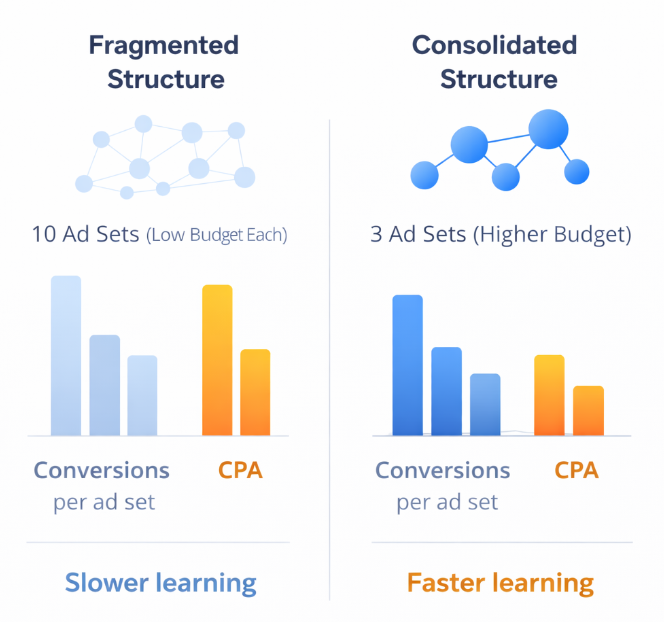
Consolidating budgets into fewer ad sets improves data volume per ad set, accelerating learning and increasing conversion efficiency
Impact of fragmentation:
-
Slower learning phase
-
Higher CPA
-
Inconsistent delivery
3. Learning Phase Sensitivity
The learning phase is critical for performance. Structural decisions directly influence how quickly and effectively campaigns exit this phase.
Actions that reset learning include:
-
Significant budget changes (more than 20%)
-
Frequent edits to ad sets
-
Adding too many new ads at once
Campaigns with simplified structures tend to stabilize faster because they accumulate data more efficiently.
4. Signal Clarity
Facebook’s algorithm relies on signals such as user behavior, engagement, and conversion data. A complex or fragmented structure dilutes these signals, making optimization less effective.
Simplified structures improve signal clarity by:
-
Concentrating data in fewer ad sets
-
Allowing the algorithm to learn faster
-
Improving targeting precision
5. Campaign Budget Optimization (CBO) Dynamics
Using Campaign Budget Optimization shifts budget allocation decisions to the algorithm. However, the effectiveness of CBO depends heavily on structure.
Best practices for CBO:
-
Limit the number of ad sets per campaign
-
Ensure each ad set has sufficient differentiation
-
Avoid over-segmentation
Improper structure under CBO can result in uneven spend distribution and unstable delivery.
Key Statistics to Consider
-
Campaigns with consolidated ad sets can improve conversion efficiency by up to 20% compared to fragmented setups.
-
Advertisers who reduce audience overlap report up to 30% lower CPM.
-
Stable campaigns exiting the learning phase within 7 days are 45% more likely to maintain consistent CPA.
Best Practices for Stable Delivery
Keep Structures Simple
Limit the number of campaigns and ad sets. Focus on clarity rather than excessive segmentation.
Avoid Audience Overlap
Ensure each ad set targets a distinct audience segment to prevent internal competition.
Consolidate Budgets
Allocate sufficient budget to fewer ad sets to accelerate learning and improve performance.
Minimize Frequent Changes
Avoid making constant edits that reset the learning phase and disrupt delivery stability.
Monitor Performance Consistently
Track key metrics such as CPM, CTR, and CPA to identify early signs of instability.
Common Mistakes
-
Over-segmentation of audiences
-
Running too many ad sets with small budgets
-
Frequent structural changes
-
Ignoring learning phase requirements
Conclusion
Campaign structure is not just a matter of organization—it directly influences how Facebook’s algorithm interprets data and delivers ads. A well-structured campaign reduces internal competition, accelerates learning, and stabilizes performance.
By focusing on simplicity, signal clarity, and strategic budget allocation, advertisers can achieve more predictable results and long-term scalability.
Recommended Articles