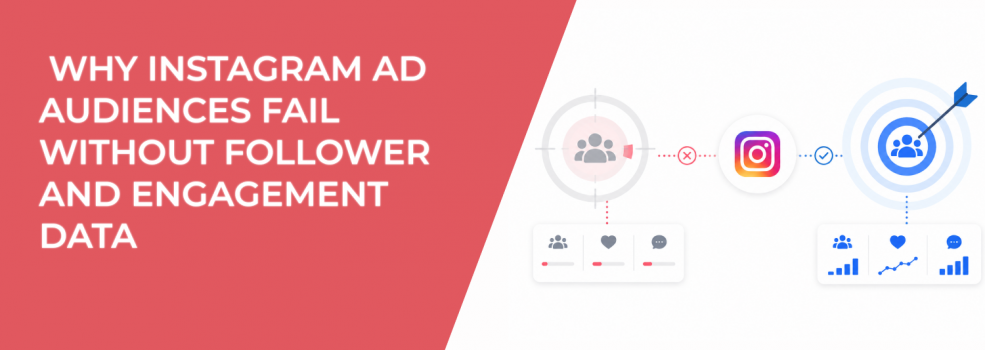
Many Instagram advertisers still build audiences using broad interests and demographic assumptions.
The setup feels logical at first. A skincare brand targets beauty interests. A coaching business targets entrepreneurs. A SaaS company targets marketing professionals.
But once campaigns launch, the traffic often becomes inconsistent. CTR may look acceptable, yet lead quality drops. CPC stays low while conversion rates remain unstable. Some campaigns generate engagement but almost no sales activity.
This happens because broad targeting rarely tells Meta which users actually show intent around a specific brand, product category, or buying behavior.
Follower and engagement data help close that gap.
Broad Instagram Targeting Often Produces Weak Audience Signals
Instagram’s targeting system works best when it receives stronger behavioral direction.
Interest targeting alone usually creates mixed audience pools. Some users are active buyers. Others only consume content casually. Many interact with topics without purchase intent.
That creates noisy optimization patterns.
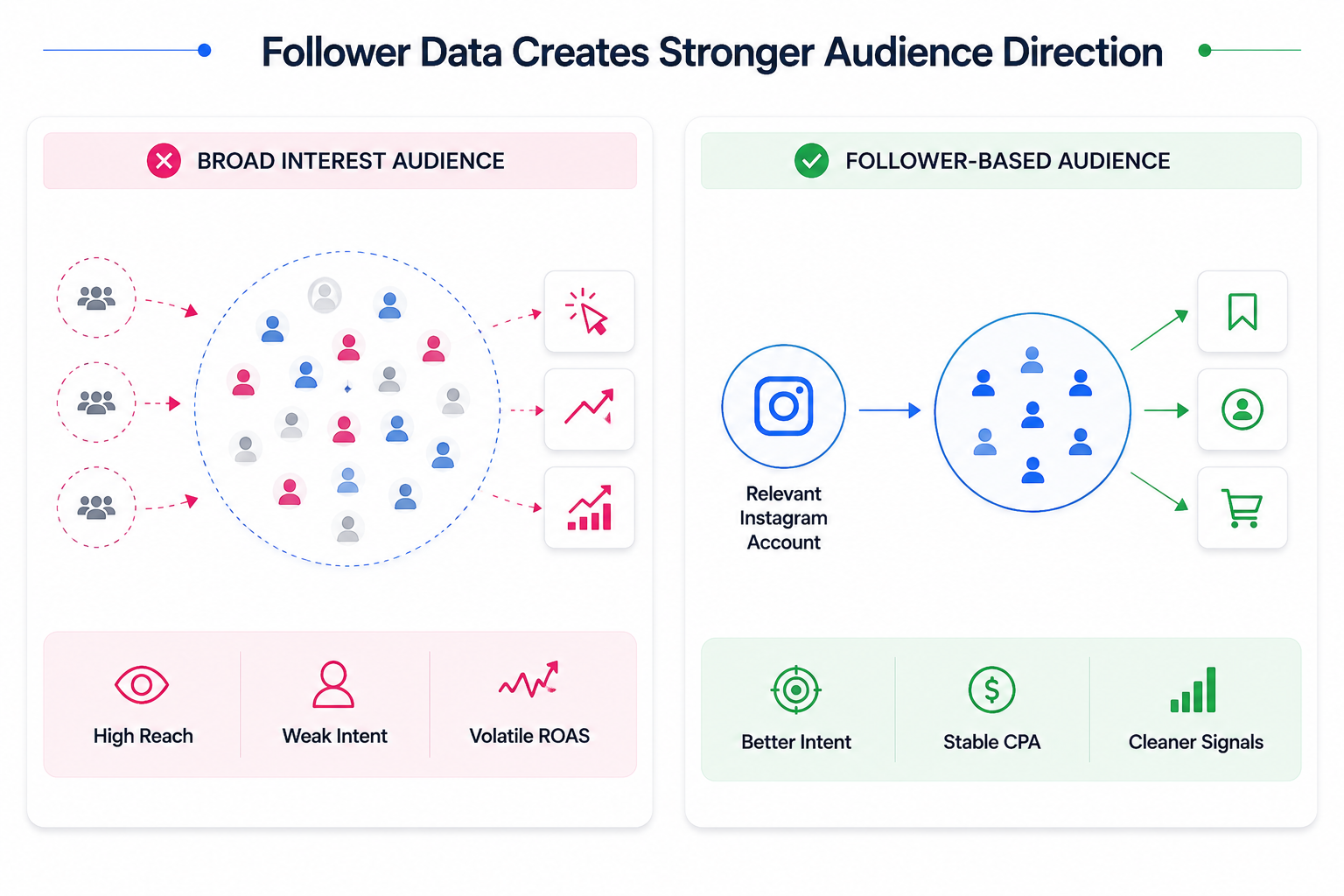
A campaign may initially scale because Meta finds cheap engagement. Then performance declines once the system exhausts the easiest low-intent traffic inside the audience.
You can often spot this pattern through metrics like:
- High engagement with weak website activity.
- Low CPC but poor conversion quality.
- Strong Reel interaction without downstream actions.
- Rapid reach expansion followed by rising CPA.
The issue is not always the creative. Often the audience itself lacks behavioral precision.
Instagram Followers Create Stronger Audience Context
Follower-based audiences work differently because they already contain platform-level relevance signals.
Someone who follows a niche skincare brand behaves differently from someone who casually interacts with beauty content once a month. The same applies to B2B software, fitness coaching, local services, or ecommerce categories.
Follower relationships create contextual intent.
That does not mean every follower is a buyer. It means the audience already contains stronger category alignment than a generic interest stack.
This becomes especially useful in crowded markets where broad targeting pushes campaigns into expensive auctions with low purchase intent.
Brands looking to build Instagram ad audiences from account followers often see more stable early campaign behavior because the targeting starts closer to existing interest clusters.
Engagement Data Helps Separate Passive Users From Active Buyers
Follower count alone is not enough.
Some accounts have large audiences with very weak commercial intent. Others have smaller but highly responsive communities.
Engagement behavior helps identify the difference.
For example, users who repeatedly interact with educational posts, product comparisons, or offer-driven content usually behave differently from users who only watch entertainment Reels.
That distinction matters because Meta optimizes around behavioral patterns, not audience labels.
Several engagement actions often indicate stronger intent:
- Profile visits after content interaction.
- Repeated Story engagement.
- Saves on product-focused posts.
- Click activity tied to commercial content.
These signals create more useful audience direction than broad demographic assumptions alone.
That is why many advertisers now prioritize ways to target engaged Instagram users instead of relying entirely on traditional interest targeting.
Generic Interest Audiences Usually Become Less Efficient During Scaling
A common scaling problem appears when campaigns initially perform well, then collapse after budget increases.
This often happens because the original audience was too broad from the beginning.
Meta finds the easiest conversions first. Once those users are exhausted, delivery expands into weaker behavioral segments. CPC rises, conversion rates drop, and ROAS becomes unstable.
Follower and engagement data help slow that decline because the audience starts with stronger behavioral consistency.
That does not eliminate scaling problems completely. It simply improves signal quality inside the learning process.
For advertisers using LeadEnforce, this becomes more actionable because the platform allows businesses to target Instagram followers from relevant accounts, creators, and communities instead of relying only on broad interests.
Better Audience Inputs Usually Improve Campaign Efficiency
Meta’s algorithm performs better when the audience contains clearer intent signals.
That affects more than targeting accuracy. It also influences how efficiently the platform spends budget during optimization.
Stronger audience quality can help:
- Reduce wasted impressions.
- Improve click relevance.
- Stabilize CPA during testing.
- Build cleaner retargeting pools.
- Improve long-term ROAS consistency.
This is why many Instagram campaigns fail even when the creative itself performs reasonably well. The campaign enters the auction with weak audience inputs, so Meta learns from inconsistent behavior patterns.
Final Takeaway
Instagram ad audiences often fail because they rely too heavily on broad interests and demographic assumptions.
Follower and engagement data create stronger behavioral context. They help Meta identify users who already show category alignment, interaction patterns, and platform-level relevance before large amounts of budget are spent.
That does not guarantee immediate profitability. But it usually creates cleaner optimization signals, more stable testing conditions, and better long-term audience quality than generic targeting alone.