
Meta’s advertising system is built around machine learning models that optimize for specific outcomes. Campaign objectives act as signals that guide the delivery system toward users most likely to complete a desired action—whether it’s a purchase, lead submission, or video view.
However, not all objectives are treated equally. Some are prioritized by Meta’s optimization systems due to data availability, conversion predictability, and revenue alignment. Understanding these dynamics is critical for building efficient and scalable campaigns.
How Meta’s Optimization Engine Works
Meta’s ad delivery relies on large-scale predictive modeling. Each campaign objective feeds the algorithm a different type of conversion signal. The system then evaluates millions of potential impressions in real time and selects those with the highest probability of achieving the defined outcome.
Three core factors influence performance:
-
Signal volume – The number of events generated (e.g., purchases, leads)
-
Signal quality – How clearly events reflect real business outcomes
-
Learning stability – Whether the system can consistently predict results
Objectives that provide stronger signals tend to receive better optimization and lower costs.
Why Conversion-Based Objectives Are Favored
Conversion-focused objectives (such as purchases or qualified leads) are heavily prioritized because they directly align with advertiser value and Meta’s revenue model.
High-Intent Data
Conversion events represent users at the bottom of the funnel. Meta’s system benefits from this high-intent data because it improves prediction accuracy.
-
Campaigns optimized for conversions can reduce cost per acquisition (CPA) by up to 30–50% compared to traffic campaigns.
-
Advertisers using conversion objectives typically see 20–30% higher return on ad spend (ROAS).
Better Feedback Loops
Frequent conversion events allow the algorithm to refine targeting more quickly. Campaigns generating at least 50 conversion events per week tend to exit the learning phase faster and stabilize performance.
Revenue Alignment
Meta prioritizes objectives that demonstrate clear business outcomes. Conversion data helps justify ad spend and supports long-term advertiser retention.
Limitations of Traffic and Awareness Objectives
While traffic and awareness objectives are useful in certain contexts, they are generally less favored by Meta’s optimization systems.
Lower Signal Quality
Clicks and impressions do not always correlate with meaningful actions. As a result:
-
Up to 60% of link clicks may not translate into meaningful engagement.
-
Traffic campaigns often result in higher bounce rates compared to conversion campaigns.
Weaker Predictive Power
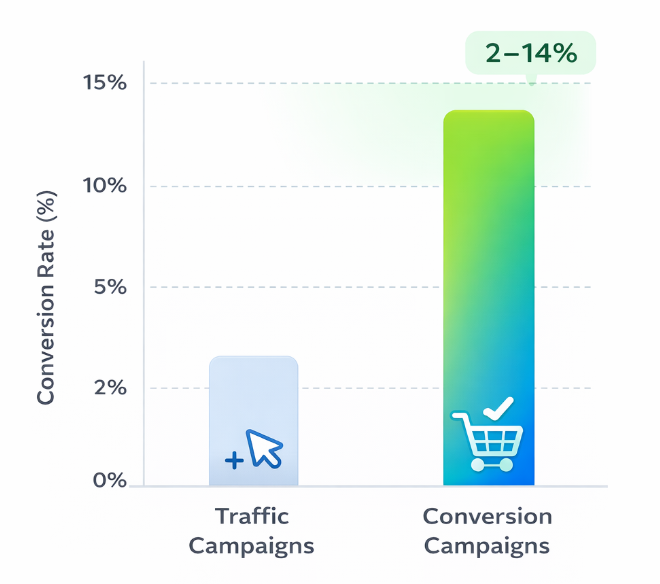
Conversion-focused campaigns consistently outperform traffic campaigns in generating measurable outcomes, as they optimize for real actions rather than clicks
Because traffic signals are less tied to revenue outcomes, the algorithm has less reliable data to optimize against. This can lead to inconsistent delivery and higher long-term costs.
Misalignment with Business Goals
Meta’s system is designed to prioritize measurable outcomes. Objectives that do not clearly demonstrate value are deprioritized in favor of those that do.
The Role of Aggregated Event Measurement and Privacy
Privacy changes have significantly influenced how Meta evaluates objectives.
Reduced Signal Availability
With limitations on tracking, fewer conversion events are available. This makes high-quality signals even more valuable.
Prioritization of Modeled Conversions
Meta increasingly relies on modeled data to fill gaps. Conversion objectives provide stronger inputs for these models, improving accuracy.
Impact on Optimization
Campaigns that rely on weak signals (such as clicks) are more affected by data loss, leading to reduced performance over time.
Advantage+ and Objective Consolidation
Meta has been actively simplifying campaign structures through solutions like Advantage+.
Automation-First Approach
Advantage+ campaigns reduce manual control and allow the system to dynamically allocate budget and targeting.
-
Advertisers using Advantage+ Shopping Campaigns have reported up to 32% lower CPA.
-
Automated placements and targeting improve efficiency by leveraging cross-channel data.
Fewer Objectives, Better Outcomes
Meta is moving toward consolidating objectives to focus on outcomes rather than tactics. This reduces fragmentation and improves learning efficiency.
When to Use Each Objective Strategically
Despite Meta’s preferences, each objective still has a role when used correctly.
Conversion Objectives
Best for:
-
Scaling revenue
-
Optimizing for purchases or qualified leads
-
Mature funnels with sufficient data
Traffic Objectives
Best for:
-
Early-stage testing
-
Driving initial website visits
-
Supporting retargeting pools
Awareness Objectives
Best for:
-
Brand launches
-
Market entry campaigns
-
Top-of-funnel exposure
The key is to transition toward conversion optimization as soon as sufficient data is available.
Practical Recommendations
To align with Meta’s optimization priorities:
-
Prioritize conversion tracking – Ensure events are properly configured and verified.
-
Consolidate campaigns – Avoid fragmentation that limits learning.
-
Reach 50+ conversions per week – This threshold significantly improves stability.
-
Use broader targeting – Allow the algorithm to explore and optimize.
-
Adopt automation tools – Leverage Advantage+ where applicable.
Common Mistakes to Avoid
-
Optimizing for clicks instead of outcomes
-
Running too many small ad sets
-
Resetting learning phases frequently
-
Ignoring signal quality issues
These mistakes can prevent the algorithm from reaching optimal performance.
Conclusion
Meta prefers campaign objectives that provide strong, high-quality signals and directly align with measurable business outcomes. Conversion-based objectives outperform others because they enable better prediction, faster learning, and clearer value.
Advertisers who understand and align with these priorities can achieve lower costs, higher efficiency, and more scalable results.