Digital advertising is often grouped under a single umbrella, but in practice, pay-per-click (PPC) search campaigns and social media ads operate according to fundamentally different mechanisms. They differ in how users encounter ads, how intent is expressed, how platforms price inventory, and how performance should be evaluated. Treating them as interchangeable channels is a common reason campaigns underperform.
This article explains the core reasons PPC and social ads behave differently and how those differences affect results.
1. User Intent: Demand Capture vs. Demand Creation
PPC search advertising primarily captures existing demand. Users actively search for solutions, products, or services, signaling high commercial intent. According to industry benchmarks, search ads convert on average 2–3× higher than social ads for bottom-of-funnel offers.
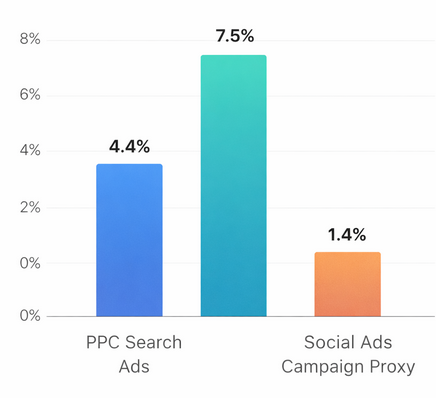
Average conversion rates for PPC search campaigns are significantly higher than typical social advertising engagement metrics, illustrating stronger direct-response performance
Social ads, by contrast, focus on demand creation. Users are not searching for a solution; they are consuming content. Ads interrupt rather than respond to intent. As a result, social campaigns typically show lower immediate conversion rates but higher influence on awareness and consideration.
Key implication: PPC is more efficient for direct response and lead capture, while social ads excel at introducing or warming up audiences.
2. Auction Dynamics and Cost Behavior
Search PPC auctions are driven by keyword competition and Quality Score. Costs tend to be more stable because demand for keywords changes gradually. In competitive B2B niches, average CPCs commonly range from $3 to $12, with high-intent keywords justifying higher costs due to predictable conversion behavior.
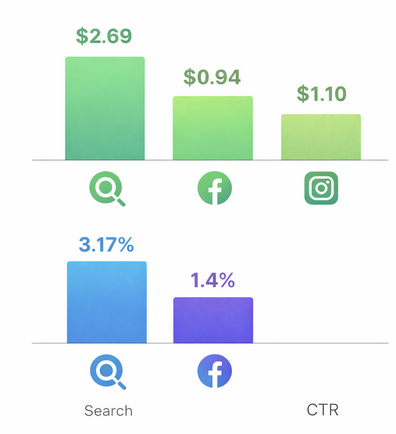
Comparison of cost-per-click and click-through rate benchmarks shows that search ads typically cost more per click but also generate higher engagement than social placements
Social ad auctions are impression-based and highly volatile. CPMs fluctuate based on audience size, seasonality, and advertiser demand. Industry data shows that social CPMs can vary by 40–60% within the same quarter, especially during high-competition periods.
Key implication: PPC costs scale linearly with intent, while social costs fluctuate with market pressure and creative performance.
3. Creative’s Role in Performance
In PPC search campaigns, ad copy plays a supporting role. Relevance and keyword alignment matter more than creativity. Even modest copy changes usually result in incremental improvements rather than dramatic swings.
Social advertising is creative-driven. Visuals, messaging angles, and formats heavily influence performance. Studies show that creative quality can account for up to 70% of performance variance in social campaigns. A strong creative can outperform a weak one by several multiples, even when targeting and budget remain the same.
Key implication: PPC optimization is systematic and structural, while social optimization is iterative and creative-led.
4. Learning Periods and Optimization Speed
PPC campaigns often stabilize quickly. With sufficient search volume, meaningful performance insights can emerge within days. Optimization focuses on bids, keywords, and landing page relevance.
Social platforms require longer learning phases. Algorithms need conversion data to optimize delivery, and performance may fluctuate significantly during the first 7–14 days. Premature changes often reset learning, delaying results.
Key implication: PPC rewards fast, data-driven adjustments; social ads require patience and controlled testing cycles.
5. Attribution and Measurement Challenges
PPC attribution is relatively straightforward. Search clicks often occur close to conversion, making last-click attribution reasonably accurate.
Social ads influence conversions indirectly. Users may view an ad, not click, and convert days later through another channel. Research indicates that over 50% of social-driven conversions occur without a direct click, making traditional attribution models understate social impact.
Key implication: PPC performance is easier to measure directly, while social ads require broader attribution models and longer evaluation windows.
How to Use PPC and Social Ads Together
The strongest results usually come from combining both channels:
-
Use social ads to build awareness and retarget engaged users
-
Capture high-intent demand with PPC search
-
Align messaging across channels to reinforce recognition
-
Evaluate performance using channel-appropriate metrics
When each channel is judged by its own role rather than identical KPIs, overall efficiency improves.
Suggested Reading
To explore related topics, consider these articles:
Conclusion
PPC and social ads behave differently because they serve different purposes, respond to different user mindsets, and operate under distinct auction and optimization systems. Recognizing these differences allows advertisers to design strategies that play to each channel’s strengths instead of forcing uniform expectations.
Understanding how and why these channels diverge is a prerequisite for building paid media programs that scale predictably and sustainably.