
Digital marketing campaigns rarely fail because of creativity alone. More often, the problem lies in how campaigns are structured: how audiences are segmented, how budgets are allocated, and how performance data flows through the system.
A campaign structure that works during launch may begin to degrade within months as data volume increases, new audiences appear, and optimization complexity grows. However, some campaign structures remain effective for years with minimal rebuilding.
Understanding why some campaign structures age well while others deteriorate is essential for building sustainable marketing systems.
Structural Simplicity Enables Longevity
One of the most common characteristics of durable campaigns is structural simplicity. Complex campaign architectures with dozens of micro-segments, overlapping audiences, and tightly constrained budgets tend to become unstable over time.
As platforms evolve and algorithms change, overly complex structures create maintenance overhead. Small structural adjustments can cascade into large disruptions.
Research from marketing analytics platforms shows that campaigns with simplified segmentation structures can reduce management overhead by up to 35% while maintaining similar performance levels.
Simpler architectures also allow algorithms to accumulate more data per segment, which improves optimization accuracy over time.
Data Density Determines Optimization Quality
Campaigns age better when each structural element accumulates sufficient data.
When a campaign is fragmented into too many ad sets, audience groups, or targeting layers, each component receives limited data. This slows down machine learning optimization and creates unstable performance patterns.
According to industry benchmarks, advertising systems typically require at least 50–100 conversion events per optimization unit each week to stabilize performance. Campaign structures that fail to reach these thresholds often require constant manual adjustments.
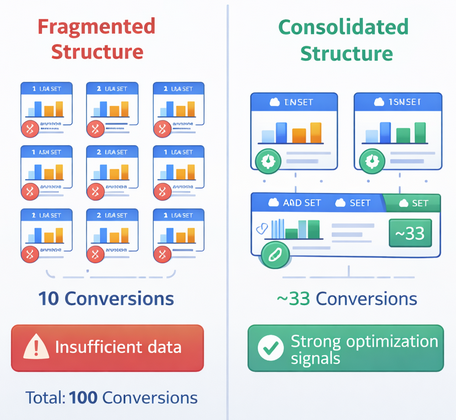
How campaign fragmentation reduces optimization efficiency. Advertising platforms typically require around 50 weekly conversions per ad set for stable learning and performance optimization
Durable campaign frameworks concentrate data rather than dispersing it.
Adaptability to Platform Evolution
Advertising platforms evolve rapidly. Targeting options disappear, attribution models change, and new automation layers are introduced.
Campaign structures that depend heavily on specific targeting tricks or fragile segmentation logic tend to break when platform changes occur.
In contrast, resilient campaigns rely on broader audience definitions, flexible creative rotation, and adaptive budget allocation strategies.
Industry studies suggest that over 60% of major advertising platform updates directly affect targeting capabilities. Campaigns that rely on rigid targeting layers therefore degrade more quickly.
Structures designed around broader signals rather than narrow targeting remain stable across platform changes.
Scalability Without Structural Rebuild
Another indicator of long-lasting campaign architecture is scalability.
Campaigns that age well can scale spend without requiring full structural redesign. When budgets increase, the campaign framework should absorb additional traffic naturally.
However, fragile campaign designs often hit scaling ceilings. When performance begins to decline at higher budgets, marketers frequently respond by duplicating campaigns, creating additional layers, or restructuring the entire account.
This resets learning cycles and increases operational complexity.
Stable campaign structures allow gradual scaling while maintaining performance consistency.
Maintenance Cost Over Time
Many campaign designs appear effective during initial testing but become expensive to maintain. Structures that require constant manual optimization, duplication, and segmentation eventually drain marketing resources.
Research from marketing operations teams indicates that campaign management can consume up to 30% of a marketer’s weekly workload when campaign structures become too granular.
Durable campaigns minimize routine intervention by relying on consistent frameworks that continue to function as data grows.
Signals of a Campaign That Will Age Poorly
Certain warning signs often indicate that a campaign structure will degrade quickly:
-
Excessive audience fragmentation
-
Overlapping targeting layers
-
Frequent duplication to achieve scale
-
Heavy reliance on narrow targeting criteria
-
Constant manual budget redistribution
When these patterns appear, the campaign architecture is usually compensating for structural weaknesses rather than enabling sustainable growth.
Designing Campaign Structures for Longevity
Campaign longevity is not accidental. It results from deliberate structural choices during campaign design.
Effective long-term campaign structures typically share several characteristics:
-
Broad audience groupings
-
Clear budget hierarchies
-
Consistent creative testing frameworks
-
Sufficient data flow per optimization unit
-
Flexibility to absorb platform changes
Campaigns built around these principles tend to improve with age rather than deteriorate.
Conclusion
The lifespan of a marketing campaign is determined less by creative ideas and more by structural architecture. Campaigns that concentrate data, maintain simplicity, and adapt to platform evolution remain effective long after launch.
As marketing platforms become increasingly automated, campaign structure plays an even greater role in long-term performance stability.
Organizations that design campaigns with longevity in mind reduce operational overhead, preserve optimization data, and achieve more sustainable growth.