High click volume with low conversions is a common pattern in digital advertising. According to industry benchmarks, the average Facebook ad click‑through rate across industries is around 0.9–1.5%, yet landing page conversion rates often remain below 3%. This means a large percentage of users who show interest never complete the intended action.
Understanding why this gap occurs requires looking beyond audience targeting and examining the entire customer journey.
Mismatch Between Ad Message and Landing Page
One of the most frequent issues is message inconsistency. Users click because the ad promises a specific benefit, offer, or outcome. When the landing page fails to immediately reinforce that promise, trust drops and visitors leave.
Common problems include:
• Different messaging between the ad and landing page
• A different product or offer than expected
• Lack of clear continuation of the ad narrative
Even small inconsistencies can significantly reduce conversions. Research shows that message match improvements can increase conversion rates by over 20%.
Slow or Poorly Optimized Landing Pages
Landing page performance strongly influences whether clicks become conversions. A delay of only a few seconds can drastically reduce engagement.
Google research shows that when mobile page load time increases from 1 second to 3 seconds, the probability of bounce increases by 32%. At 5 seconds, the bounce probability jumps to 90%.
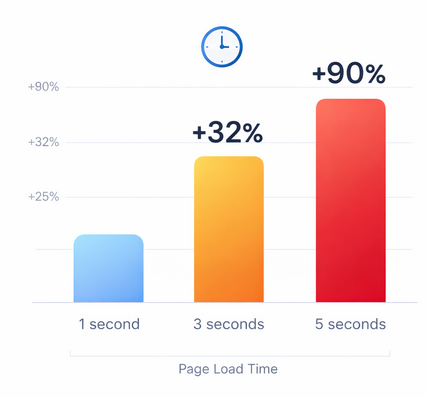
Page load speed significantly affects whether ad clicks turn into conversions. Even a few seconds of delay dramatically increases bounce rates
If users arrive from an ad and the page loads slowly, many leave before seeing the offer.
Weak Value Proposition
Clicks indicate interest, but conversions require conviction. If the offer on the landing page is not compelling enough, visitors hesitate.
Signs of a weak value proposition include:
• Vague product benefits
• Lack of differentiation
• No clear explanation of why the product is better than alternatives
When users do not immediately understand the value, they postpone the decision or abandon the page.
Poor User Experience on Mobile
More than 80% of Facebook traffic comes from mobile devices. However, many landing pages are designed primarily for desktop viewing.
Problems commonly include:
• Small or difficult-to-tap buttons
• Long forms that are hard to complete on phones
• Large images that slow page performance
Even minor usability issues can drastically reduce conversion rates.
Too Many Conversion Steps
Another overlooked factor is funnel complexity. Every additional step between the ad click and the final action increases friction.
Typical conversion barriers include:
• Multi-step checkout processes
• Mandatory account creation
• Long lead forms
Studies show that reducing form fields from 11 to 4 can increase conversions by up to 120%.
Lack of Trust Signals
Users clicking from social media often have limited familiarity with a brand. Without reassurance, they hesitate to complete purchases or submit personal information.
Effective trust elements include:
• Customer reviews
• Testimonials
• Security badges
• Clear refund or guarantee policies
Landing pages that include visible trust signals consistently outperform those that do not.
Misaligned Audience Intent
Even when targeting settings appear correct, intent may still be mismatched. Users might click out of curiosity rather than purchase readiness.
For example:
• Educational ads attracting research-oriented users
• Discounts attracting bargain seekers rather than buyers
• Broad interest targeting capturing casual browsers
Refining messaging and funnel design often improves intent alignment more effectively than adjusting targeting alone.
How to Diagnose the Real Problem
To identify the true cause of low conversions, advertisers should analyze multiple campaign metrics simultaneously:
• Click-through rate
• Landing page bounce rate
• Time on page
• Form completion rate
• Checkout abandonment rate
These metrics help determine whether the issue lies in the ad creative, landing page experience, or funnel structure.
Key Takeaways
Clicks alone do not guarantee conversions. When Facebook ads attract traffic but fail to generate results, the issue often lies in post-click experience rather than targeting.
Advertisers who optimize landing pages, improve message alignment, reduce friction, and strengthen value propositions typically see significant improvements in conversion performance.