Digital advertisers often assume that replicating a successful campaign structure will produce the same results everywhere. However, advertising platforms rely heavily on machine learning, historical performance data, and account-level signals. These factors can cause the exact same ad to perform dramatically differently depending on the account it runs in.
According to industry benchmarks, the average Facebook ad click‑through rate (CTR) across all industries is about 0.90%, while conversion rates average around 9–10%. Yet advertisers regularly observe campaigns in different accounts producing CTR differences of 2–3× and conversion rates varying by more than 50%.
Understanding the mechanisms behind these discrepancies helps marketers diagnose performance problems faster and design campaigns that scale reliably.
Account History and Learning Data
Advertising algorithms depend heavily on historical data. When an account has accumulated thousands of conversions, the system can better predict which users are likely to engage or purchase.
Accounts with strong historical performance often exit the learning phase faster and optimize campaigns more efficiently. In contrast, new or inactive accounts lack sufficient signals, forcing the algorithm to explore audiences more broadly.
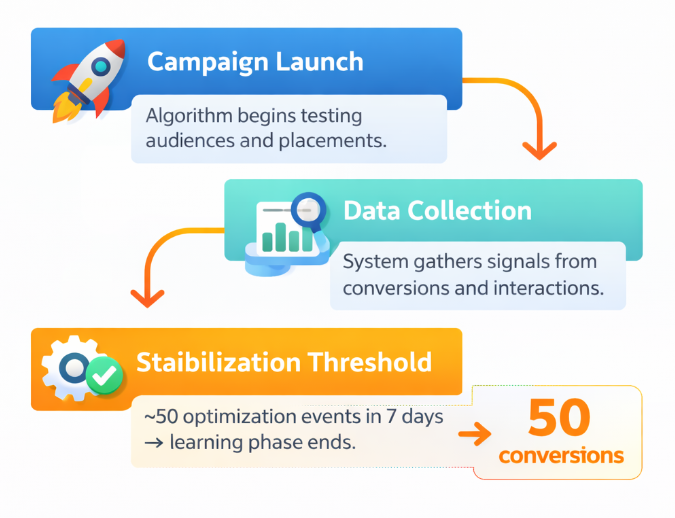
Meta’s algorithm typically requires about 50 optimization events within seven days to exit the learning phase and stabilize campaign performance
Research from Meta indicates that ad sets typically require around 50 optimization events within seven days to stabilize performance. Accounts that consistently generate these events provide better training data for the algorithm.
Pixel and Event Quality
Tracking quality significantly affects campaign outcomes. Even when two campaigns target the same audience, differences in pixel implementation or event quality can lead to different optimization results.
If one account records cleaner, more consistent events—such as purchases, leads, or add‑to‑cart actions—the algorithm receives clearer feedback about which users convert.
Industry studies suggest that advertisers using accurate event tracking and server‑side tracking can improve optimization efficiency by 10–20% compared with accounts relying solely on browser‑based tracking.
Audience Overlap and Saturation
Audience behavior also varies across accounts. One account may have already exposed a specific audience to multiple campaigns, increasing fatigue and lowering engagement.
Even when the targeting settings appear identical, overlapping campaigns, retargeting pools, and frequency levels can produce different results.
Marketing benchmarks show that ad frequency above 3–4 impressions per user often correlates with declining CTR and rising cost per acquisition.
Budget Structure and Learning Stability
Budget distribution across campaigns affects algorithm stability. Accounts with fragmented budgets across many ad sets often prevent the system from collecting enough optimization signals.
For example, if ten ad sets each receive small budgets, none may achieve the 50 conversion events needed for stable optimization. Consolidated structures typically perform better because they concentrate data and accelerate learning.
Data from multiple performance marketing studies suggests consolidated campaigns can reduce cost per acquisition by 15–25% compared with overly segmented account structures.
Creative Fatigue and Account Context
Creative performance depends not only on the ad itself but also on the environment in which it appears. If an account frequently tests new creatives, the algorithm has a larger pool of high‑performing assets to deliver.
Accounts that repeatedly run the same creative assets may experience declining engagement as audiences become familiar with the message.
Advertising analytics reports indicate that CTR can drop by more than 30% after two to three weeks of heavy exposure to the same ad creative.
Optimization Strategy Differences
Optimization settings influence how the algorithm distributes impressions. Two accounts may run identical ads but optimize for different events—such as link clicks versus conversions.
Conversion‑optimized campaigns often outperform click‑optimized campaigns when the pixel data is sufficient. However, in accounts with limited conversion history, click optimization may initially generate better engagement signals.
Selecting the correct optimization event for the account’s maturity level is therefore critical.
How to Reduce Performance Gaps Between Accounts
While differences between accounts are inevitable, advertisers can reduce performance variability by following several best practices:
-
Maintain accurate tracking and event implementation to ensure the algorithm receives reliable conversion data.
-
Consolidate campaigns and budgets so that each ad set gathers enough optimization events.
-
Continuously refresh creative assets to prevent audience fatigue and maintain engagement.
Applying these strategies helps stabilize algorithm learning and improves campaign scalability across multiple accounts.
Conclusion
Campaign performance differences between advertising accounts are rarely random. They usually stem from variations in historical data, event tracking quality, audience exposure, budget structure, and optimization strategies.
By recognizing how these factors influence the platform’s machine‑learning system, advertisers can diagnose inconsistencies more effectively and design campaigns that deliver stable results across different accounts.
Recommended Articles