Data has become one of the most valuable assets for marketing and sales operations. However, not all data is created equal. Two categories that have gained particular importance in recent years are zero‑party data and first‑party data.
Both types are collected directly from users and customers rather than purchased from third parties. Because of this, they are considered more reliable, privacy‑compliant, and strategically valuable. Yet despite their similarities, the way they are collected, interpreted, and used differs significantly.
Understanding these differences helps organizations design better personalization strategies, build trust with customers, and maintain long‑term data sustainability.
What Is Zero‑Party Data?
Zero‑party data refers to information that a customer intentionally and proactively shares with a company. This data is provided directly by the individual with the clear understanding that it will be used to improve their experience.
Typical examples of zero‑party data include:
-
Preference center selections
-
Product interest surveys
-
Quiz results
-
Form responses
-
Explicit communication preferences
The defining characteristic is transparency and intent. The customer knowingly provides the data to help the organization personalize content, recommendations, or communication.
According to research by Forrester, nearly 64% of marketers say zero‑party data will become a critical component of their personalization strategies in the coming years.
What Is First‑Party Data?
First‑party data is information a company collects from user behavior and interactions across its owned channels. This data is generated through activities such as browsing, purchasing, or engaging with digital properties.
Examples include:
-
Website behavior and page visits
-
Purchase history
-
CRM interactions
-
Email engagement metrics
-
Customer support interactions
Unlike zero‑party data, this information is typically inferred from behavior rather than explicitly provided.
First‑party data is widely used because it is highly accurate and directly connected to real interactions. Studies show that organizations using first‑party data for marketing decisions are 2.9 times more likely to report revenue growth above their industry average.
Key Strategic Differences
Although both data types come directly from the customer relationship, their strategic roles differ.
Source of the Data
Zero‑party data is declared by the user. Customers voluntarily provide it through surveys, forms, or account settings.
First‑party data is observed. It is generated from interactions such as clicks, purchases, or browsing sessions.
Level of Customer Intent
Zero‑party data reflects explicit intent. If a customer indicates they are interested in a particular product category, the signal is very clear.
First‑party data reflects behavioral signals. A customer may browse several pages about a product without necessarily intending to purchase.
Personalization Potential
Zero‑party data supports highly accurate personalization because preferences are directly stated.
First‑party data enables predictive personalization through behavioral analysis and pattern recognition.
Data Collection Methods
Zero‑party data typically requires engagement strategies such as surveys, interactive content, preference centers, or onboarding questionnaires.
First‑party data is collected automatically through analytics tools, CRM systems, website tracking, and transaction records.
Why Zero‑Party Data Is Becoming More Important
Privacy regulations and technology changes are reshaping how companies collect and use data. The decline of third‑party cookies has accelerated the shift toward direct data relationships.
Research from Gartner suggests that by 2025, 80% of marketers will abandon third‑party data in favor of first‑party and zero‑party strategies.
Zero‑party data is particularly valuable because:
-
It strengthens transparency with customers
-
It improves trust and brand perception
-
It enhances personalization accuracy
-
It supports compliance with privacy regulations
When customers voluntarily share their preferences, companies gain insight that behavioral analytics alone cannot provide.
The Continued Value of First‑Party Data
Despite the growing focus on zero‑party data, first‑party data remains the foundation of most data strategies.
Behavioral signals reveal patterns that customers may not explicitly communicate. For example, browsing activity can uncover emerging interests, while purchase history identifies loyalty trends.
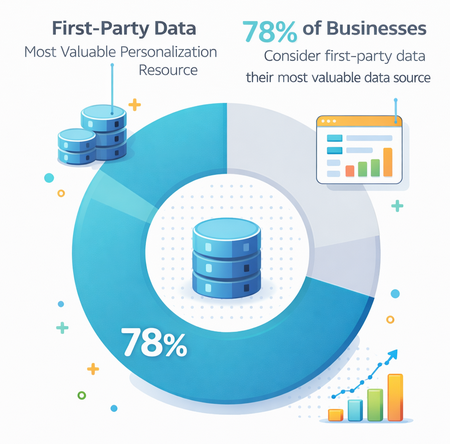
First-party data has become the primary personalization resource for most organizations. Surveys show that 78% of businesses consider it their most valuable data source for building personalized marketing strategies
A McKinsey study found that companies using advanced first‑party data strategies can increase marketing ROI by up to 30%.
In practice, the most effective strategies combine behavioral data with declared preferences.
How Businesses Should Use Both Together
Rather than choosing between zero‑party and first‑party data, organizations should integrate both to create a more complete customer view.
A balanced strategy may include:
-
Collecting zero‑party data through onboarding surveys and preference centers
-
Enriching profiles with first‑party behavioral signals
-
Using analytics to detect patterns between stated preferences and actual behavior
-
Continuously updating profiles based on new interactions
This combined approach improves segmentation accuracy and allows companies to deliver more relevant experiences.
Challenges to Consider
Although both data types are valuable, there are several challenges organizations must address.
Data Accuracy
Customers may provide outdated preferences over time. Behavioral data may also misinterpret intent.
Engagement Barriers
Collecting zero‑party data requires active participation, which means organizations must design engaging experiences.
Data Integration
Combining behavioral data with declared preferences requires well‑structured data systems and governance processes.
Organizations that successfully address these challenges can unlock powerful insights while maintaining strong privacy standards.
Conclusion
Zero‑party data and first‑party data represent the foundation of modern, privacy‑centric marketing strategies. While first‑party data captures behavioral signals from real interactions, zero‑party data reveals the preferences customers intentionally share.
The most effective organizations combine both sources to create a deeper understanding of their audience. By aligning declared preferences with behavioral insights, companies can improve personalization, strengthen customer relationships, and build sustainable data strategies for the future.
Recommended Reading
To further explore data‑driven marketing strategies, consider these articles: