Facebook ad setup looks simple until you have to choose how much control you actually need.
Meta’s Page-level ad workflow frames the process as choosing an ad type and goal, adding visuals and text, defining your audience, setting budget and duration, then publishing and optimizing. That sounds straightforward, but the confusion starts when advertisers see multiple setup paths, especially Automated Ads and more manual “new ad” options from a Page.
This affects SMB owners, agencies, startup marketers, B2B lead-generation teams, affiliate marketers, and performance marketers who need more than “the ad is live.” They need to know whether the campaign is built to attract the right clicks, qualified leads, sales, booked calls, or pipeline.
The Problem
The problem is not that advertisers cannot find the ad creation button.
The problem is that they do not know which setup path fits the campaign.
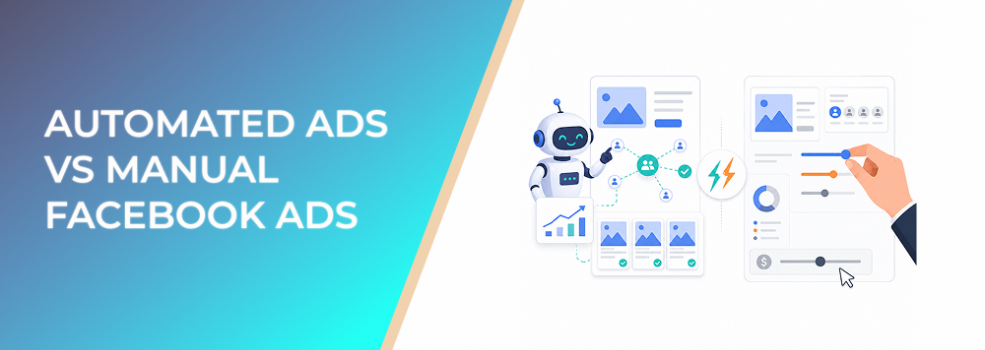
Automated Ads feel safer because Meta handles more decisions. Manual or “new ad” setups feel more flexible because the advertiser can make more decisions directly. But more automation is not automatically better, and more control is not automatically smarter.
The setup confusion usually sounds like this:
“Should I let Meta build the campaign for me, or should I control the audience, objective, creative, and budget myself?”
That question matters even more now because Meta Help snippets state that Automated Ads are being phased out in 2026, and some advertisers may no longer have access to them.
Why This Problem Hurts Performance
Choosing the wrong setup path can turn a simple campaign into wasted spend.
If you use too much automation for a high-risk campaign, Meta may optimize toward easy surface-level actions instead of business value. You may get cheap clicks, low-quality form fills, weak appointment requests, or leads that sales teams reject.
If you use a manual setup when you do not have a clear strategy, you can overcomplicate the account. Too many audiences, too many ad sets, too many creative variations, and too little budget per test can create noisy results.
Both mistakes hurt performance in practical ways:
- CPC rises when relevance is weak.
- CPA rises when the campaign attracts people who are not ready to convert.
- CAC rises when sales teams must chase low-quality leads.
- ROAS drops when spend goes toward curiosity instead of purchase intent.
- Scaling becomes risky because you do not know what is actually working.
Common Scenarios Where This Happens
A local service business launches Automated Ads because setup is fast, but it does not define what a qualified appointment looks like. The campaign generates inquiries, but many are outside the service area or not ready to book.
A B2B SaaS startup chooses a simplified setup because the team wants leads quickly. The campaign produces form fills, but most leads are junior employees, students, or people without buying authority.
An agency inherits a client account where every ad was launched from the Page. Some ads are active, some are boosted posts, some are automated, and nobody can clearly explain which audience or goal each one is using.
An ecommerce brand manually builds too many ad sets for a small budget. The team wants control, but the setup fragments delivery and makes it hard to identify the winning product angle.
An affiliate marketer uses automated setup for a niche offer. The campaign gets engagement, but the audience is too broad for the payout economics to work.
Why the Problem Happens
Setup confusion happens because Facebook ad creation mixes platform steps with strategic decisions.
A platform step is simple: choose a goal, add creative, define an audience, set budget, publish.
A strategic decision is harder: decide whether Meta should make more of those choices automatically or whether the advertiser needs to control them because the campaign has real business risk.
Advertisers also confuse “easy to launch” with “safe to scale.” A campaign can be easy to publish and still be strategically weak.
The deeper issue is that many advertisers begin with the interface instead of the business outcome. They ask, “Which button should I click?” before asking, “What result would justify this spend?”
The Solution
The solution is to choose the setup path based on campaign risk, not comfort.
Before launching, answer four questions.
1. What business result must the ad create?
Do not stop at “more leads,” “more traffic,” or “more sales.”
Define the result in business terms:
- Qualified demo requests from companies that match your ICP.
- Booked calls from people who can buy within the next 30 days.
- First purchases at or below a profitable CPA.
- Quote requests from people in the right location and service category.
- Retargeting engagement from users who already showed purchase intent.
The clearer the outcome, the easier the setup choice becomes.
2. How expensive is a bad conversion?
If a bad lead is not very costly, a more automated setup may be acceptable for testing.
If a bad lead wastes sales time, damages reporting, or pushes CAC above target, you need more control.
High-risk campaigns usually include B2B lead generation, high-ticket services, niche ecommerce offers, local services with strict location constraints, and affiliate offers with tight payout economics.
3. How specific does the audience need to be?
Use simpler automation when the audience is broad and the conversion quality is easy to judge.
Use a more manual setup when you need to define:
- Buyer role.
- Community intent.
- Competitor awareness.
- Funnel stage.
- Location quality.
- Professional relevance.
- Lead qualification standard.
Audience specificity is one of the strongest reasons to move away from a simplified setup.
4. What will you review before spending more?
Every setup path needs a decision rule.
Decide before launch when you will review the campaign and what will count as success. For lead generation, review lead quality, booked calls, qualification rate, and cost per qualified lead. For ecommerce, review purchase rate, CPA, ROAS, AOV, and margin. For traffic, review meaningful site behavior instead of clicks alone.
How LeadEnforce Helps
LeadEnforce helps when setup confusion is really audience confusion.
If you decide that your campaign needs a more controlled setup, the next question is often, “What audience should I actually test?” LeadEnforce supports source-based audience creation from Facebook group members, Instagram profile followers, LinkedIn-derived professional data, and custom social-profile links.
That matters because manual setup is only useful if your manual decisions are better than guesswork.
For example, a B2B campaign can test an audience built around relevant professional signals instead of relying only on broad interests. A niche ecommerce brand can test followers or engagers of relevant Instagram profiles. A local service business can explore community-based audiences that better reflect real buyer context.
LeadEnforce does not choose your objective, write your creative, fix your landing page, or guarantee conversion quality. It helps with the audience input, so the manual setup has a clearer audience hypothesis to test.
Risks and Considerations
Do not assume manual setup always beats automation.
Manual campaigns can fail when advertisers over-segment audiences, create too many ad sets, or make decisions before enough data exists. Automated setup can fail when the campaign goal is vague or conversion quality is difficult to judge.
Also, audience precision does not fix weak creative. If the offer is unclear, the landing page is mismatched, or the conversion event is low quality, better targeting will not rescue the campaign.
If using LeadEnforce, evaluate the relevance of each source audience. A large Facebook group, Instagram profile, or professional segment is not automatically valuable. It must match the buyer, the offer, and the campaign objective.
Prerequisites and Dependencies
To fix setup confusion, you need:
- A clear business outcome.
- A campaign objective that reflects that outcome.
- A defined ICP or audience hypothesis.
- A realistic budget and review window.
- Creative that matches audience intent.
- A landing page or lead flow that continues the same promise.
- Reliable success metrics beyond clicks and impressions.
If LeadEnforce is part of the workflow, you also need relevant source communities, Instagram profiles, LinkedIn-derived criteria, or social-profile data that map to the audience you want to test.
Practical Recommendations
Use Automated Ads only when the campaign is simple, the risk of a bad conversion is low, and you have a clear review point.
Use a more manual setup when lead quality, audience specificity, funnel stage, or diagnostic control matters.
Create a pre-launch setup brief with five fields:
- Goal.
- Audience.
- Offer.
- Creative angle.
- Success metric.
Then choose the setup path that gives you the right amount of control for those decisions.
If you are moving from automated setup into manual campaigns, start with one clean campaign structure. Do not rebuild every possible audience at once. Test one strong audience hypothesis, one core offer, and a small set of creative angles.
Final Takeaway
Facebook Ads setup confusion is not solved by picking the easiest interface.
It is solved by matching the setup path to the business risk of the campaign. Use automation when simplicity helps. Use manual control when audience quality, conversion quality, and diagnostic clarity matter more.
To build more relevant audiences for controlled Facebook and Instagram campaign tests, join the free 7-day LeadEnforce trial period.
Related LeadEnforce Articles
- Automated Ads vs Manual Facebook Ad Campaigns: How to Protect Your Ad Performance — Helps clarify when automation helps and when manual control protects performance.
- Facebook Automated Ads: How They Work and When to Use Them — Useful background for understanding the simplified automated setup path.
- How To Replace Facebook Automated Ads Before Meta Phases Them Out — Relevant for advertisers preparing to move from Page-level automation to more structured campaigns.
- Plan Facebook Ads So Creative, Audience, And Goal Stay Aligned — Supports the pre-launch alignment process recommended in this article.