When an advertiser cannot create a new Meta ad account, the first reaction is often frustration.
A new client needs campaigns launched. A startup wants to separate product lines. An agency wants a clean account for testing. A growth team wants to isolate budgets.
But a new ad account is not always the right solution.
Meta’s help materials for ad-account creation troubleshooting reference issues such as reaching an ad-account limit, and Meta notes that ad-account limits are generally adjusted based on historical spending and use of existing ad accounts.
For performance marketers, the practical question is not only “How do we create another account?” It is “Do we actually need another account to test better?”
What is happening when Meta blocks new ad-account creation?
In many cases, the business portfolio cannot create another ad account because Meta has limited the number of ad accounts it can create.
That limit may relate to the business’s account history, existing ad account usage, payment history, or account standing. Meta’s public help snippets also point advertisers toward existing active ad accounts when creation is not available.
This can feel like a scaling blocker, especially for agencies and advertisers that are used to separating campaigns by client, region, or business line.
But creating more ad accounts is not the only way to organize testing.
Sometimes the better answer is to use the existing account structure more intelligently: better campaign naming, cleaner business asset groups, tighter permissions, more disciplined budget allocation, and sharper audiences.
Why this matters for paid social performance
Ad-account structure affects more than administration.
It can influence how teams manage budgets, compare tests, read performance history, and maintain campaign learning.
Creating extra accounts without a real business reason can fragment reporting. It can also spread budget too thin across accounts that do not have enough activity to produce useful learning.
On the other hand, being unable to create a new account can slow legitimate work. A new agency client may need separation. A franchise may require different billing. A multi-brand company may need separate controls. A business expanding into a new market may need cleaner reporting.
The key is to distinguish between business necessity and organizational convenience.
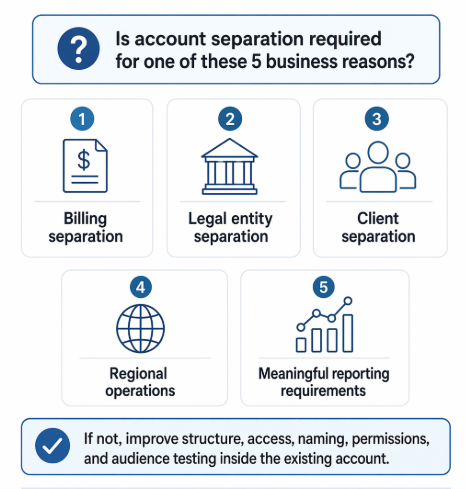
Five business reasons can justify a separate Meta ad account: billing, legal entity, client, regional, or reporting separation. Routine audience testing or messy internal structure usually calls for better organization inside the existing account instead
If the real problem is messy assets, read Business Asset Groups for Meta Ads: Organize Accounts So Campaign Testing Does Not Break. If the issue is access, see Adding People to Business Asset Groups: Give Paid Media Teams Access Without Overexposing Assets.
Business impact
Ad-account creation problems can affect campaign performance in several ways.
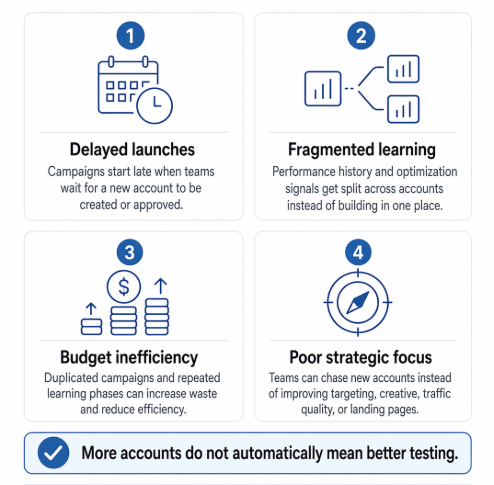
Account-creation problems can create four distinct paid social risks: delayed launches, fragmented learning, budget inefficiency, and poor strategic focus. The issue is not only administrative; it can directly affect how teams test, optimize, and interpret performance
Delayed launches
If a team waits for a new account instead of using an available active account, campaigns may launch late.
This can affect seasonal promotions, event-based campaigns, lead-generation pushes, and client onboarding timelines.
Fragmented learning
Unnecessary account creation can split campaign history and performance signals across too many places.
That can make optimization harder, especially for smaller budgets.
Budget inefficiency
More accounts can mean more duplicated campaigns, inconsistent naming, repeated learning phases, and unclear reporting.
The result may be higher CPA or CAC, not because Meta’s delivery is worse, but because the team is harder to manage.
Poor strategic focus
A new account can become a distraction from the real issue: weak targeting, poor audience quality, low-intent traffic, bad creative, or a landing page that does not convert.
Typical scenarios where this applies
This problem appears in many paid social environments.
- An agency wants to create a separate ad account for a new client but runs into a creation limit.
- A startup wants one ad account per product, even though the products share the same brand, audience, and funnel.
- An ecommerce brand expands internationally and wants better market separation.
- A B2B company launches a new lead-generation initiative and assumes a new ad account is required.
- An affiliate marketer wants to create many accounts for niche testing, instead of using a controlled campaign and audience-testing framework.
- A local business changes agencies and discovers that existing ad accounts are inactive, disorganized, or controlled by the wrong people.
- A growth team creates new accounts because its existing naming convention and asset structure are confusing.
Before assuming account creation is the answer, audit your operating structure with Meta Business Suite Settings: The Paid Social Control Layer Most Advertisers Ignore.
Risks and considerations
The biggest risk is trying to work around Meta account limits in ways that create more problems.
- Advertisers should avoid creating unnecessary duplicate structures, using unclear ownership, or spreading campaigns across accounts without a business reason.
- Another risk is misreading the problem. If the real issue is bad campaign performance, a new ad account will not fix weak creative, poor landing pages, poor conversion tracking, or broad low-intent audiences.
- There is also a measurement risk. If each test is placed in a different account, comparing CPA, CAC, ROAS, lead quality, and conversion rate can become harder.
- Advertisers should also consider policy and account health. If existing accounts are restricted or in poor standing, the priority should be resolving those issues rather than scaling a fragile setup.
Prerequisites and dependencies
Before deciding whether a new ad account is necessary, advertisers should have visibility into existing ad accounts, business settings, asset ownership, and permissions.
They need a clear reason for account separation. Valid reasons may include billing separation, legal entity separation, client separation, regional operations, or meaningful reporting requirements.
They also need an active account that can support testing, a reliable payment method, campaign objectives, enough budget, conversion tracking, and clear success metrics.
For LeadEnforce-driven testing, the advertiser needs relevant source communities, profiles, competitors, or social engagement signals to build useful audience segments.
How LeadEnforce helps
LeadEnforce helps advertisers keep testing momentum when account creation is not the best or available path.
Instead of multiplying ad accounts to test different audiences, advertisers can use LeadEnforce to build more precise audience segments inside the accounts they already have.
- For example, a B2B team can test audiences built from relevant Facebook groups, professional communities, competitor-adjacent Instagram profiles, or high-intent social segments.
- An ecommerce brand can compare audiences based on niche Instagram follower groups, category communities, or competitor engagement.
- An agency can build differentiated prospecting audiences for each client without assuming that every test requires a new ad account.
This is where LeadEnforce can reduce targeting guesswork. The advertiser still needs a clean Meta setup, but the testing focus moves from “How many accounts can we create?” to “Which audiences are most likely to produce qualified traffic and leads?”
LeadEnforce does not increase Meta ad-account limits, repair account standing, resolve payment issues, or guarantee account approval. Its role is audience quality and campaign targeting precision.
Practical recommendations
- First, inventory existing ad accounts. Identify which are active, inactive, restricted, client-owned, partner-shared, or no longer needed.
- Second, check whether the problem is truly account creation or simply poor organization. If you need clearer structure, business asset groups may be enough.
- Third, avoid creating accounts for every audience test. Most audience testing should happen through campaign and ad set structure, not separate accounts.
- Fourth, keep accounts aligned with real business needs. If a new account is needed for a client, region, billing structure, or brand, document the reason.
- Fifth, use LeadEnforce to prioritize audience tests. Build audience segments from high-intent Facebook groups, Instagram profiles, followers, and engagers. Then test those segments inside a clean campaign structure.
- Finally, review access before restructuring accounts. Sometimes a team thinks it needs a new account because it cannot access the correct existing one.
Final takeaway
A new Meta ad account is not a performance strategy.
When account creation is blocked or unnecessary, advertisers should focus on structure, access, and audience quality. Clean settings and asset groups keep the operation stable. LeadEnforce helps make the audiences inside that operation more relevant.
The result is a smarter testing process: fewer unnecessary accounts, less operational confusion, and more attention on the audiences most likely to improve paid social efficiency.
Start your free LeadEnforce trial today and see how sharper audience segments can keep testing moving without adding unnecessary Meta ad accounts.