Success in advertising often depends less on the creative or media buy, and more on what the advertiser expected in the first place.
Many campaigns underperform not because they’re poorly executed, but because the metrics are judged without context. Unrealistic expectations often lead to premature cuts, wasted budget, and missed insights that could fuel growth.
Getting better results starts with seeing the full picture — not just the dashboard. If you’re stuck comparing ads without proper baselines, this breakdown will help you step back. For further clarity, see how to interpret short-term vs long-term results.
Context First, Metrics Second
Not all campaigns are designed to deliver immediate returns. That’s why expecting a direct purchase from every ad click sets you up for disappointment.
Identify the Campaign Stage Before You Analyze Performance
Each phase of an ad account behaves differently. Treating a test campaign like a scaling campaign leads to bad decisions.
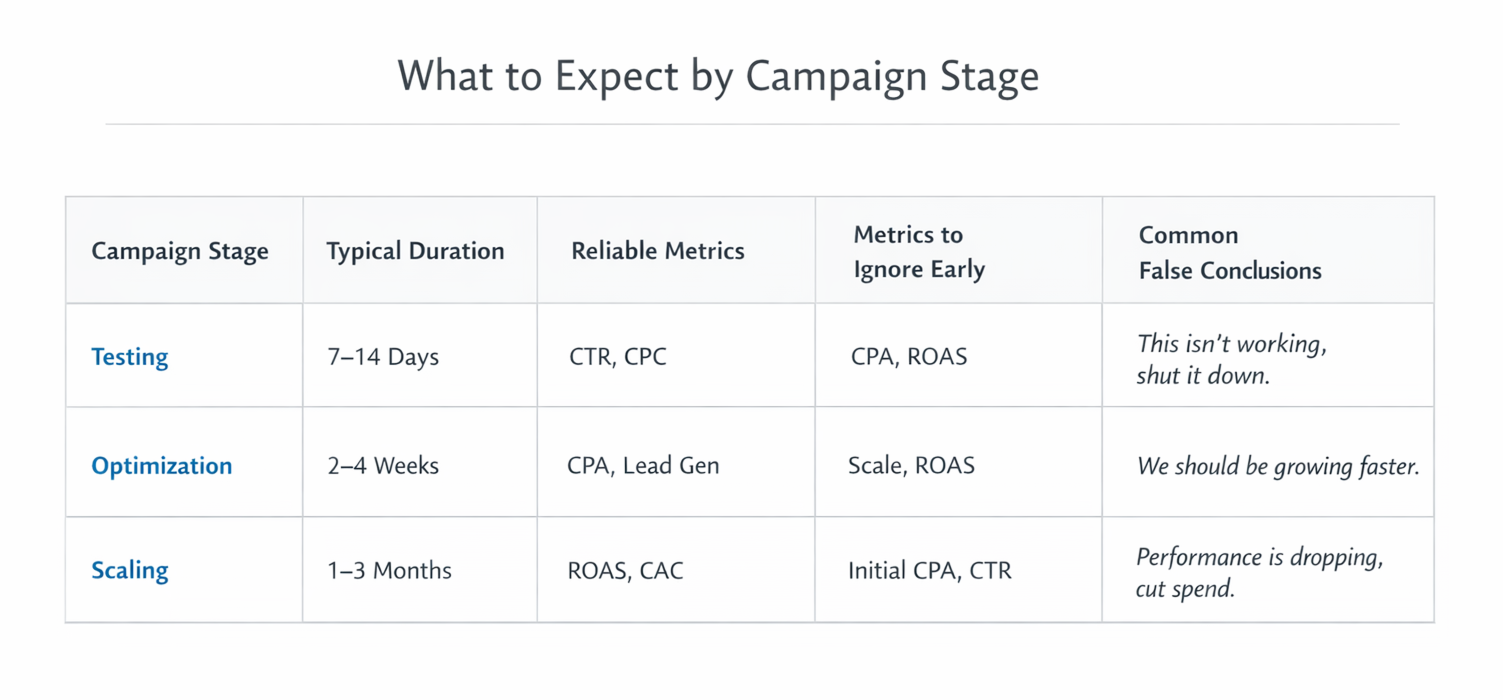
Here’s how to distinguish the stages:
-
Testing campaigns are designed to learn, not profit. Metrics will be unstable, and CPAs may be high. That's expected.
-
Optimization campaigns focus on refining what works. Expect smaller, steady gains rather than sharp improvements.
-
Scaling campaigns often see performance dips. Costs increase, reach broadens, and creative fatigue becomes a factor.
If you’re unsure how long to let a campaign run, check how long Facebook ads should run before judging results.
Match Metrics to Objectives, Not Just Channels
Too often, advertisers treat metrics like scores. But metrics are only meaningful when tied to the campaign’s role in the funnel.
Build a Metric Framework That Reflects Customer Behavior
Good measurement aligns with how people actually discover and decide. Here’s how to segment metrics by funnel stage:
-
Top-of-funnel campaigns should prioritize CPM, scroll stop rate, and CTR. These metrics show if the creative catches attention.
-
Mid-funnel campaigns benefit from metrics like landing page engagement, add-to-cart rate, and email sign-ups. These indicate intent.
-
Bottom-of-funnel campaigns should be judged on ROAS, conversion rate, and customer acquisition cost. These reflect revenue-driving performance.
Need help knowing which metrics actually matter? Here’s a detailed breakdown: The 5 ad metrics that actually matter when optimizing campaigns.
Don’t Ignore the Conversion Delay on Paid Social
One major difference between Google and Meta platforms is the delay between engagement and action. On Facebook and Instagram, that delay is often longer.
Understand What ‘Slow Conversions’ Actually Mean
People on social platforms aren’t searching for solutions. They’re browsing. That changes how they behave after the click.
For example:
-
A user might click to learn more, but isn’t ready to purchase until they’ve seen the ad five times.
-
Others need to visit your site multiple times before trusting your brand.
-
Higher-priced products or new categories often require days of consideration — not minutes.
This doesn’t mean the campaign failed. It means your attribution model must reflect how long your customer journey takes. Learn more in What conversion lag means for your Facebook ads.
Check Your Business Fundamentals Before Blaming the Ads
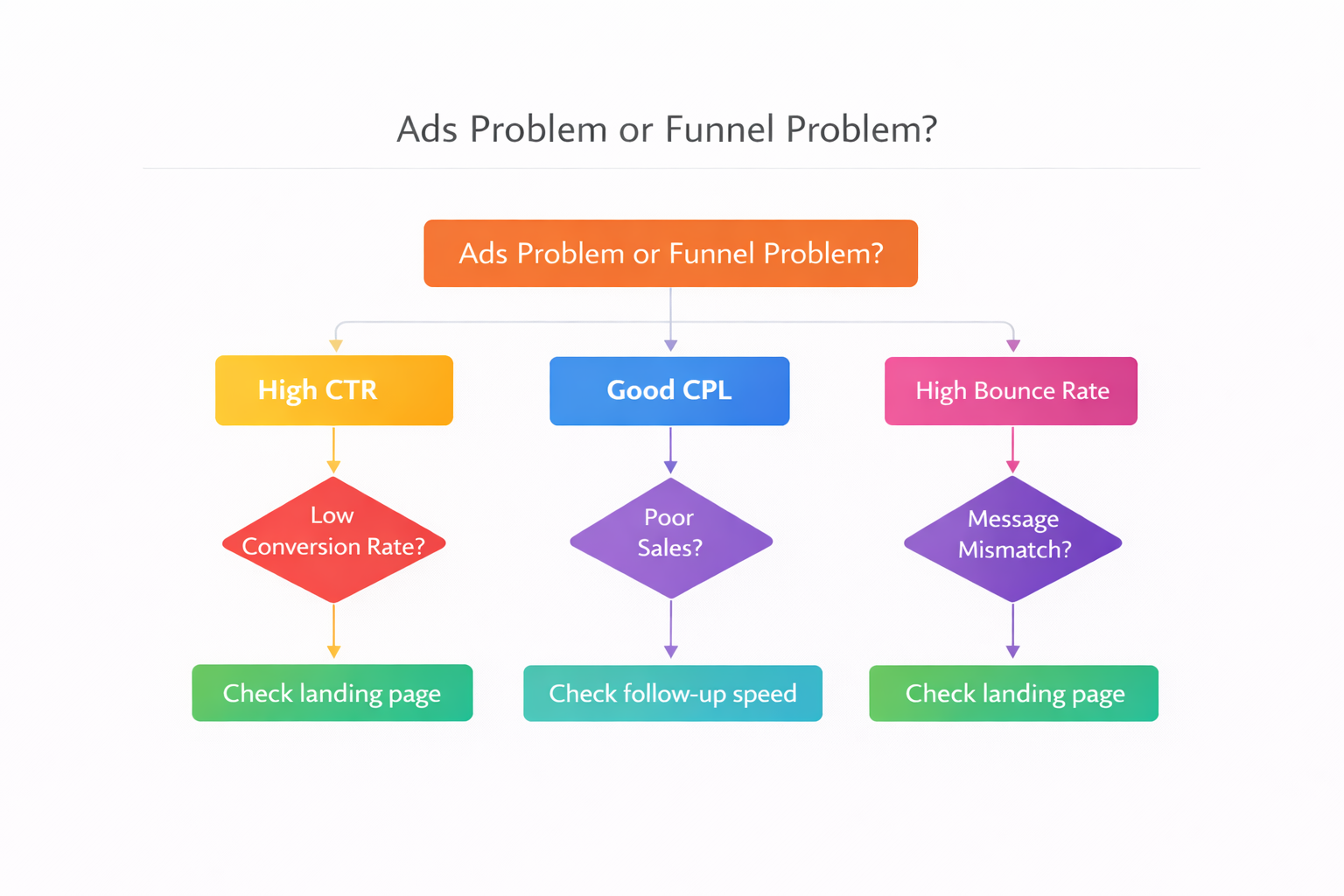
If your ads are getting clicks but not driving results, the issue might not be the ads at all.
Audit the Full Customer Experience
Small bottlenecks in your funnel often make a bigger impact than ad tweaks. Before adjusting your targeting or creative, look at these areas:
-
Page speed — Slow-loading pages kill conversions, especially on mobile.
-
Message match — If your landing page doesn’t align with your ad promise, users will bounce.
-
Offer clarity — Confusing offers or vague value propositions make it harder for users to commit.
-
Follow-up process — For lead gen, the speed and quality of your follow-up matter more than the lead cost.
If your campaign seems broken but metrics look fine, explore why your Facebook ads look great but still don’t sell.
Industry Benchmarks Are a Trap — Build Your Own
Comparing your ad performance to broad benchmarks often leads to flawed conclusions.
Most benchmarks don’t account for your price point, market, or sales cycle.
Create Internal Baselines Instead of Chasing External Averages
Here’s how to think more clearly about your own performance:
-
For subscription models, a high cost per acquisition might still be profitable if the payback period is short.
-
In B2B, lead quality matters more than lead volume. A $150 CPL could be a win if one in five closes.
-
For low-cost eCommerce, a 1.5x ROAS might not be enough if margins are thin or shipping is expensive.
If you need help translating metrics into actions, read How to analyze ad metrics like a pro.
Focus on What You’re Learning, Not Just Earning
Most campaigns fail quietly — not because they lose money, but because they never generate insights.
Track Progress Beyond Profit
A campaign with zero ROI can still be a win if it teaches you what not to do, or what to improve next. Consider tracking:
-
Winning hooks or creative angles across different ads — These often repeat in top-performing campaigns.
-
Audience overlap and fatigue — Are you reaching new people or just recycling your budget?
-
Test velocity — Are you launching new creative often enough to avoid stagnation?
To learn more about running effective experiments, try How to run split tests that reveal real insights.
Final Thought: Realistic Doesn’t Mean Passive
Setting realistic expectations isn’t about playing it safe. It’s about giving your campaigns the time and context they need to deliver.
Track the right metrics. Match them to your funnel. Understand what success looks like at each stage — and why delayed results don’t mean failure.
The more grounded your expectations, the better your long-term performance will be.