You’ve tested creatives, audiences, hooks, and offers. You’ve optimized for conversions, traffic, engagement, and leads. Yet the right people still aren’t showing up.
This is the moment many advertisers misdiagnose the problem. They assume the creative is weak or the funnel is broken. Sometimes that is true. But in many cases, the real issue is structural.
Your target market may not be reachable through paid social — at least not in a reliable, scalable way.
This does not mean your audience does not exist. It means the channel you are using is not where they are most accessible, responsive, or measurable.
If you are running Facebook or Instagram ads and seeing low intent, poor match quality, or inconsistent results, it may be time to look beyond paid social.
If you're unsure whether your campaigns are truly failing or just misaligned, here’s what to do when your Facebook ads look fine but don’t drive results.
Why paid social can’t always deliver
Paid social platforms rely on predictive modeling. They use behavioral signals, engagement data, and past activity to decide who sees your ad.
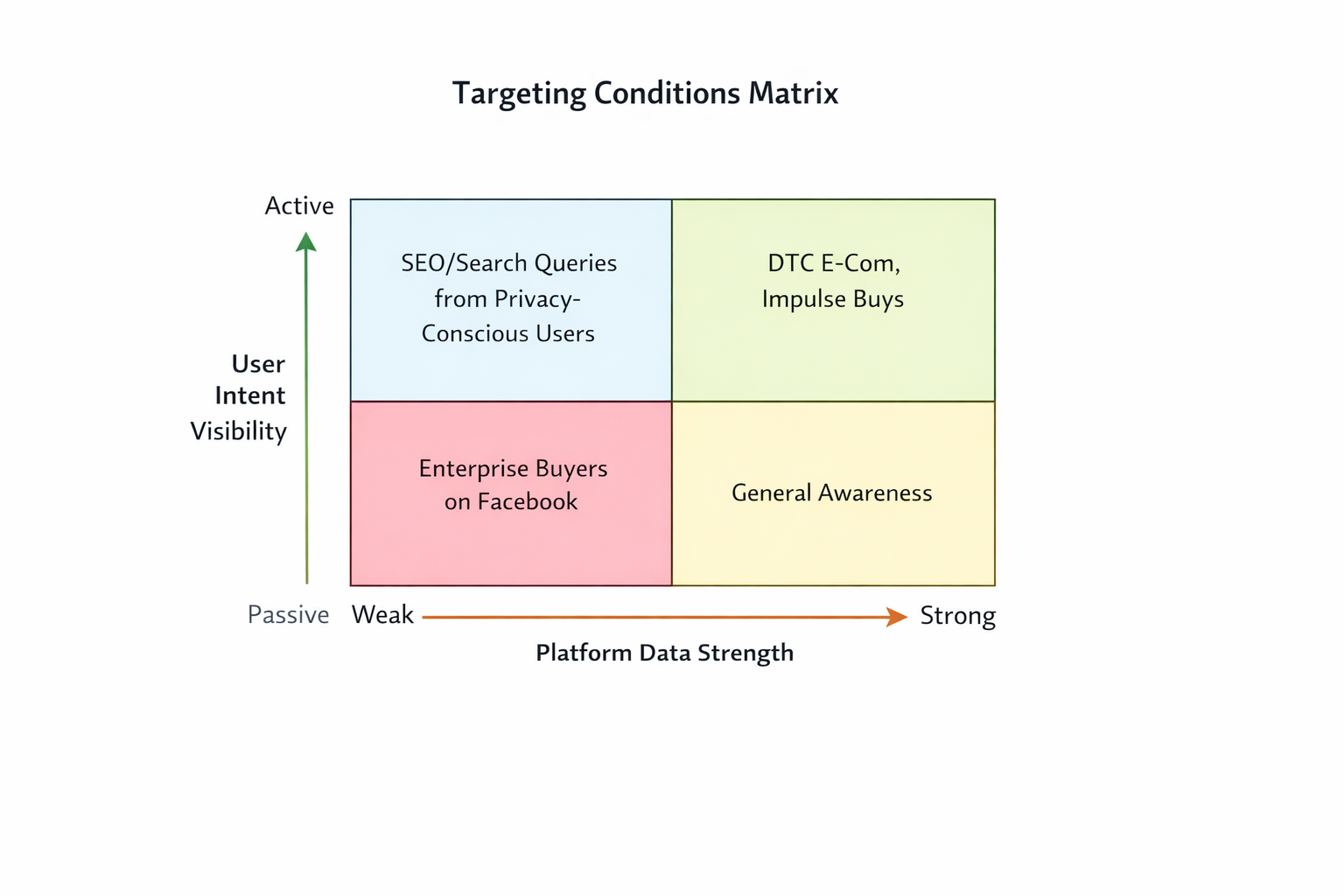
That works well when your audience:
-
Spends significant time on Meta platforms;
-
Engages publicly with relevant content;
-
Falls into clearly modeled interest categories;
-
Produces strong conversion signals.
But not every audience behaves this way.
Limited platform presence
Some professionals rarely use Facebook or Instagram for decision-making. Examples include:
-
Enterprise buyers researching software;
-
Procurement managers evaluating vendors;
-
Doctors, lawyers, or financial advisors operating in regulated industries.
They may have accounts, but they are not browsing with purchase intent.
In those cases, the platform shows your ads to adjacent users who resemble the model — not the actual buyer.
For advertisers in regulated industries, special ad category rules may further limit reach.
Privacy and signal loss
Signal loss has fundamentally changed targeting accuracy. Users opt out of tracking. Browsers block cookies. Devices fragment attribution. As a result:
-
Conversions go unattributed;
-
Lookalikes weaken;
-
Retargeting pools shrink.
If your audience is privacy-sensitive or high-income, signal loss tends to be even stronger.
To navigate this, see what marketers can do when signal loss breaks targeting.
Weak intent signals
Some buyers research quietly. They do not click ads. They do not like posts. They consume content passively.
Meta’s systems interpret silence as lack of relevance.
That does not mean the buyer is uninterested. It means the platform cannot detect the interest.
Here’s what makes an ad “high intent” and how to optimize for it when clicks don’t tell the full story.
Restricted targeting categories
Industries such as healthcare, finance, employment, and housing face targeting limitations. Even when you understand your audience deeply, the platform may restrict how precisely you can define them.
If your campaigns struggle despite strong messaging, the channel itself may be the constraint.
How to tell if this is your problem
You can often identify unreachable audiences through performance patterns.
Low CPMs with low engagement
Low CPMs may look efficient, but they often indicate poor audience alignment.
When Meta cannot confidently match your target buyer, it prioritizes cheap inventory to spend your budget. That produces reach without intent.
If your CTR is weak and conversion rates are low despite inexpensive traffic, your ads may be reaching the wrong segment entirely.
This guide explains what to check when Facebook shows your ads to the wrong people.
Lookalikes perform no better than broad targeting
Strong lookalikes require strong seed data. If your source list is small, outdated, or poorly matched, the algorithm has little to train on. The result is diluted targeting.
When 1 percent lookalikes behave like broad campaigns, the underlying audience model is likely weak. Learn how to fix underperforming lookalike audiences and regain targeting precision.
Retargeting fails to scale
If your retargeting audiences remain small even with significant traffic, there are two possible explanations:
-
The right audience never clicked;
-
Tracking never captured the right signals.
In both cases, paid social alone cannot build enough momentum.
See privacy-safe retargeting tactics that work in 2025 when platform signals fall short.
Sales happen but attribution fails
If you see conversions in your CRM or analytics platform but not in Ads Manager, signal fragmentation is likely. When attribution is incomplete, optimization becomes unstable. The platform may reduce delivery because it cannot “see” results.
At this point, doubling down on paid social usually increases waste rather than performance.
How to reach the right people outside of paid social
When paid social struggles, you do not stop marketing. You diversify attention sources.
The key is to meet your audience where intent is stronger, trust is higher, and tracking is more reliable.
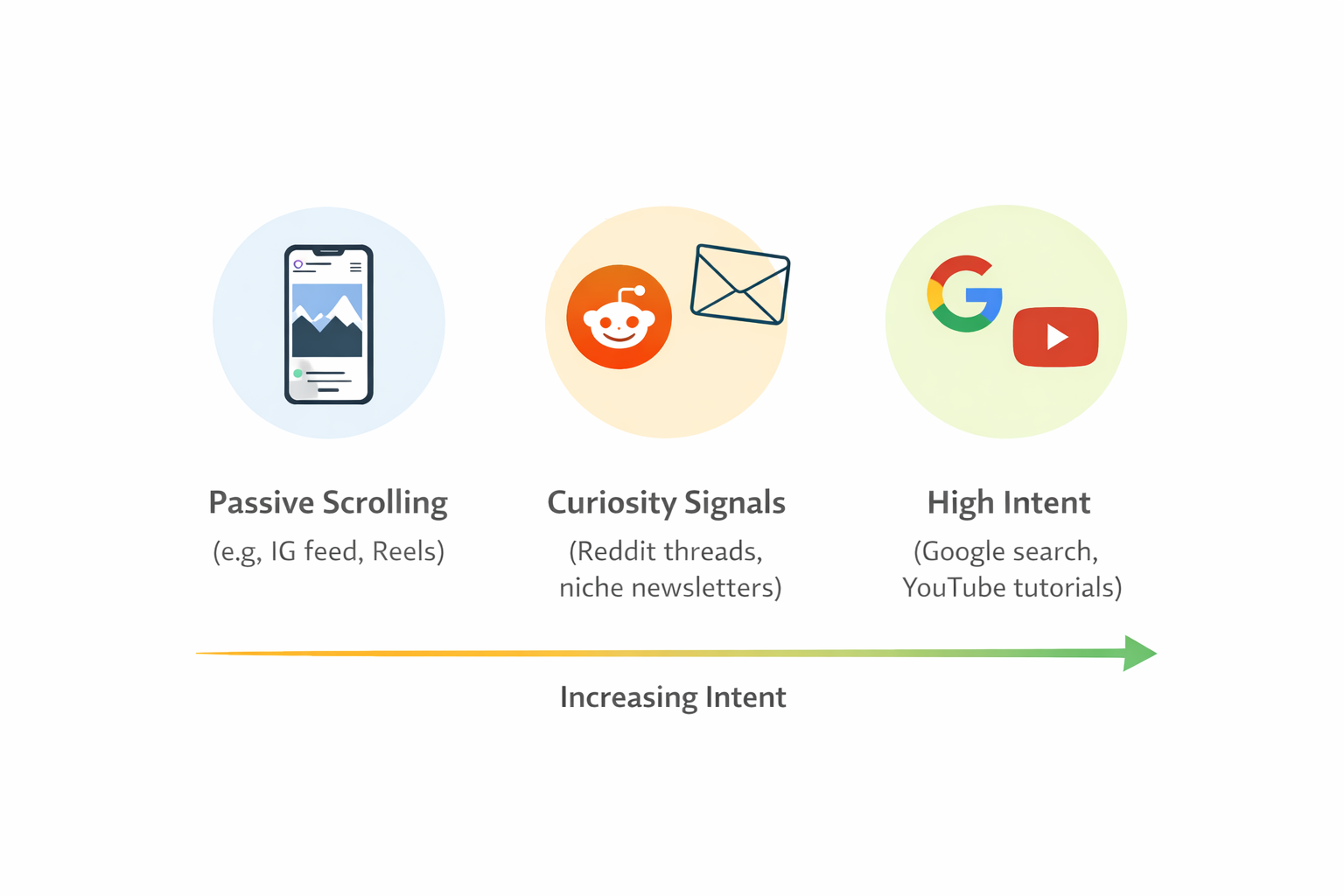
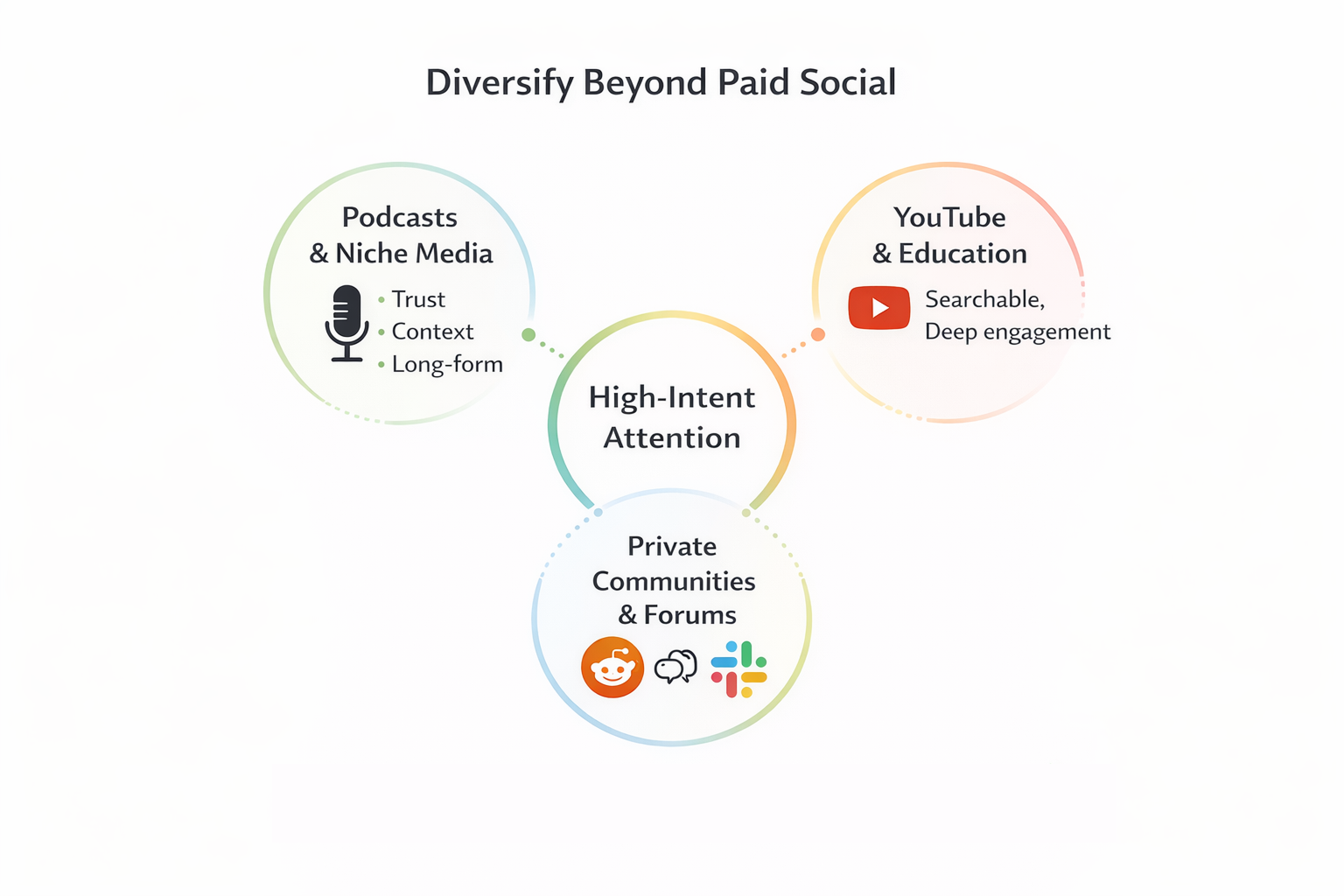
1. Get in front of the content they already consume
Instead of interrupting users in social feeds, embed your brand into environments they actively choose. This creates contextual alignment.
Podcasts and niche media
Many professionals consume long-form content through podcasts and specialized newsletters.
Sponsorship or guest appearances provide:
-
Built-in trust;
-
Higher engagement depth;
-
Clear audience alignment.
YouTube and long-form education
YouTube is often used for research, not distraction.
Educational videos, case studies, and explainers allow you to:
-
Demonstrate expertise;
-
Address objections in depth;
-
Capture high-intent viewers.
Private communities and forums
Communities on Slack, Discord, Reddit, and specialized forums often contain highly concentrated audiences.
Engaging authentically in these spaces can:
-
Reveal real objections;
-
Generate referral traffic;
-
Build authority organically.
If you want to reach hard-to-target groups, consider using community-based data for audience building.
2. Capture attention through high-value content — not immediate offers
Cold audiences rarely convert instantly. Instead of leading with a product pitch, lead with value.
Educational assets
Examples include:
-
Industry benchmark reports;
-
ROI calculators;
-
Diagnostic tools;
-
Technical guides.
These assets create utility before persuasion.
Content designed for search and sharing
Content optimized for SEO allows you to reach users during research phases. Search traffic typically reflects stronger intent than social scrolling.
When you combine search visibility with gated assets, you build first-party data without relying on ad targeting.
Explore how to combine SEO and Meta ads for smarter customer acquisition.
3. Lean into search and intent-driven channels
Search is fundamentally different from social.
Social is interruption-based. Search is demand-based.
When someone searches “best project management software for construction,” they are already in evaluation mode. Paid search and SEO allow you to:
-
Capture bottom-funnel intent;
-
Compete on specificity rather than scale;
-
Reduce reliance on algorithmic audience modeling.
If you’re exploring this shift, see how buyer intent differs across digital channels.
4. Partner with niche communities and micro-influencers
Borrowing trust is often more efficient than building it from scratch. Micro-influencers and community leaders have:
-
Established credibility;
-
Engaged audiences;
-
Clear positioning.
Instead of running ads to cold audiences, you can:
-
Co-create webinars;
-
Sponsor community resources;
-
Offer exclusive insights to curated lists.
5. Build your own retargeting engine with first-party data
Owning your data reduces dependency on platform algorithms.
You can track behavior across:
-
Email engagement;
-
On-site activity;
-
CRM interactions;
-
Sales conversations.
With this data, you can build:
-
Behavior-triggered email flows;
-
Sales outreach sequences;
-
Segmented offers based on intent.
To future-proof your remarketing, learn why first-party data is essential for modern Facebook ads.
Build attention systems, not just ad campaigns
If your target market is not reachable through paid social, the solution is not more testing inside the same system. It is building a broader attention strategy.
Paid social works best when:
-
Your audience is active on the platform;
-
Signals are strong;
-
Buying cycles are short;
-
Targeting flexibility is high.
When those conditions are missing, diversify.
Use:
-
Search to capture intent;
-
Content to build authority;
-
Partnerships to borrow trust;
-
Email to nurture;
-
First-party data to optimize.
Growth becomes more stable when it does not depend on one algorithm.
The strongest advertisers do not rely on paid social alone. They build systems that continue working even when platforms change.